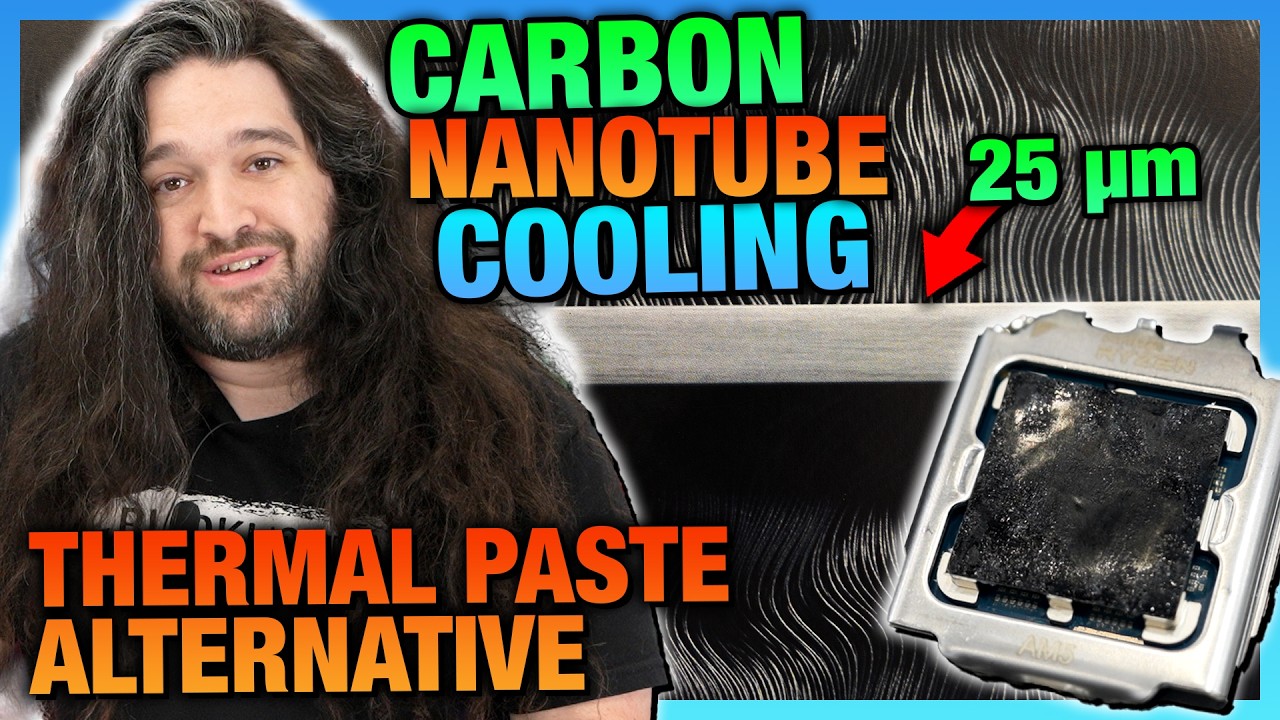
Carbice, in collaboration with Noctua, has developed a carbon nanotube thermal pad featuring vertically grown nanotubes on an aluminum core, offering a long-lasting, maintenance-free alternative to traditional thermal paste with improved thermal performance over time through thermal cycling. This easy-to-install, peel-and-stick pad is already used in CPU cooling applications like AMD’s AM5 platforms, providing consistent performance for over ten years and promising future adaptations for GPUs.
The video discusses an innovative thermal pad alternative to traditional thermal paste for CPU and GPU cooling, developed by Carbice in collaboration with Noctua. This thermal pad features a forest-like structure of carbon nanotubes grown vertically on both sides of a thin, robust aluminum foil core. The carbon nanotubes exhibit extremely high thermal conductivity, and the pad is coated with a phase change material that improves thermal performance over time as it melts and wicks the nanotubes into better contact with the device surfaces. This design enables a peel-and-stick application, making installation easy and clean compared to messy thermal pastes.
One of the key advantages highlighted is the pad’s long-term stability and maintenance-free nature. Unlike thermal paste, which can degrade due to pump-out and drying effects, this carbon nanotube pad improves its thermal conductivity through thermal cycling and maintains consistent performance for over ten years. This makes it especially suitable for applications where reapplication is difficult or impossible, such as in satellites, where Carbice initially commercialized the technology. Noctua and AMD are currently using this pad on AM5 platforms, including the Ryzen 5800 X3D Anniversary Edition.
The manufacturing process involves vapor deposition growth of carbon nanotubes on aluminum foil sheets suspended in a gaseous environment. The final product is about 90 microns thick and benefits from the aluminum core’s strength, allowing for thin and robust pads that resist tearing. The phase change material coating ensures the pad becomes tacky and sticks well during installation, reducing the risk of misapplication. While the initial out-of-the-box thermal performance may be slightly lower than paste, the pad quickly surpasses paste as it breaks in through thermal cycling.
From a user perspective, the pad is easy to remove with minimal residue and is safe to apply due to its electrically non-conductive surfaces, though the aluminum edges remain conductive. Though not officially marketed as reusable due to risks of damage during removal, many users can reuse it without performance loss if careful. The current focus is on CPU applications with well-understood mounting pressures and surface flatness; GPU applications are more challenging due to varied cooler designs and die curvatures, but Carbice plans to develop optimized versions for GPUs in the future.
The product is expected to launch in September at a price point around $24.99 USD/Euro. The video also touches on the natural thermal cycling the pad undergoes during regular use, which activates and improves its performance without requiring deliberate cycling. The collaboration between Carbice and Noctua represents a significant step forward in thermal interface materials, offering a long-lasting, maintenance-free, and easy-to-use alternative to traditional thermal pastes for PC enthusiasts and professionals alike.