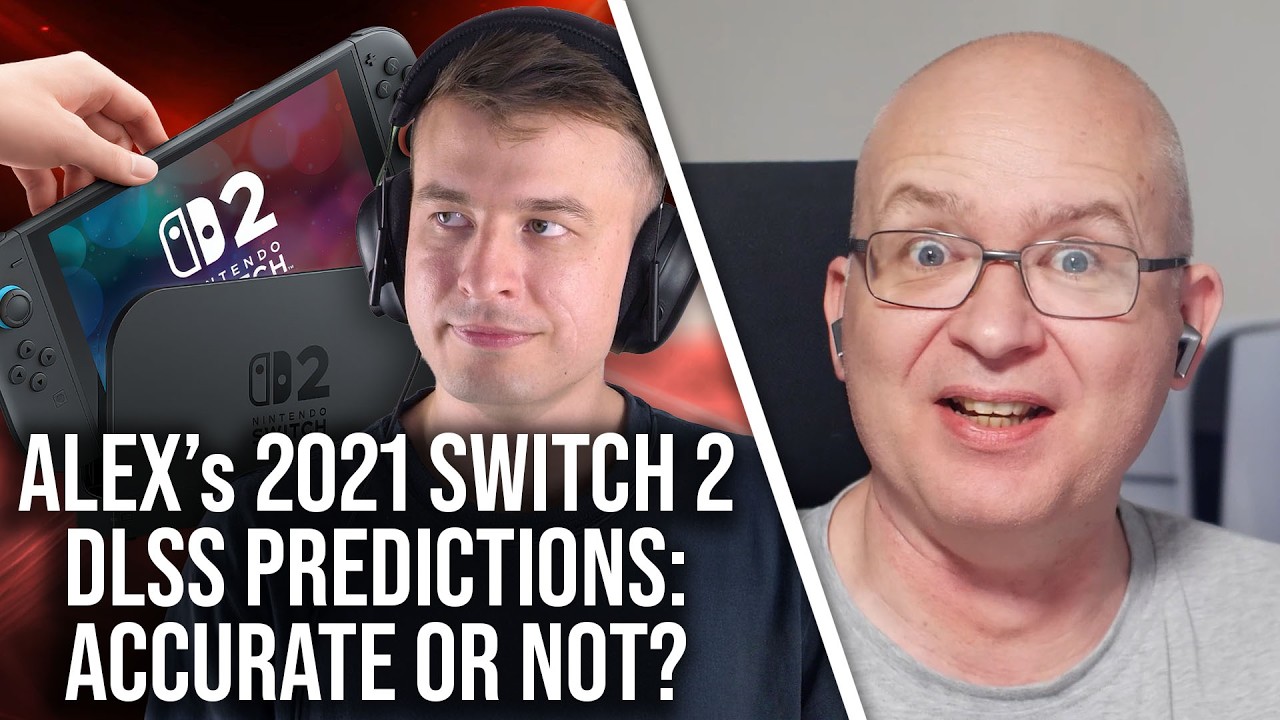
The video begins with the hosts revisiting a time machine website created by Will Judd from Digital Foundry, which allows them to look back at gaming discussions from one, five, and ten years ago. They reflect on past topics such as Metal Gear Solid Delta and Ghost of Tsushima Director’s Cut, before focusing on a notable video from Alex made five years ago. This video speculated on the capabilities of the then-unknown Switch 2, particularly whether 4K DLSS (Deep Learning Super Sampling) would be possible on the next-generation Nintendo console. Despite limited information back then, Alex’s predictions about DLSS being a key feature were largely accurate, although some details like the screen resolution were off.
The hosts discuss how Alex’s hardware estimates for the Switch 2 were impressively close to the final specs, especially regarding performance measured in teraflops, which ended up slightly higher than his rough calculations. However, Alex had predicted a 720p screen, which turned out to be incorrect as the Switch 2 features a 1080p display. This higher resolution screen has proven to be a good choice, enhancing image clarity despite some criticism of the screen’s overall quality. The conversation highlights how DLSS has been effectively used to upscale games on the Switch 2, particularly in docked mode, helping to deliver better visuals without sacrificing performance.
They also touch on the rarity of true 4K DLSS on the Switch 2, noting that only a few titles, such as Shin’en Multimedia’s Fast Fusion, have attempted it using a pared-down version of DLSS. Most games use DLSS to upscale from lower resolutions like 540p to 1080p, which strikes a balance between performance and visual quality. The hosts observe that third-party developers are more likely to utilize DLSS than Nintendo’s first-party titles, which tend to rely on simpler anti-aliasing methods. Overall, DLSS has become an important tool for bringing demanding games to Switch 2 hardware, even if full 4K remains largely impractical.
The conversation then shifts to the Switch 2’s LCD screen quality, which has been a point of contention. One host admits to rarely playing handheld but noticed issues like smearing and slow pixel response, especially in dark scenes with high contrast, such as in Skyrim. While not a dealbreaker, these screen shortcomings have led some players to prefer the original Switch OLED for handheld gaming due to its superior display and lack of upscaling. The hosts agree that while the Switch 2’s screen resolution choice was smart, the overall display quality could use improvement, and the older model still holds value for handheld play.
Finally, the hosts compare their personal preferences for playing on the Switch models. One prefers handheld gaming on the original Switch due to its better screen, while favoring docked play on the Switch 2 because the docked experience has exceeded expectations. Despite some disappointment with the Switch 2’s handheld screen quality, they acknowledge that DLSS technology helps maintain a good visual experience. The discussion closes with a recognition that while the Switch 2 has made strides in performance and upscaling, there remains room for improvement in display technology for handheld gaming.