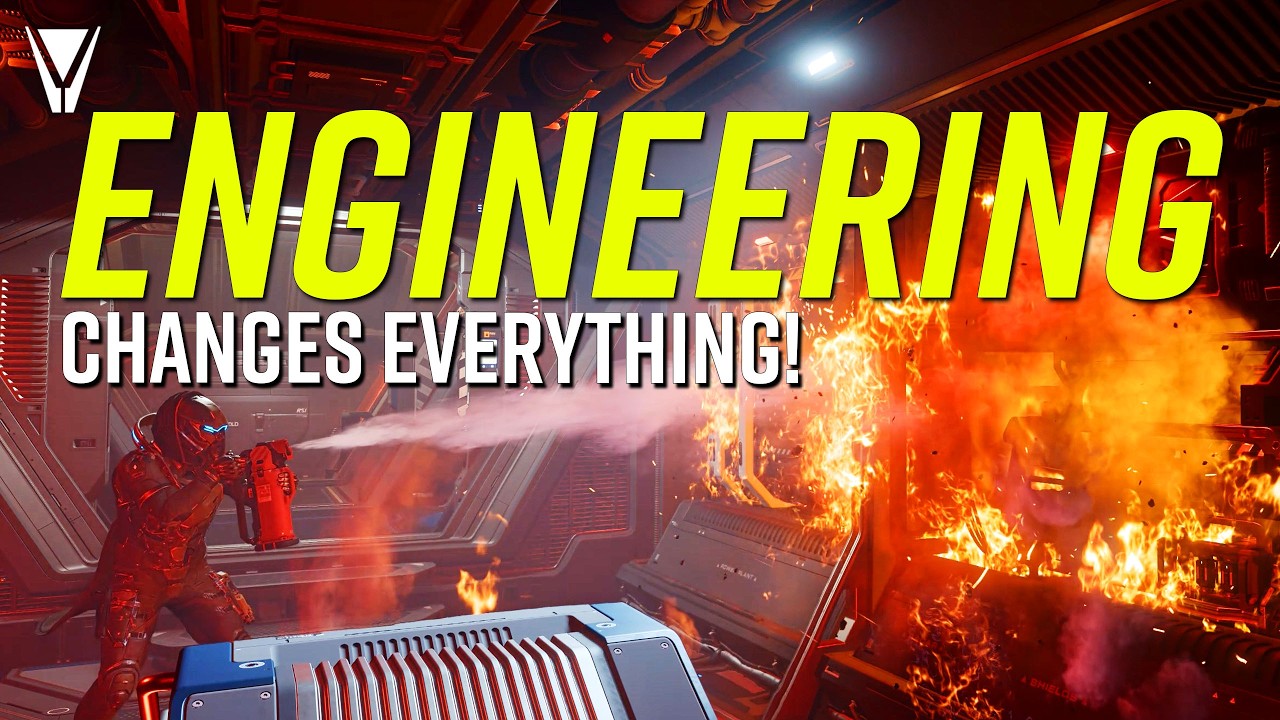
The recent Engineering Update in Star Citizen introduces a comprehensive system that governs nearly every major ship function, including power routing, system failures, fires, onboard repairs, and wear and tear, impacting all players regardless of their playstyle. This update aims to add depth and realism to ship management, making solo operation of large ships more challenging. The engineering console, available on about 80 ships currently, provides a 3D schematic with color-coded components and system alerts, allowing players to manage power presets and monitor component health. Components degrade over time and through damage, with specific effects on power plants, coolers, shields, quantum drives, and life support systems. Fires can start from overheating or damage and must be managed using fire extinguishers or venting atmosphere, adding another layer of complexity to ship survival.
However, the update lacks clear guidance on the intended flow of damage and repair encounters, making it difficult to assess balance and gameplay expectations. In practice, the system shows promise, especially when coordinated crews manage damage and repairs, creating tense and engaging moments. Yet, the implementation is inconsistent across different ships. For example, the Crusader Intrepid often suffers from sudden, unrecoverable damage with little opportunity for engineering intervention, while the Perseus offers a more balanced experience with viable repairs and recovery. Other ships like the Carrick and Paladin exhibit issues such as turret fragility and inconsistent internal damage, highlighting the uneven state of the update.
Interface and usability issues also hinder the engineering experience. The 3D schematic becomes cluttered and hard to interpret on larger ships, and the limited color-coded damage states lack clarity on critical failures. Subsystem targeting during combat is confusing due to poor labeling and the absence of clear visual indicators, making it hard to know which components are being hit. Additionally, there is no MFD or engineering readout for exterior components like thrusters and turrets, forcing players to EVA for damage assessment. This incomplete integration limits the system’s effectiveness and player control during combat situations.
A significant balance problem arises from penetration-based damage, where shot placement can lead to wildly varying time-to-kill outcomes. Some ships can be destroyed almost instantly by targeting vulnerable internal components, undermining the opportunity for engineering-based recovery and teamwork. This issue is compounded by the current flight model, which favors small, agile ships in combat, making large ships easy targets despite their size and crew. Consequently, large ships remain vulnerable and less viable in PvP scenarios, with players often preferring multiple fighters over a single capital ship crewed by many players.
In conclusion, while the Engineering Update represents a major step forward for Star Citizen, it is currently a work in progress with significant balancing, usability, and design challenges to overcome. Clearer design direction, improved interface clarity, and adjustments to combat mechanics and ship durability are needed to fulfill the system’s potential. The update has the foundation to become one of the game’s most compelling features, emphasizing teamwork and strategic ship management, but achieving this will require substantial ongoing development and player feedback. The community is encouraged to share their experiences and ideas to help shape the future of engineering gameplay in Star Citizen.