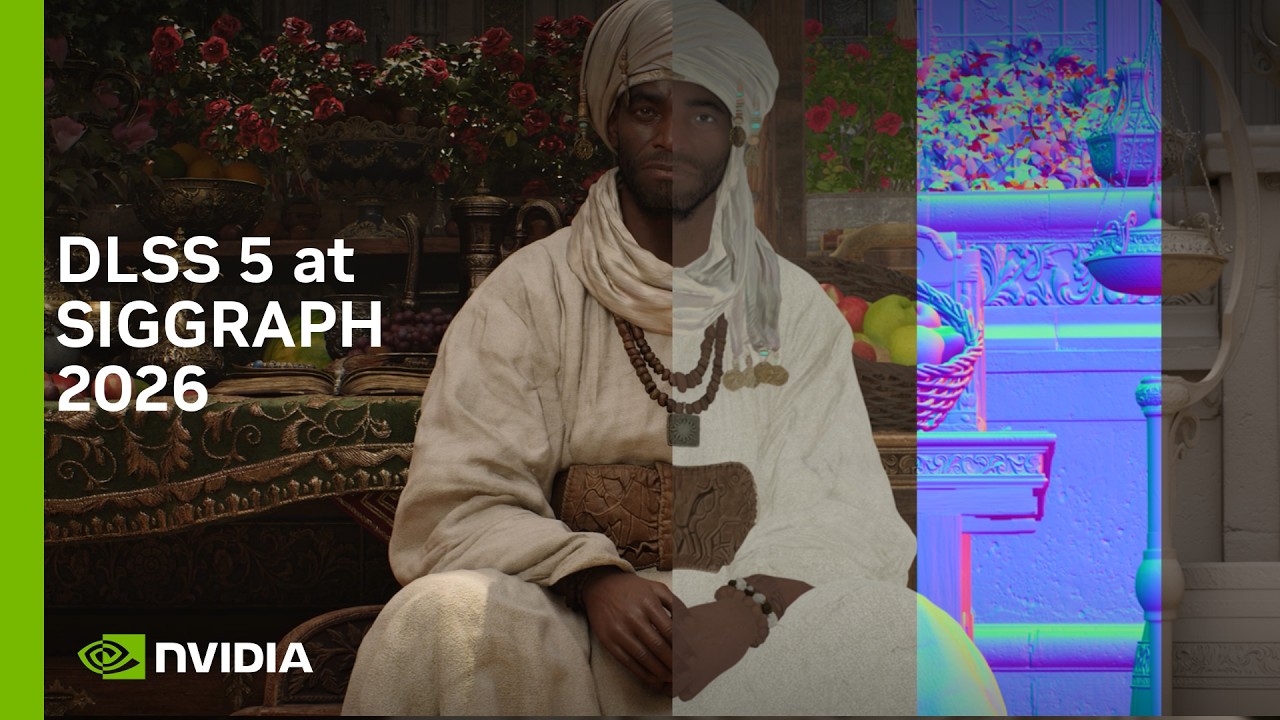
In the SIGGRAPH 2026 keynote presentation, Edward Liu and Gabriele Leone introduced DLSS 5, the latest evolution in real-time rendering technology that combines traditional graphics with AI-driven generative models to achieve unprecedented photorealism. DLSS 5 builds upon NVIDIA’s Turing architecture, which integrated RT and Tensor Cores, and represents a new leap in image fidelity by enriching rendered frames with learned generation techniques. This approach maintains the original scene’s artistic intent while enhancing visual realism, bridging the gap between physically accurate rendering and AI-based image generation.
The core innovation of DLSS 5 lies in its ability to use the game’s own rendered frame as a grounding signal for generative enhancement, rather than relying on abstract prompts or reference images. This ensures that the AI respects the original content and artistic direction, avoiding unwanted changes that could alter character identity or scene composition. The technology addresses three major challenges: preserving artistic intent, maintaining temporal coherence frame-by-frame without lag, and achieving the speed necessary to run at real-time frame rates, even at 4K resolution.
Gabriele Leone demonstrated the extensive artist and developer controls integrated into DLSS 5, allowing fine-tuned adjustments at multiple levels. Developers can choose from different AI models tailored for various scenes or cutscenes and adjust global parameters like structure and tone intensity to modulate details such as ambient occlusion, subsurface scattering, and lighting. Additionally, DLSS 5 supports masking specific scene elements, enabling selective enhancement of characters, objects, or environments, thereby giving artists precise control over how and where the AI applies its improvements.
Edward Liu positioned DLSS 5 as a third major AI application in real-time graphics, alongside reconstruction and functional approximation. Unlike previous DLSS versions focused on recovering ground truth images, DLSS 5 actively generates enhanced appearances guided by artistic direction, effectively creating a new paradigm where the AI-generated output becomes the new ground truth. This dual-lever approach—improving both rendering quality and AI model sophistication—promises continuous fidelity improvements without necessarily increasing runtime costs.
In conclusion, DLSS 5 represents a significant milestone in the evolution of real-time rendering, extending rather than replacing existing pipelines like path tracing and programmable shaders. While true photorealism remains a future goal, DLSS 5 offers a practical and artist-friendly solution that enriches visual realism while respecting creative intent. NVIDIA plans to ship DLSS 5 in the fall, inviting ongoing collaboration with developers and the SIGGRAPH community to further refine AI-driven graphics technologies.