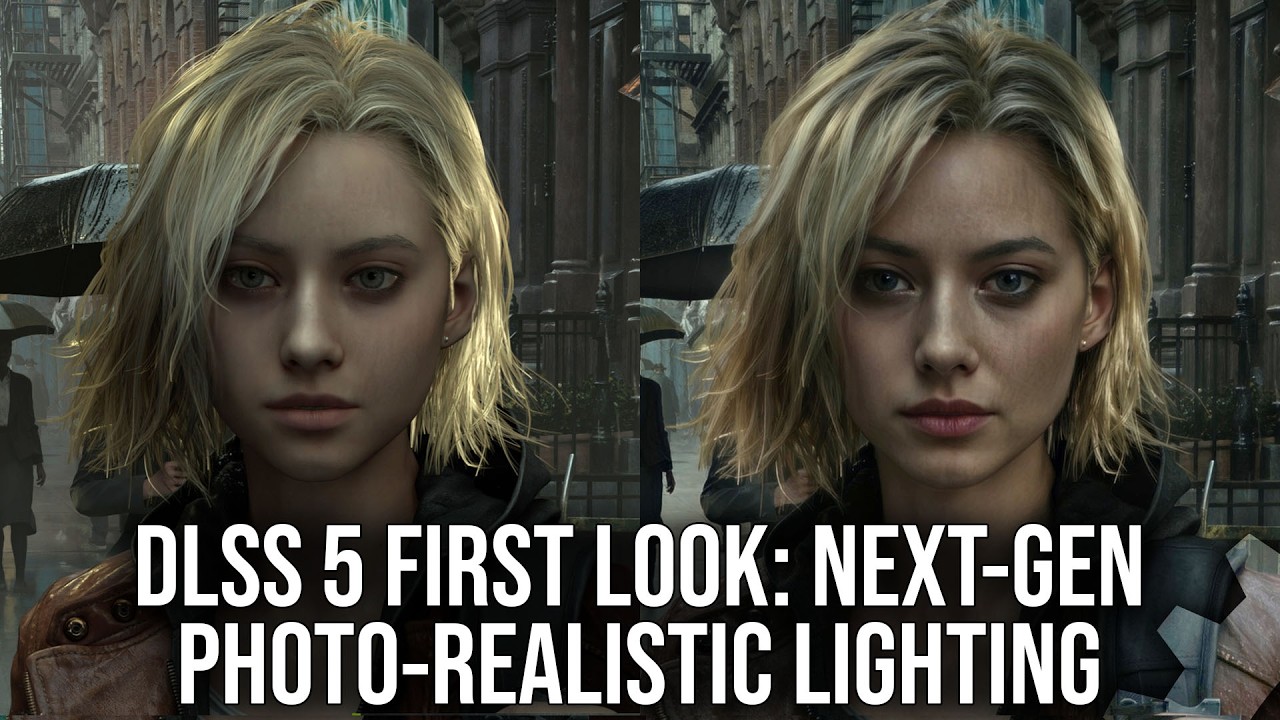
The video presents an in-depth first look at Nvidia’s DLSS 5 technology, unveiled at GTC in San Jose, which represents a groundbreaking advancement in real-time lighting for games. Unlike previous hardware-dependent lighting improvements, DLSS 5 leverages machine learning to deliver photo-realistic lighting effects that dramatically enhance visual fidelity. This new iteration of DLSS complements existing frame generation and super-resolution techniques, offering a transformative approach to lighting without altering game assets or geometry. The hosts highlight a striking demo from Resident Evil Re:Verse, showcasing significantly improved facial lighting, realistic specular highlights, and enhanced environmental reflections that elevate the scene’s realism.
DLSS 5 operates by applying an AI-driven lighting pass on top of the base game render, effectively simulating next-generation lighting effects such as subsurface scattering, accurate specular reflections, and complex shadowing. The technology was demonstrated running on dual RTX 5090 GPUs for performance reasons, but Nvidia aims to optimize it to run on a single GPU by its planned launch in fall 2026. This optimization will make the technology accessible on consumer-grade hardware, potentially scaling across Nvidia’s GPU lineup, including the 4070 and 4080 series. The hosts note that while DLSS 5 greatly enhances lighting, it still depends on the quality of the base render and can exhibit some screen-space artifacts.
Several game demos underline DLSS 5’s versatility and impact, including Starfield, Oblivion Remastered, and Assassin’s Creed Shadows. In Starfield, DLSS 5 significantly improves character rendering and lighting, addressing the game’s previously flat and less detailed visuals. Oblivion Remastered benefits from enhanced software Lumen lighting, delivering tight shadows and realistic occlusion effects that transform the game’s environments and characters. Assassin’s Creed Shadows sees improved shadow detail and environmental lighting, making scenes appear almost photorealistic despite lacking native ray tracing. These examples collectively demonstrate how DLSS 5 can elevate both new and existing titles by adding a sophisticated layer of lighting realism.
The hosts also discuss the broader implications and potential controversies surrounding DLSS 5. Since the technology applies AI-driven lighting enhancements on top of existing game visuals, it raises questions about artistic intent and whether this aligns with developers’ original visions. While some developers have embraced the technology, seeing it as a way to realize their intended visual fidelity, others may be more cautious. The technology’s integration into Nvidia’s broader DLSS ecosystem suggests that it could become widely adopted, with users potentially creating mods to apply DLSS 5 lighting effects to various games, even simpler titles like Minecraft, further blurring the lines between developer intent and AI-enhanced visuals.
In conclusion, DLSS 5 represents a remarkable leap forward in real-time graphics, blending neural rendering with traditional game engines to achieve lighting quality previously reserved for high-end CGI. Although still a work in progress, early demonstrations show impressive performance and visual improvements, with Nvidia targeting a consumer release within a few years. The hosts express excitement about the technology’s potential while acknowledging open questions about performance scaling, artistic control, and compatibility across different game styles. They promise a more detailed follow-up video after further exploration and discussions with the creators, underscoring DLSS 5’s significance as one of the most impressive advancements in gaming graphics to date.