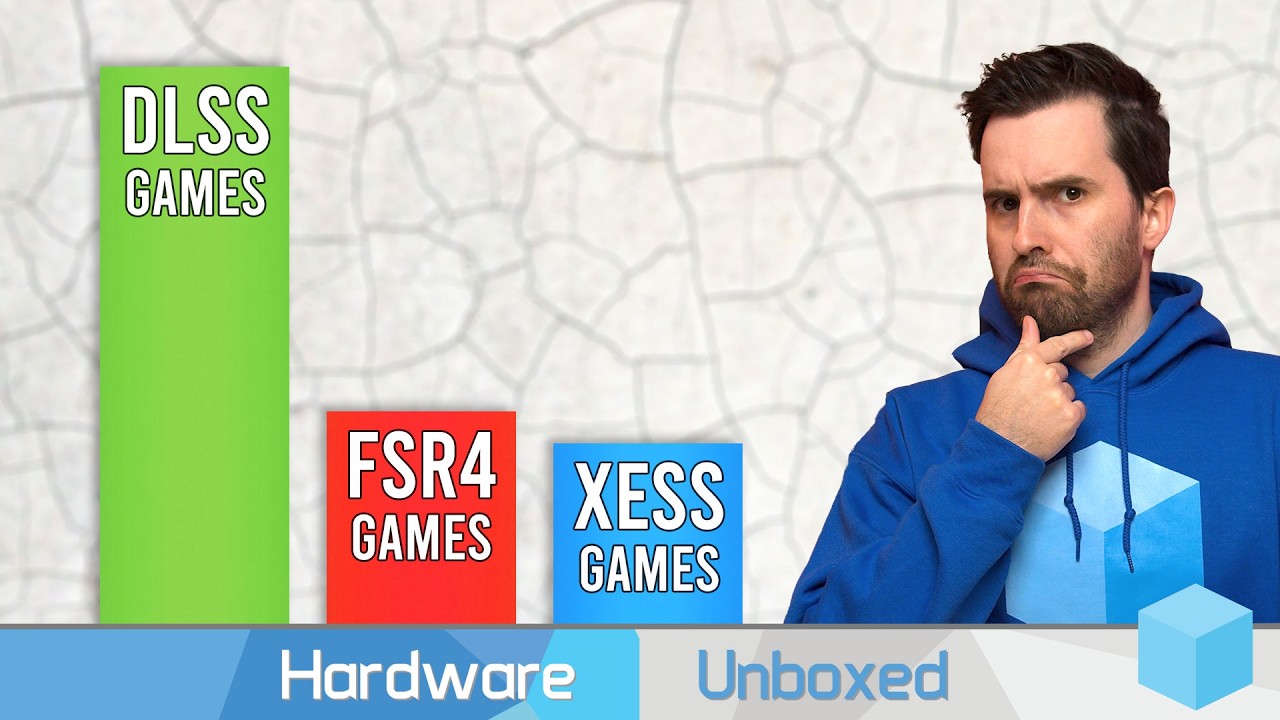
The video provides an in-depth analysis of the support for upscaling and frame generation technologies across over 100 games released in 2025 and more than 550 older titles, focusing on Nvidia’s DLSS, AMD’s FSR, and Intel’s XCSS. Nvidia emerges as the clear leader with DLSS supported in 97% of 2025 games featuring upscaling, often with the latest DLSS4 integration. AMD’s FSR support is decent, with 88% of 2025 titles including some form of FSR, and 72% supporting FSR4 or upgradeable versions, though AMD struggles with Vulkan compatibility and updating older titles. Intel’s XCSS support, while less widespread at 57%, is notable given Intel’s smaller desktop GPU market share and is often included at game launch.
Frame generation support is present in two-thirds of 2025 games with upscaling, with Nvidia again dominating at 95% adoption of DLSS frame generation. AMD’s FSR frame generation is available in 71% of these titles, while Intel’s XCSS frame generation, introduced in late 2024, appears in 35% of frame gen games. Some games support all three technologies for both upscaling and frame generation, indicating a trend among developers to include broad compatibility despite Nvidia’s market dominance.
When examining games released before 2025, Nvidia’s advantage becomes even more pronounced. About 90% of older titles with temporal upscaling support DLSS, many upgradable to the latest DLSS4 or 4.5. AMD’s FSR support in older games is weaker, with only 17% supporting FSR 3.1 or newer and thus eligible for FSR4 upgrades. This leaves many popular older games with only older, lower-quality FSR versions or no AMD vendor-specific upscaling at all, making Nvidia the preferred choice for playing legacy titles. Intel’s XCSS fares better than AMD in older titles but still lags behind Nvidia.
The video highlights that while AMD has made significant strides in integrating FSR4 into new releases, their challenge lies in convincing developers to update older games to newer FSR versions. Intel, with its smaller market share, has achieved respectable XCSS support in new titles but faces similar hurdles with legacy game integration. The presence of competing technologies in many games shows an industry trend toward inclusivity, but Nvidia’s longer presence and driver support give it a substantial lead in both new and old games.
In conclusion, for gamers seeking the broadest and highest-quality upscaling and frame generation support, Nvidia’s GeForce GPUs with DLSS remain the best choice due to extensive game compatibility and ongoing support. AMD Radeon cards perform well with new games but fall short in older game support, while Intel’s ARC GPUs offer a viable option in select modern titles but have limited legacy support. The video suggests that future updates will continue to track these trends, with hopes for improved support from AMD and Intel, but currently, Nvidia holds a dominant position in this space.