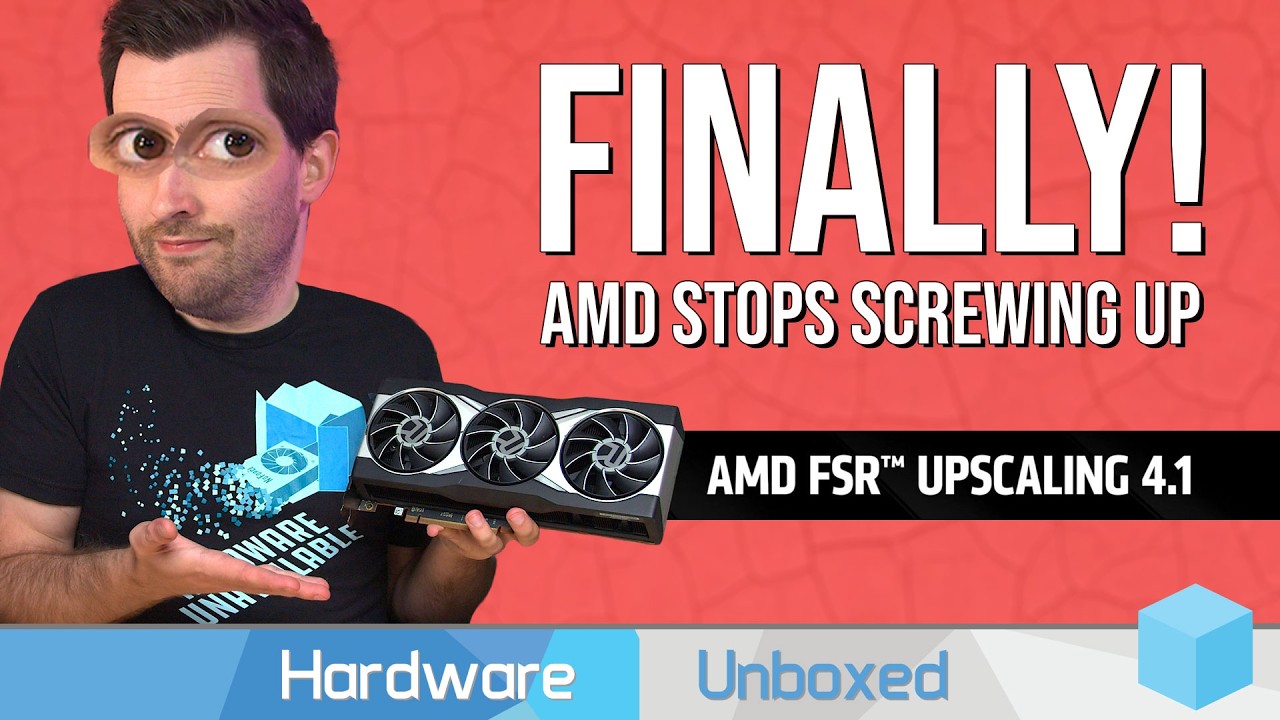
AMD has officially announced that FSR 4.1 upscaling support is coming to their RDNA 3 RX7000 series graphics cards in July 2026, with plans to extend support to RDNA 2 RX 6000 series GPUs in 2027. This decision comes after more than eight months of silence and inaction regarding the release of FSR4-level technology for older GPUs. Previously, FSR4 upscaling was exclusive to RDNA4 RX9000 series cards, leaving RDNA 3 and RDNA 2 owners stuck with the inferior FSR 3.1 technology. The announcement is a welcome move, as it allows gamers with older Radeon GPUs to access AMD’s improved machine learning-based upscaling without needing to upgrade to the latest generation.
The story behind this development is complex. In August 2025, AMD accidentally leaked source code revealing an INT8-based version of FSR4 that could theoretically support older RDNA 3 and RDNA 2 architectures, unlike the official FP8 version limited to RDNA4. This leak enabled the community to create a functional FSR4 INT8 DLL that gamers could use with some tweaks, showing significant visual improvements over FSR 3.1. However, despite strong evidence that this version worked well, AMD chose not to officially release it, frustrating many Radeon users who felt neglected compared to competitors.
The frustration grew when Sony released PlayStation Spectral Super Resolution 2.0 (PSSR 2.0) for the PS5 Pro, which is based on the same neural network as FSR 4.1 but uses INT8 instructions. This meant that PlayStation users had access to a superior upscaling technology that AMD refused to provide to RDNA 3 owners, despite it being proven viable months earlier. The gaming community reacted strongly, criticizing AMD for poor support and causing many potential customers to reconsider purchasing Radeon GPUs due to perceived neglect of older hardware.
In contrast, Nvidia has been praised for consistently supporting older GPUs with new DLSS versions, including DLSS 4.5, which works back to RTX 20 series cards from 2018. This ongoing support has helped Nvidia maintain customer trust and market share, highlighting AMD’s delay and lack of support as a significant misstep. AMD’s eventual decision to bring FSR 4.1 to RDNA 3 and RDNA 2 is seen as overdue and necessary, but the long delay—over a year after RDNA4 launch and nearly a year after the leak—has already damaged AMD’s reputation among its user base.
Looking ahead, AMD claims to have optimized the INT8 FSR 4.1 model for RDNA 3, improving memory usage, motion vector validation, and artifact reduction to ensure smooth performance. While the leaked INT8 version had a noticeable performance cost compared to the FP8 RDNA4 version, AMD’s work may close this gap. RDNA 2 support is delayed until 2027 likely due to performance challenges. Overall, FSR 4.1 on RDNA 3 is expected to deliver a major visual upgrade over FSR 3.1, though AMD must improve its timeliness and long-term support strategies to regain gamer trust and compete effectively with Nvidia.