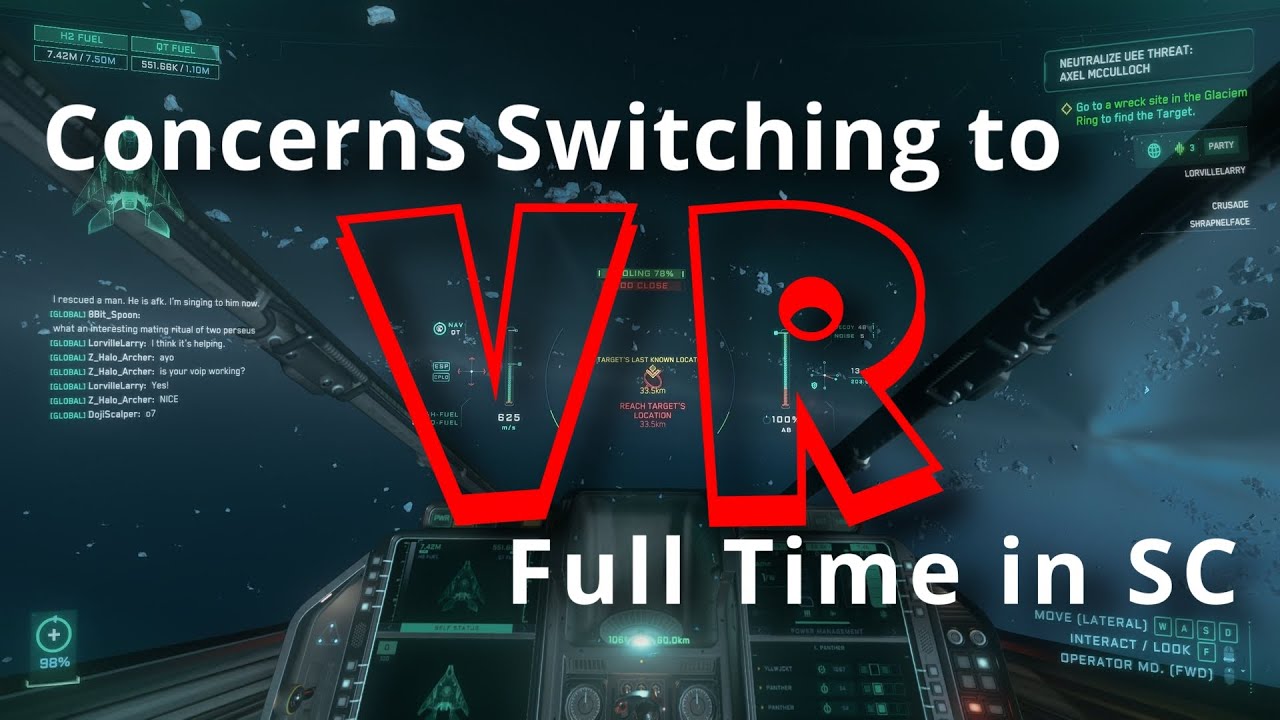
Daniel Raymond discusses Cloud Imperium Games’ new experimental VR mode for Star Citizen, highlighting both its potential for immersive gameplay and current limitations such as lack of hand controller support and challenges with peripheral vision. He advises players to carefully consider VR’s suitability for their play style, suggests various controller options, and recommends entry-level VR hardware while announcing a related giveaway for his channel members.
In this video, Daniel Raymond from Ray’s Guide discusses the recent announcement by Cloud Imperium Games (CIG) introducing an experimental virtual reality (VR) mode for Star Citizen in the Backer Test Universe (BTU). This move, while somewhat unexpected, signals significant progress in integrating VR into the game, potentially extending to the upcoming single-player game Squadron 42. VR enthusiasts are particularly excited about this development, as the first-person free movement gameplay style of Star Citizen is well-suited for VR immersion.
Daniel emphasizes that while VR support is now available, players should carefully consider whether VR is the right choice for them. He points out that VR is not just a novelty but should enhance gameplay by making missions more enjoyable or efficient. He advises players to think about their typical play session lengths and whether they can comfortably wear a VR headset for that duration, highlighting the importance of checking return policies due to the risk of nausea. Additionally, he notes the challenge of losing access to second screens and real-world peripherals, which many players rely on for communication and game management.
A significant limitation of the current experimental VR mode is the lack of support for hand motion controllers integrated with VR headsets. Daniel explains that these controllers do not have enough buttons to handle the complex controls needed for Star Citizen. He discusses the difficulty of using keyboards and mice in VR due to the absence of peripheral vision, which players typically rely on to locate keys without looking directly. As a result, players may need to adapt their control schemes and consider alternative controllers for a smoother VR experience.
Daniel outlines three primary controller options for VR play: dual stick or stick and throttle setups, standard gamepads, and voice command software like VoiceAttack. Dual sticks offer extensive button options suitable for all game modes but require players to memorize new bindings. Gamepads are easier to manage with one hand and provide more buttons than VR controllers but fewer than dual sticks or keyboards. Voice commands can supplement controls by reducing the number of physical keybindings needed, enhancing immersion and usability in VR.
Finally, Daniel provides recommendations for those interested in entering PC VR. He highlights the MetaQuest 3S as a budget-friendly entry point and the MetaQuest 3 as a higher-end option with better specs. He also mentions the upcoming Steam Frame, expected to offer superior processing power and portability for PC gaming on the go. To encourage engagement, Daniel announces a hardware giveaway for his channel members, with prizes ranging from the MetaQuest 3S to the Steam Frame, depending on membership growth. He concludes by reminding viewers to consider the challenges of restricted peripheral vision in VR and encourages safe and enjoyable gameplay.