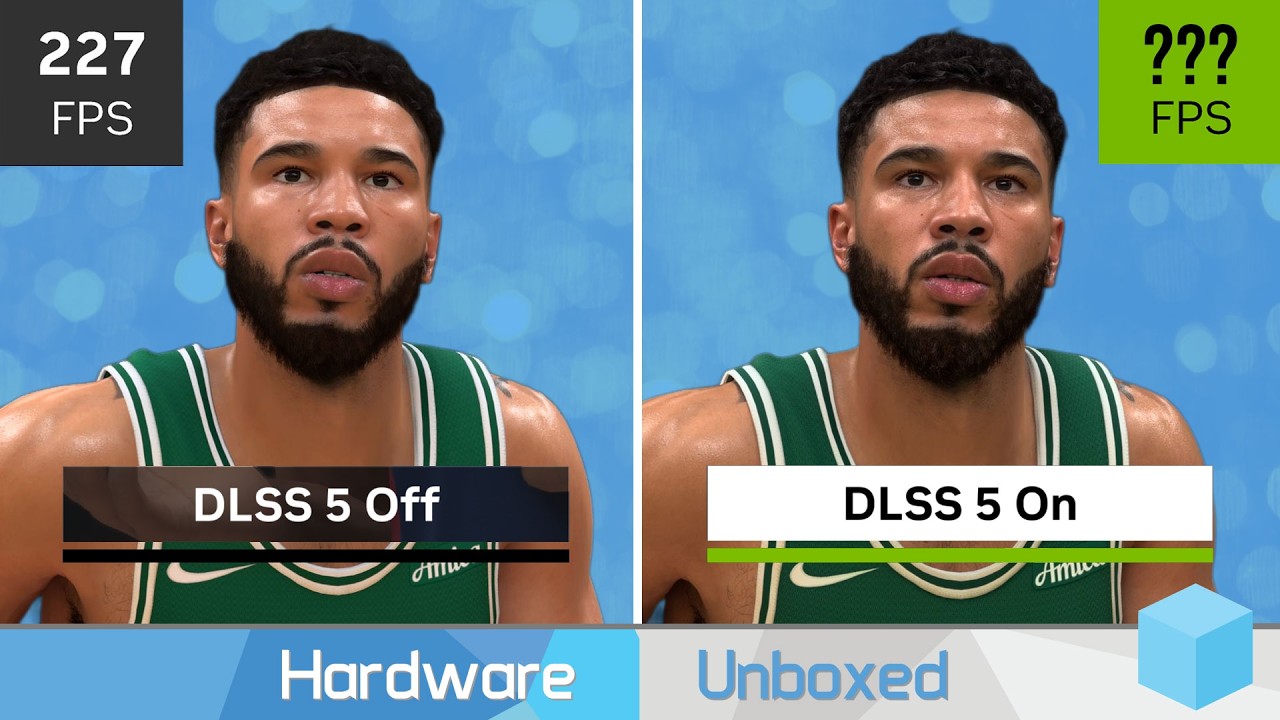
DLSS 5, Nvidia’s latest AI-driven upscaling technology, is officially launching on September 3rd with NBA 2K27 as its debut title. Despite early leaks and mods showing DLSS 5 in action, Nvidia’s official rollout has been somewhat chaotic, including a poorly timed briefing and the absence of provided video demos or early game access for reviewers. This has limited early hands-on impressions and detailed analysis, leaving many questions about the technology’s real-world performance and visual impact unanswered until the game’s release.
Nvidia’s performance benchmarks for DLSS 5 in NBA 2K27 reveal some intriguing but complex data. The tests, conducted at 4K with ray tracing enabled, show very high final frame rates thanks to a combination of performance mode upscaling and aggressive 6x frame generation. However, the actual rendering frame rates are much lower, especially on GPUs below the RTX 5080, which struggle to maintain acceptable performance without frame generation. This indicates that DLSS 5 is highly demanding, and many current GPUs may not handle it well at higher resolutions without significant compromises.
A key point Nvidia emphasizes with DLSS 5 is its focus on preserving artistic intent. Unlike previous versions or unofficial mods, DLSS 5 is designed for developer integration and tuning, with controls over aspects like structure and tone intensity, object masking, and model selection intended as developer tools rather than gamer-accessible settings. Nvidia stresses that the technology respects the original rendered frame and aims to enhance lighting realism without overriding the creative vision of game artists, addressing concerns raised by early modded versions that sometimes distorted game visuals.
Visually, DLSS 5 targets improvements in lighting interactions and material properties through a pixel-based diffusion transformer model, enhancing effects such as skin subsurface scattering and tone mapping. However, it does not improve basic elements like low-resolution textures, geometry complexity, or shadow resolution, nor does it simulate new reflections or ray-traced lighting. Its effectiveness depends heavily on the quality of the input rendering, meaning games with advanced base rendering techniques may see different results compared to NBA 2K27’s current visuals.
Support across GPU generations remains uncertain, with Nvidia officially showcasing DLSS 5 only on the RTX 50 series but modders already enabling it on RTX 20, 30, and 40 series cards, albeit with varying performance. Given the demanding nature of DLSS 5, Nvidia suggests that older or lower-tier GPUs may struggle to run it acceptably. Ultimately, the technology’s success will hinge on how well it balances performance costs with visual improvements, a judgment that awaits hands-on experience and broader implementation beyond the NBA 2K27 launch.
Useful Links