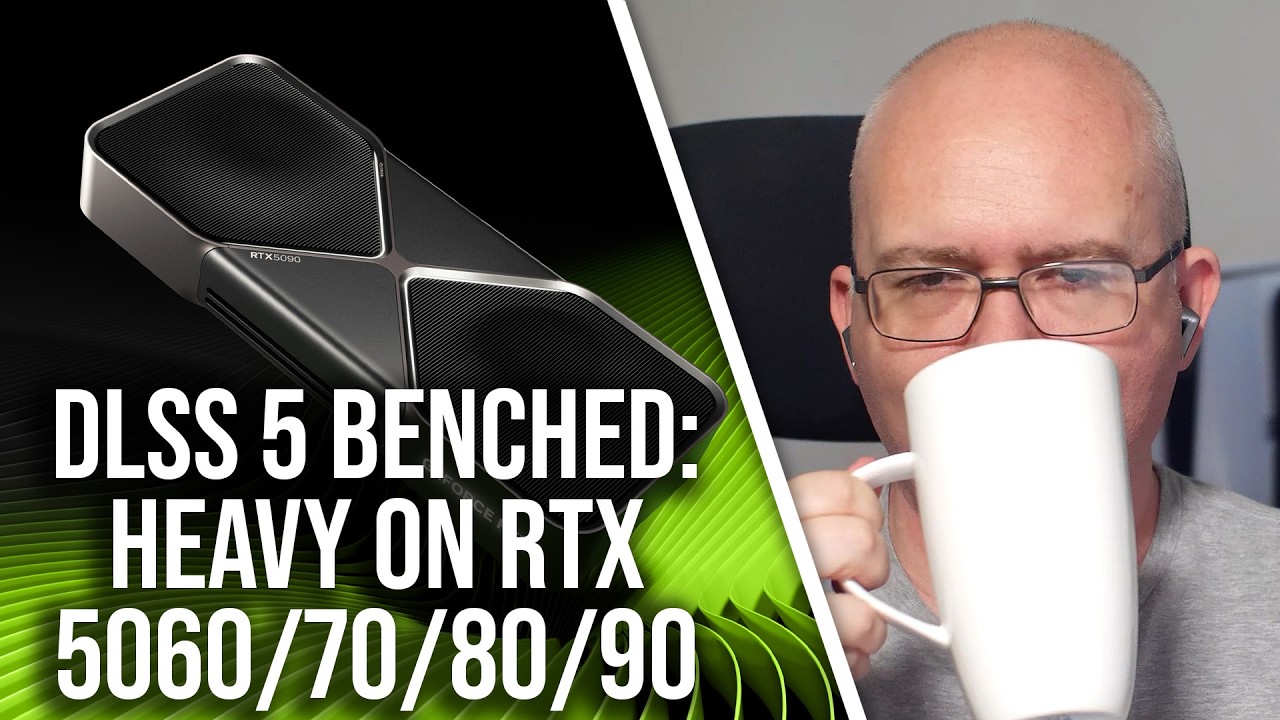
The video discusses the performance impact of Nvidia’s DLSS 5 technology across various RTX 50 series GPUs, highlighting that it is extremely demanding on hardware. Initially, Nvidia required a second RTX 5090 GPU to run the DLSS 5 model alongside frame generation, which was heavily criticized. However, Nvidia has since achieved a 5x speedup, with further optimizations expected by year-end. Despite initial assumptions that DLSS 5 would only be feasible on high-end cards with large VRAM, it surprisingly runs on the entire RTX 50 series, including 8GB laptop variants, though it remains very resource-intensive.
Testing on NBA 2K27 at ultra settings reveals that DLSS 5 adds a fixed processing cost that significantly impacts frame times. For example, on an RTX 5090 at 4K, DLSS 5 consumes about 8 milliseconds per frame, halving the available render time and resulting in a roughly 50% drop in frame rates. Lower-tier GPUs like the RTX 5080 and 5070 show even greater frame time hits, with the 5080 experiencing nearly 14 milliseconds of overhead, causing a 58% frame rate drop. Despite this, gameplay remains somewhat playable, especially when combined with frame generation, which boosts frame rates but increases latency.
Interestingly, the RTX 5060, the weakest card tested, also supports DLSS 5 at 1080p with high settings, incurring a 9.9-millisecond frame time cost and a 42% performance hit. This lower relative impact is due to the GPU’s longer base frame times, making DLSS 5’s fixed cost a smaller proportion of the total frame time. Overall, DLSS 5’s processing happens at the final output resolution, meaning there are limited savings from lower input resolutions, contributing to its heavy resource demands. The technology also introduces some stutter and frame time spikes, though these are not unique to DLSS 5.
From a technical perspective, DLSS 5 is impressive, especially given it uses a 154 million parameter model that requires less than 1GB of memory—much lower than expected. Nvidia’s approach involves a fixed frame time cost regardless of masking or input complexity, which means the performance hit is consistent but unlikely to decrease significantly without new hardware or model improvements. Future optimizations could improve efficiency, but currently, DLSS 5 is best suited for scenarios where the visual enhancements justify the substantial performance trade-offs, similar to early ray tracing adoption.
The discussion concludes with reflections on DLSS 5’s place in the current GPU landscape. While it works across the RTX 50 series and can deliver impressive visuals, its heavy frame time cost limits its practicality, especially on mainstream hardware and in more demanding AAA titles. The technology demands judicious use and artistic direction to balance visual fidelity and performance. There is speculation that future GPUs, such as a hypothetical RTX 6000 series, might handle DLSS 5 more efficiently. For now, DLSS 5 represents a significant technical achievement but remains a costly feature in terms of performance.