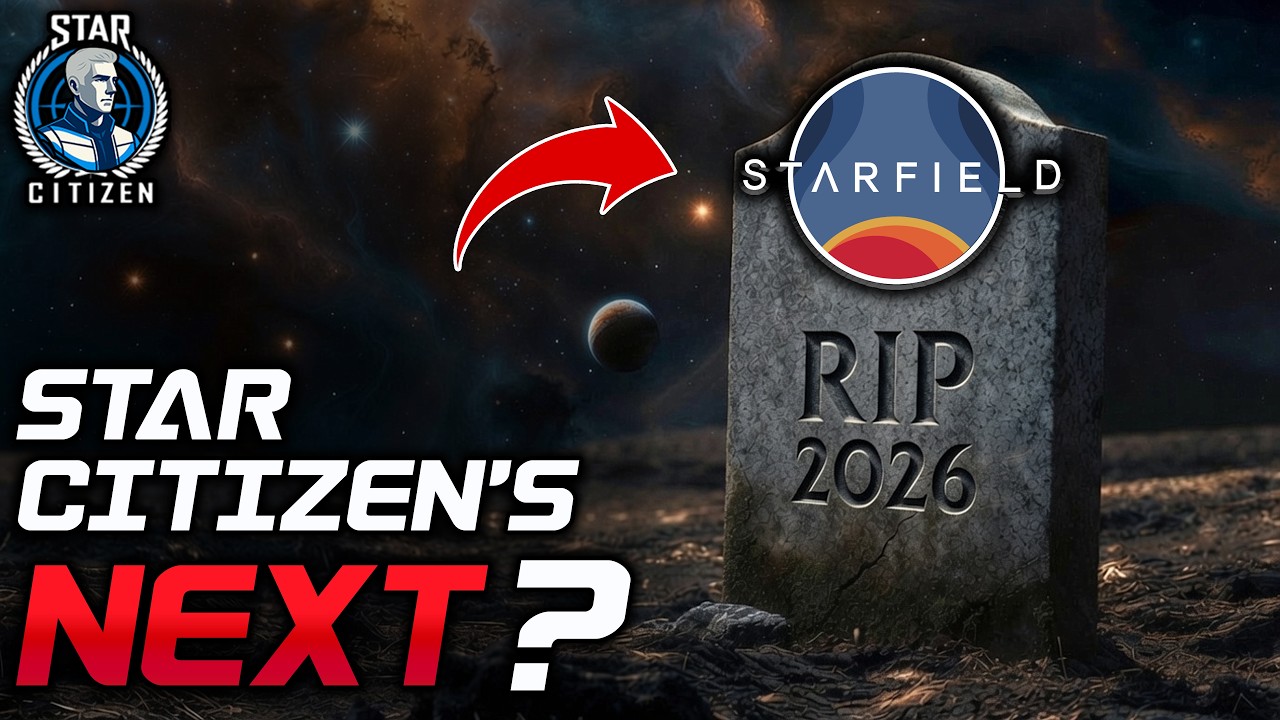
The video discusses how Starfield, Bethesda’s ambitious space RPG, has essentially died despite its initial hype and backing from Microsoft. Unlike a canceled game, a dead franchise never reaches future development stages or sequels. During a major restructuring at Xbox, Bethesda’s valuable IPs like Fallout and Elder Scrolls were prioritized, but Starfield was notably ignored. Despite a massive $400 million investment and a high-profile launch, Starfield failed to maintain momentum, leading to layoffs and abandonment. This situation serves as a cautionary tale for Star Citizen, a similarly ambitious space sim that has been in development for over 13 years.
One of the key issues with Starfield was its failure to deliver on the promise of a seamless, immersive galaxy. Players were stuck with loading screens between planets and space, turning what should have been an epic exploration experience into a tedious menu simulator. In contrast, Star Citizen boasts a seamless universe with no loading between space and planetary surfaces, a technical achievement that enhances immersion. However, this seamlessness also exposes a major risk: an empty world that lacks engaging content. Both games struggle with creating meaningful, dense environments that keep players invested.
The emptiness of Starfield’s universe stemmed largely from its reliance on procedural generation, which churned out many planets that felt identical and lifeless. Bethesda’s own developers admitted this was a core problem, with the game’s design embracing the natural emptiness of space as a feature rather than a flaw. Star Citizen faces a similar challenge but aims to overcome it with its Genesis planet tech and a system called Starkitect, designed to place unique, logically placed locations that tell stories and feel distinct. While promising, this technology remains unproven and central to Star Citizen’s future success.
Another important lesson from Starfield is the significance of player impact and meaningful choices. In single-player games like Starfield, the world should react to player actions to create a sense of consequence. However, Starfield’s world felt static and unchanged by player decisions, diminishing engagement. Star Citizen, on the other hand, is developing complex crafting and economy systems that allow players to influence the universe and interact dynamically. This player-driven economy and base-building feature could provide the meaningful, emergent gameplay necessary to avoid Starfield’s fate.
Finally, the video highlights the fundamental difference between Starfield’s publisher-driven model and Star Citizen’s community-funded approach. Starfield was bound by deadlines and publisher expectations, and when it failed to meet commercial success, it was quickly shelved. Star Citizen, funded directly by its passionate backers without a publisher, has no deadline and can continue evolving at its own pace. While this freedom can lead to delays and an unfinished feel, it also shields the game from sudden cancellation. The video concludes with cautious optimism, urging viewers to consider whether Star Citizen is learning from Starfield’s mistakes or destined to repeat them.