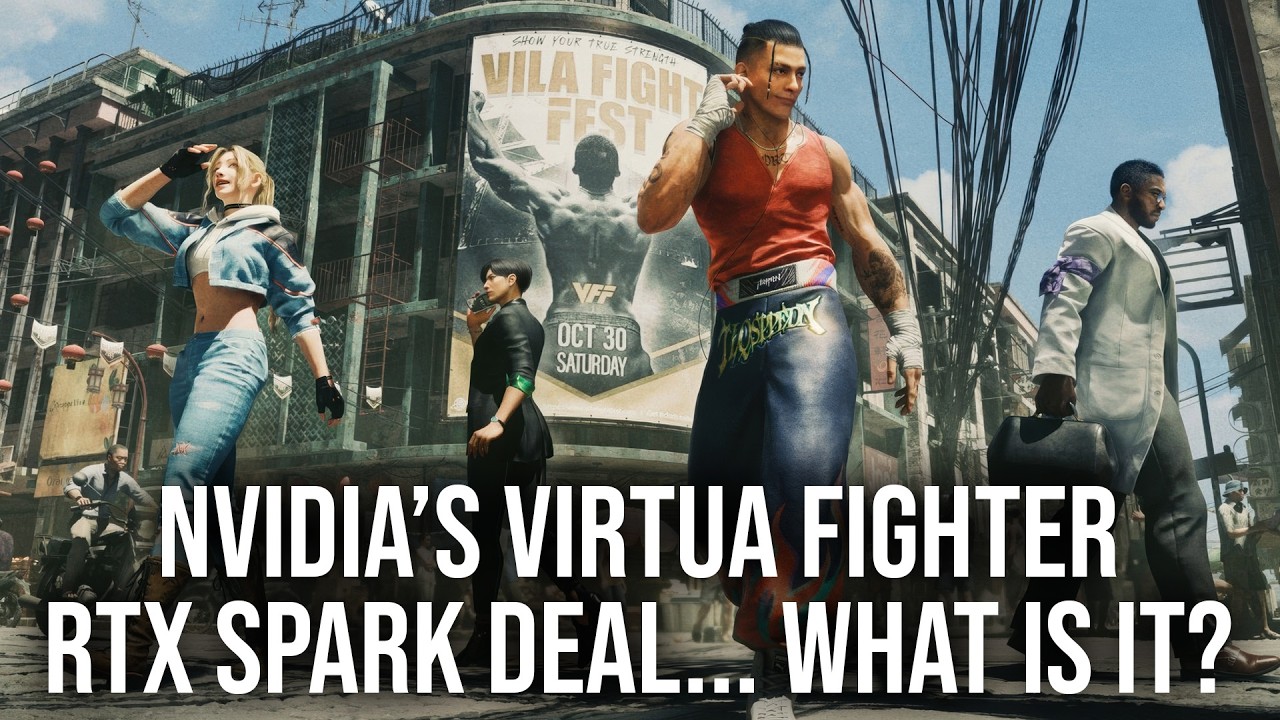
Sega’s announcement of Virtua Fighter 6 supporting Nvidia’s ARM-based RTX Spark platform likely involves running the game via a translation layer rather than a fully native ARM version, with true native support depending on the commercial success of RTX Spark. Nvidia’s collaboration with Sega appears focused on ensuring compatibility and performance on ARM hardware as part of a broader strategy to expand ARM gaming, though widespread native ARM adoption remains limited and contingent on market demand.
The discussion begins with a question about Sega and Nvidia’s recent announcement regarding Virtua Fighter 6 supporting Nvidia’s ARM-based RTX Spark platform. The question raises skepticism about whether developers will genuinely create native ARM versions for RTX Spark or if Nvidia will need to incentivize companies to support the new ARM chip. The comparison is made to Qualcomm’s limited success in gaining native support for ARM in gaming, except when Microsoft is involved, such as with anti-cheat fixes for GTA Online.
One of the speakers clarifies that the announcement from Sega did not explicitly confirm a native ARM version of Virtua Fighter 6. Instead, the game might run on RTX Spark through a translation layer, which allows PC games to run on ARM hardware without native recompilation. This raises uncertainty about what “support” truly means in this context. The speaker speculates that the game might simply be optimized to run smoothly on RTX Spark without a full native ARM build.
Regarding developer motivation, it is suggested that the decision to target ARM depends heavily on the commercial success of RTX Spark. Since the platform appears expensive and not aimed at the mass market initially, developers may have little incentive to create native ARM versions just for it. While there is some movement towards ARM in gaming, like the upcoming Steam Deck’s ARM-based model and macOS’s ARM architecture, widespread native ARM support remains limited, even on platforms with larger user bases.
Another perspective expresses skepticism that Sega will produce a fully native ARM executable for Virtua Fighter 6. Instead, it is more likely that specific components, such as anti-cheat systems, might be adapted to work better on ARM, especially since the game is a competitive online multiplayer title. The partnership between Nvidia and Sega may focus more on ensuring compatibility and smooth performance rather than full native ARM development across all Sega titles.
Finally, the conversation touches on Nvidia’s broader ARM ambitions with their N1 and N1X chips, which have different configurations and power envelopes. The N1X is powerful but expensive, while the N1 is smaller and more energy-efficient, possibly targeting handheld or smaller devices. Nvidia’s strong infrastructure and ability to secure developer support might help push ARM gaming forward over time. The Sega partnership could be an early step in a longer-term strategy to expand Nvidia’s ARM ecosystem in gaming, although the market and device availability will be critical factors in its success.