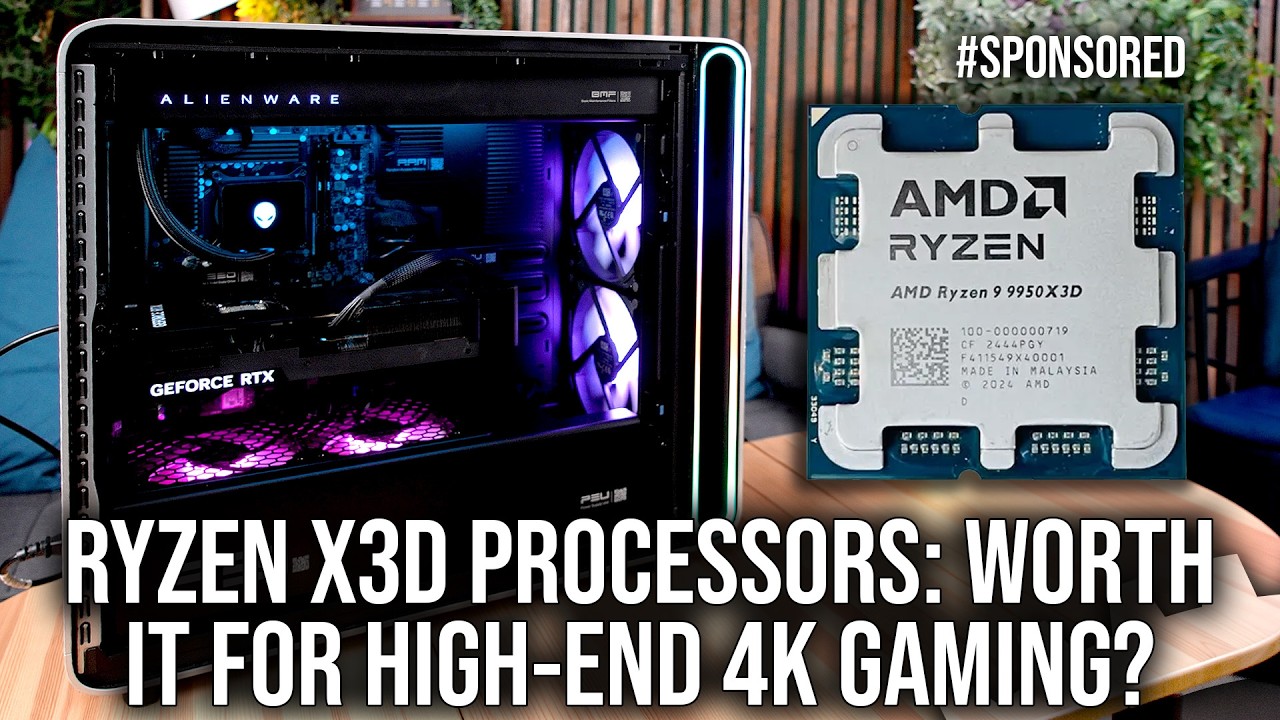
The video explores the significant impact of AMD’s 3D V-Cache technology in the Ryzen 9000 X3D processors, particularly in gaming scenarios involving high-end GPUs like Nvidia’s RTX 5090. While traditional benchmarks often isolate CPU performance at low resolutions, this video delves deeper into real-world 4K gaming performance, using Alienware’s Area 51 flagship PC equipped with Ryzen 9000 X3D CPUs and the RTX 5090. The presenter emphasizes that pairing these top-tier CPUs with powerful GPUs is becoming the standard for high-end gaming setups, and the Alienware system offers a premium platform to test this synergy.
Benchmarks reveal that Ryzen 9000 X3D processors deliver substantial performance gains over their non-X3D counterparts, with increases ranging from around 18% to over 39% in various games at low resolution where the CPU is the bottleneck. These gains are attributed primarily to the additional 64MB of 3D V-Cache, which reduces the need to access slower system memory, thus improving frame rates and reducing stutters. Both 8-core and 16-core X3D variants show similar relative improvements, highlighting the cache’s pivotal role in gaming performance enhancement.
However, the video acknowledges criticism of low-resolution CPU-focused benchmarks, noting that most gamers using GPUs like the RTX 5090 will play at 4K, where GPU limitations often dominate. Through detailed testing in demanding titles such as Baldur’s Gate 3, Warhammer 40,000: Space Marine 2, and Cyberpunk 2077, the presenter demonstrates that even at 4K, CPU performance—especially with X3D technology—can significantly affect frame rates and overall gaming smoothness. In some cases, the CPU remains the limiting factor, and the X3D chips help close the performance gap, allowing the GPU to be better utilized.
Advanced features like DLSS 4.5 and ray tracing workloads further illustrate the nuanced balance between CPU and GPU. In Cyberpunk 2077’s demanding scenarios, including path tracing, the Ryzen 9 9950X3D manages to keep pace with the RTX 5090’s output more effectively than the non-X3D variant, resulting in smoother frame times and higher average frame rates. The tests confirm that while the RTX 5090 is immensely powerful, the CPU’s ability to feed it data efficiently remains crucial, especially in richly detailed and CPU-intensive game worlds.
In conclusion, the video underscores that while traditional CPU benchmarks at 1080p remain useful for isolating performance, real-world 4K gaming benefits significantly from AMD’s 3D V-Cache technology. The Ryzen 9000 X3D processors provide meaningful performance advantages when paired with top-tier GPUs, helping to mitigate CPU bottlenecks even in the most demanding titles and settings. This synergy exemplifies the importance of balancing CPU and GPU capabilities in high-end gaming PCs, with the Alienware Area 51 serving as a prime example of such a balanced, high-performance system.