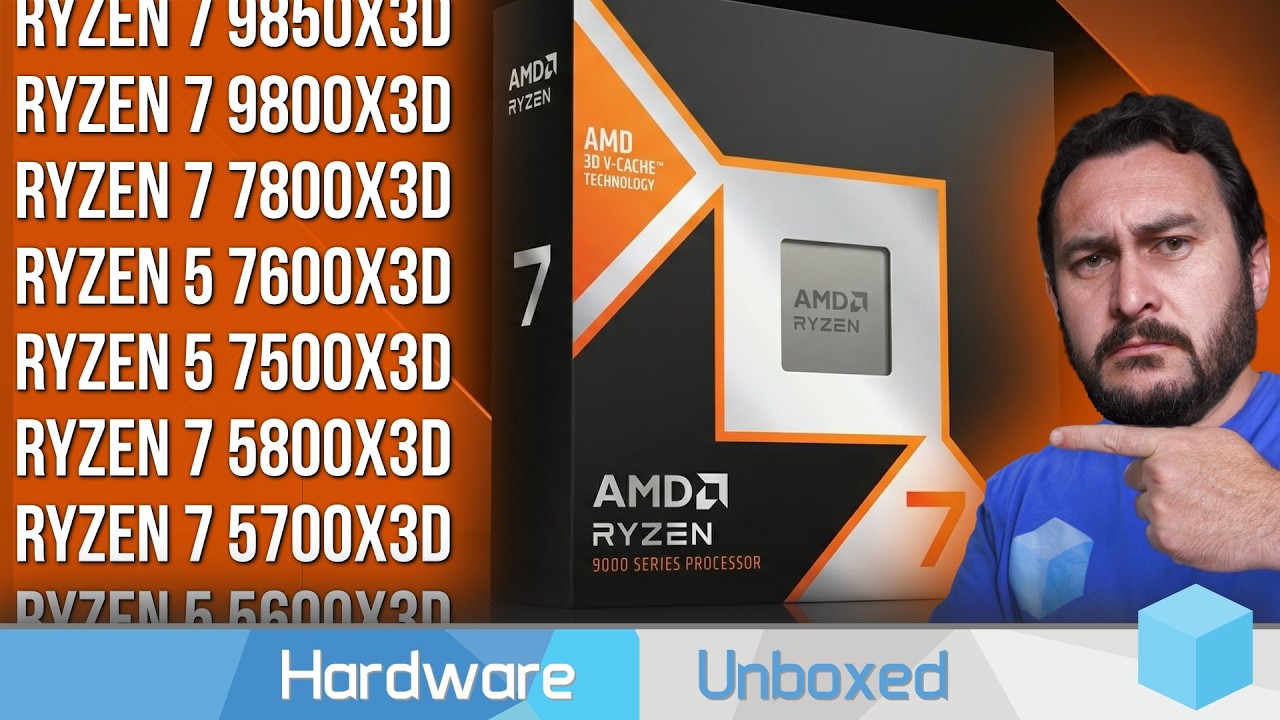
The video explores the performance of all nine single CCD Ryzen X3D processors released by AMD across both AM4 and AM5 platforms, focusing on gaming benchmarks. The presenter addresses previous viewer concerns about missing comparisons in earlier reviews and aims to provide a comprehensive analysis of these CPUs, excluding the Ryzen 9 dual CCD models. The tests were conducted using 14 games at 1080p resolution with an RTX 5090 GPU to isolate CPU performance differences. The video is sponsored by AOC, highlighting their affordable 27-inch QD OLED gaming monitor with features like 1440p resolution, 240 Hz refresh rate, G-Sync compatibility, and true HDR support.
The gaming benchmarks reveal significant performance variations between the slowest and fastest X3D CPUs, with differences reaching up to 97% in some titles like Baldur’s Gate 3. The improvements are attributed to factors such as increased IPC from Zen 4 architecture, higher core counts, core clock speeds, and memory bandwidth, particularly the upgrade from DDR4 to DDR5 in newer models. Some games, like Arc Raiders and Marvel Rivals, benefit notably from AMD’s 3D V-Cache technology and memory bandwidth, while others like Counterstrike 2 emphasize IPC gains due to their lightly threaded nature.
Several games demonstrate that core count plays a varying role depending on the title and settings. For example, Cyberpunk 2077 and Mafia the Old Country show meaningful gains with additional cores and faster clocks, whereas ACC performs well even with fewer cores but benefits from higher clock speeds and memory bandwidth. Ray tracing performance also highlights differences among CPUs, with lower-end models experiencing more significant drops. Memory sensitivity is a recurring theme, with DDR5-equipped Zen 4 processors often outperforming their DDR4 Zen 3 counterparts, especially in bandwidth-heavy games like Spider-Man 2.
The overall 14-game average data underscores consistent scaling across the Ryzen X3D lineup. The Ryzen 7500X3D is about 8-9% faster than the 5800X3D, while the 7800X3D leads with a 20-24% performance increase over the 5800X3D. The top-tier 9800X3D further extends this lead by 8-10% over the 7800X3D, marking it as the fastest gaming CPU AMD has released since the 5800X3D. The presenter notes that most of these CPUs are essentially bin variations of three core models (5800X3D, 7800X3D, and 9800X3D), and expresses curiosity about future releases like a potential 9600X3D.
In conclusion, the video provides a thorough comparison of Ryzen X3D CPUs, highlighting how architectural improvements, core counts, clock speeds, and memory upgrades influence gaming performance. It emphasizes the strengths of the 7800X3D as a standout gaming CPU and acknowledges the complexity AMD has introduced with multiple similar models. The presenter encourages viewers to subscribe for more content and offers additional engagement through membership options, thanking the audience for watching.