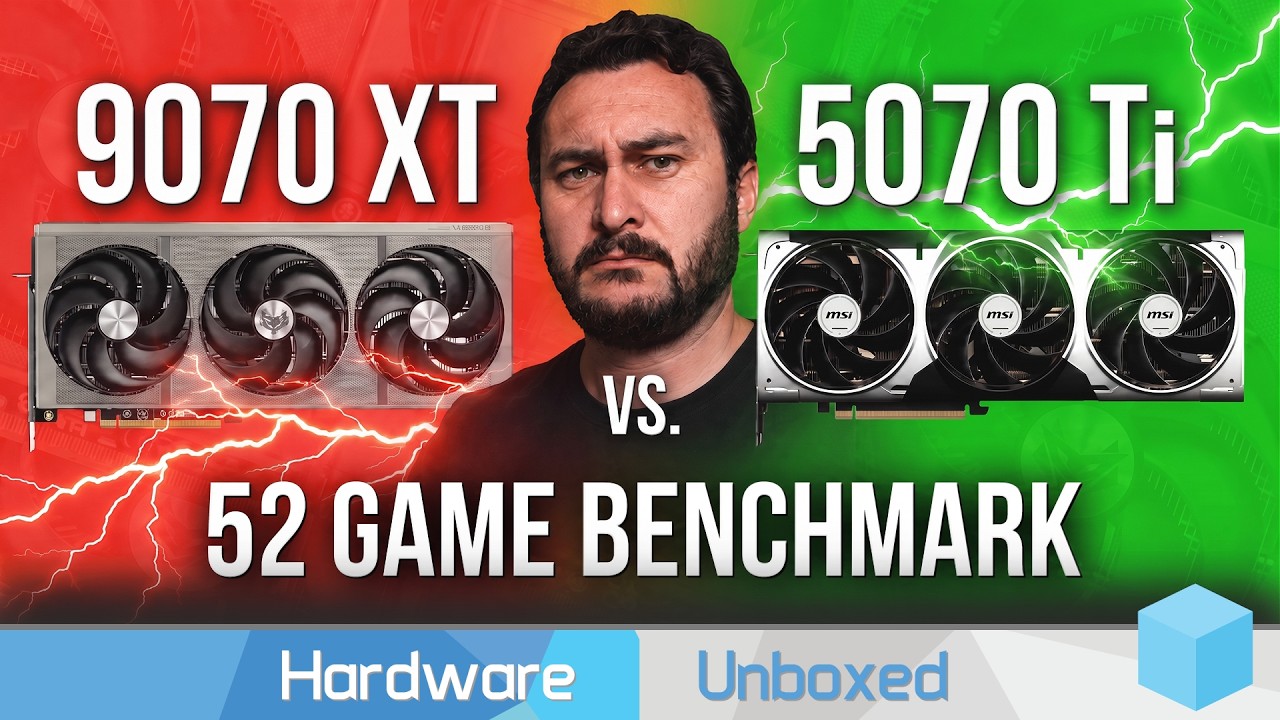
The updated comparison between the Radeon RX 9070 XT and GeForce RTX 5070 Ti across 52 games reveals a closely matched performance landscape, with both GPUs excelling in different scenarios. The testing was conducted at 1440p and 4K resolutions using two quality presets per game, including ray tracing enabled and disabled settings. Overall, the RTX 5070 Ti slightly edges out the RX 9070 XT by about 1.5% at 1440p and 4% at 4K, but these differences are minor and often fall within the margin of error. The Radeon card tends to perform better in pure rasterization tasks, especially at 1440p, while Nvidia’s GPU shines in ray tracing workloads and games that demand heavy RT processing.
Specific game benchmarks highlight this trend, with the RX 9070 XT dominating titles like Pragmata, Assassin’s Creed Shadows, Call of Duty, and several PlayStation PC ports such as Ghost of Tsushima and God of War. Conversely, the RTX 5070 Ti leads in ray tracing-heavy games like Doom: The Dark Ages, F125, and Cyberpunk 2077, as well as popular competitive shooters including PUBG, Rainbow Six Siege, and Fortnite. Nvidia also benefits from superior memory bandwidth due to its GDDR7 memory, which helps it scale better at 4K resolutions and maintain an edge in titles with demanding graphical settings.
Power efficiency is another consideration, with the RTX 5070 Ti consuming roughly 20% less power than the RX 9070 XT, making it the more energy-efficient option. However, this advantage does not fully compensate for the price difference, as the 5070 Ti is significantly more expensive—about 40% costlier in the US and 46% more in Australia. Given the similar performance levels, the reviewer suggests that the RX 9070 XT offers better value for money, especially for gamers primarily focused on rasterization performance and those who do not prioritize ray tracing.
The review also notes some surprising results where the RX 9070 XT outperforms the RTX 5070 Ti even with ray tracing enabled in certain titles like Pragmata and Resident Evil Requiem, indicating that AMD’s architecture can still deliver strong RT performance in specific scenarios. However, Nvidia remains the preferred choice for heavy ray tracing and path tracing workloads, where its hardware acceleration and driver support provide a smoother and more consistent experience. Competitive gamers might also lean towards the RTX 5070 Ti due to better driver optimizations and higher frame rates in esports titles.
In conclusion, both GPUs offer excellent performance across a wide range of games, with the choice largely coming down to budget and feature preferences. While the RTX 5070 Ti holds a slight edge in ray tracing and efficiency, the RX 9070 XT delivers strong rasterization performance at a significantly lower price point. With market pricing expected to rise, the reviewer recommends purchasing the RX 9070 XT now for the best value. Ultimately, gamers should consider their specific use cases, game preferences, and budget constraints when deciding between these two closely matched graphics cards.