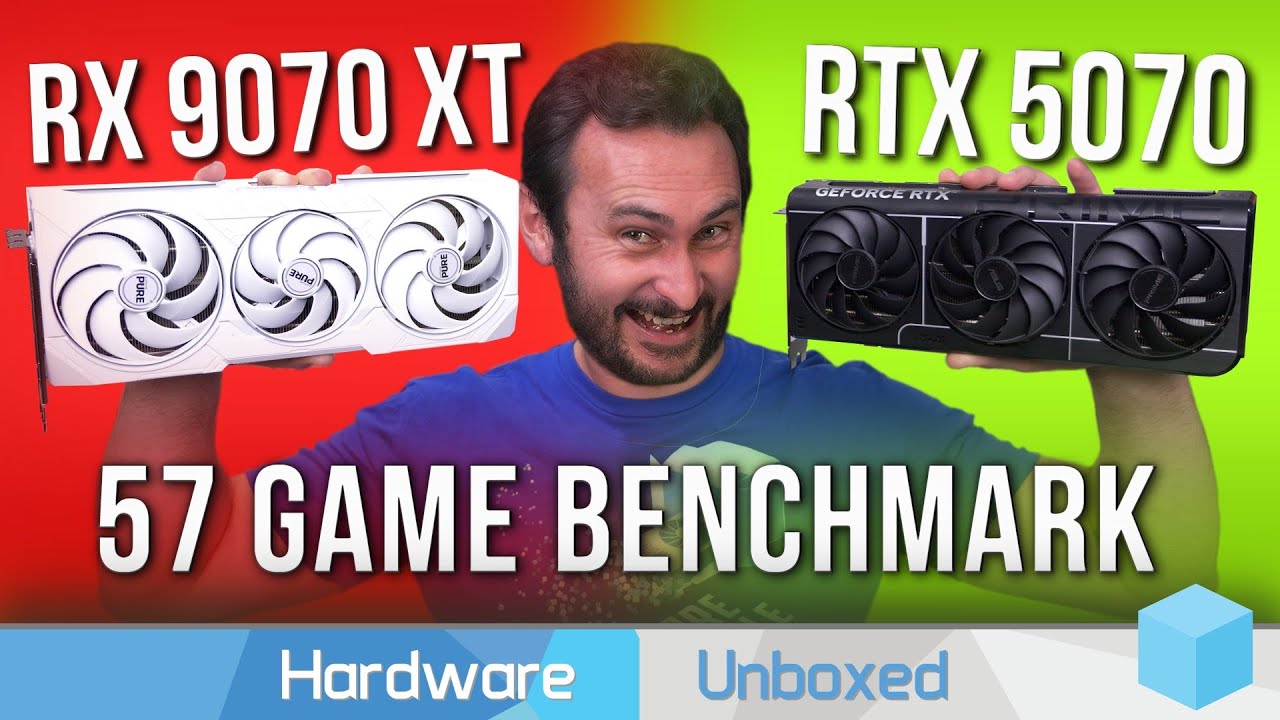
The video compares the AMD Radeon RX 9070 XT and Nvidia GeForce RTX 5070 in a comprehensive 57-game benchmark across 1440p and 4K resolutions. Initially, the RX 9070 XT was about 5% slower than the RTX 5070Ti, but considering the suggested retail prices, the AMD card should be significantly cheaper—around 20%. Due to current market conditions, the actual retail prices are higher, with the RX 9070 XT costing roughly 41% more than the RTX 5070 in the US, making it a poor value despite its performance advantage. The comparison highlights that AMD’s pricing and availability issues have diminished the potential value of their higher-performing GPU.
The performance analysis shows that the RX 9070 XT generally outperforms the RTX 5070 in most titles, sometimes by a substantial margin, such as in Starfield, Horizon Forbidden West, and The Last of Us Part One, where it was significantly faster. However, in certain games like Hunt Showdown and Grand Theft Auto 5, the RX 9070 XT underperforms relative to Nvidia’s cards, sometimes even trailing behind the RTX 5070. Driver updates have improved performance across both GPUs, but the overall trend indicates that AMD’s card offers notable performance gains, especially at 1440p, with an average of 17% higher frame rates than the RTX 5070.
Pricing remains a critical factor in evaluating value. In the US, the RX 9070 XT is about 41% more expensive than the RTX 5070, and similar trends are seen in other regions like Canada, Germany, and Australia, where it is also more costly. Despite its performance edge, the higher price diminishes its attractiveness, especially since the AMD card is not offering enough additional value for the price difference. When comparing to the RTX 5070 Ti, the RX 9070 XT provides only marginally better value in some regions, but overall, it is less compelling given the current pricing dynamics.
The video emphasizes that AMD initially launched the RX 9070 XT at or near MSRP, but supply constraints and market demand have driven prices well above the suggested retail. AMD’s attempts to subsidize prices with rebates have been limited, and actual street prices now hover around $860 USD, well above the $600 MSRP. Nvidia, on the other hand, has maintained more competitive pricing, making the RTX 5070 and its Ti variant better value options in many regions. The limited availability and high prices for AMD’s GPU undermine its initial performance advantages, making it a less attractive buy despite its technical superiority.
In conclusion, while the RX 9070 XT offers impressive performance that surpasses the RTX 5070 in most scenarios, its high market price and supply issues make it a poor value currently. Nvidia’s cards are more competitively priced and provide better cost per frame in many regions, especially in the US and Canada. The reviewer suggests that unless AMD can lower prices or improve availability, the RTX 5070 and 5070 Ti will remain the smarter choices for most consumers. Despite AMD’s initial hype and performance potential, market realities have shifted the recommendation towards Nvidia’s offerings for the time being.