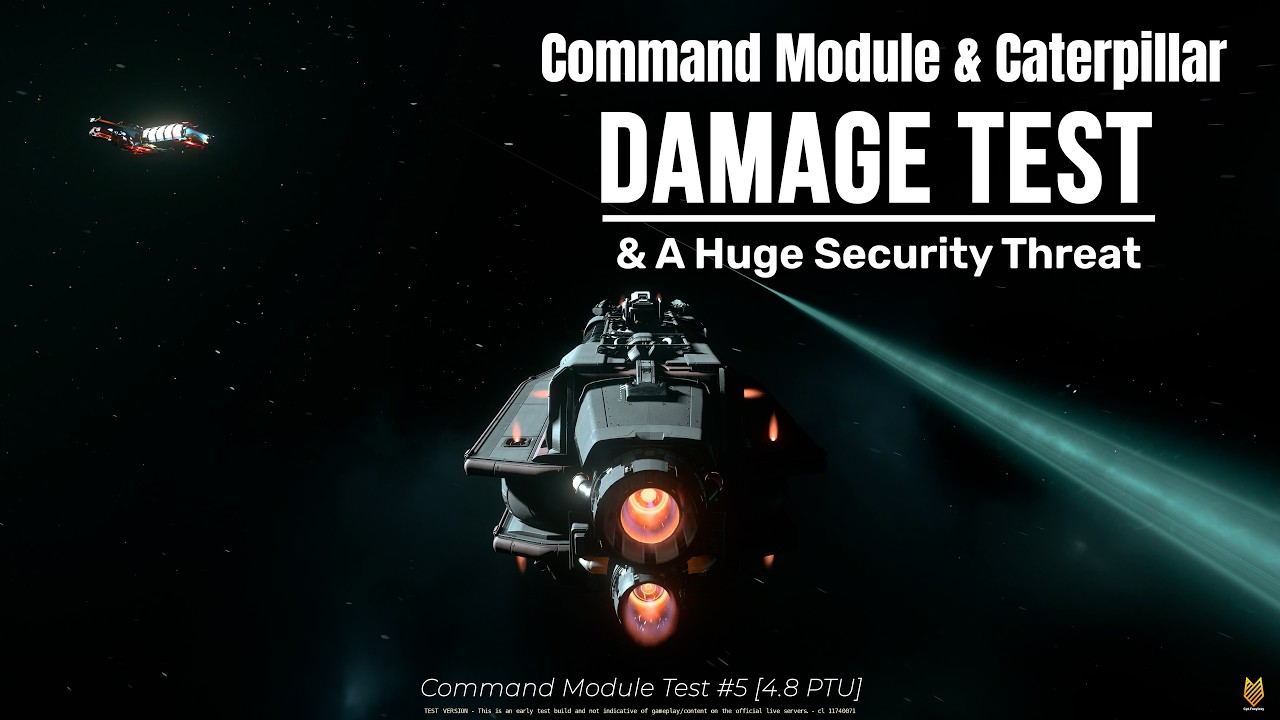
In this video, the creator continues testing the command module and Caterpillar ship in Star Citizen Alpha 4.8 PTU, addressing viewer questions about how damage works when the command module is attached or detached from the Caterpillar. They begin by examining the health and armor stats of both ships, revealing that the Caterpillar’s total hull health of 91,500 HP does not include the command module, which has its own 6,700 HP. The Caterpillar’s armor and damage deflection thresholds are significantly higher than those of the command module, suggesting that when attached, the command module should inherit the Caterpillar’s superior defensive stats.
The video then moves into practical testing with in-game weapons, showing that when the command module is attached to the Caterpillar, it cannot be targeted separately and appears as part of the larger ship. Damage tests reveal that the command module inherits the Caterpillar’s damage deflection thresholds, making it much harder to harm with smaller weapons. Even powerful weapons like size four lasers fail to damage the command module’s hull when attached, though subcomponents like turrets can still be damaged. This indicates a protective mechanic where the command module is shielded by the Caterpillar’s defenses while attached.
A surprising security flaw is demonstrated when the creator EVA’s inside the Caterpillar through the command module due to a lack of collision detection. This means players could potentially board others’ ships and attack from inside, posing a significant security risk that needs to be addressed before release. Additionally, the engineering terminal inside the command module is shown to be non-functional when attached, requiring players to access the Caterpillar’s main terminal instead. The video also confirms that missiles do not damage the command module from inside the Caterpillar, adding another layer to the ship’s defensive behavior.
When the Caterpillar is destroyed, the command module is also destroyed, confirming that the module’s survival depends on the mother ship. Upon detaching the command module, the video demonstrates that it reverts to its own lower damage deflection thresholds, making it vulnerable to smaller weapons and easier to damage and destroy. The command module’s maneuverability and speed are lower than many fighters, but it becomes a standalone target once detached. This detachment mechanic allows for separate combat scenarios involving the command module independent of the Caterpillar.
In conclusion, the tests clarify that the command module benefits from the Caterpillar’s defenses when attached, making it highly resistant to damage. However, once detached, it becomes more vulnerable and behaves like a small ship with its own stats. The video highlights some current bugs, such as the ability to EVA inside the ship and non-functional terminals, which could impact gameplay and security. Overall, the findings answer many community questions and provide valuable insight into how the command module and Caterpillar interact in combat situations.