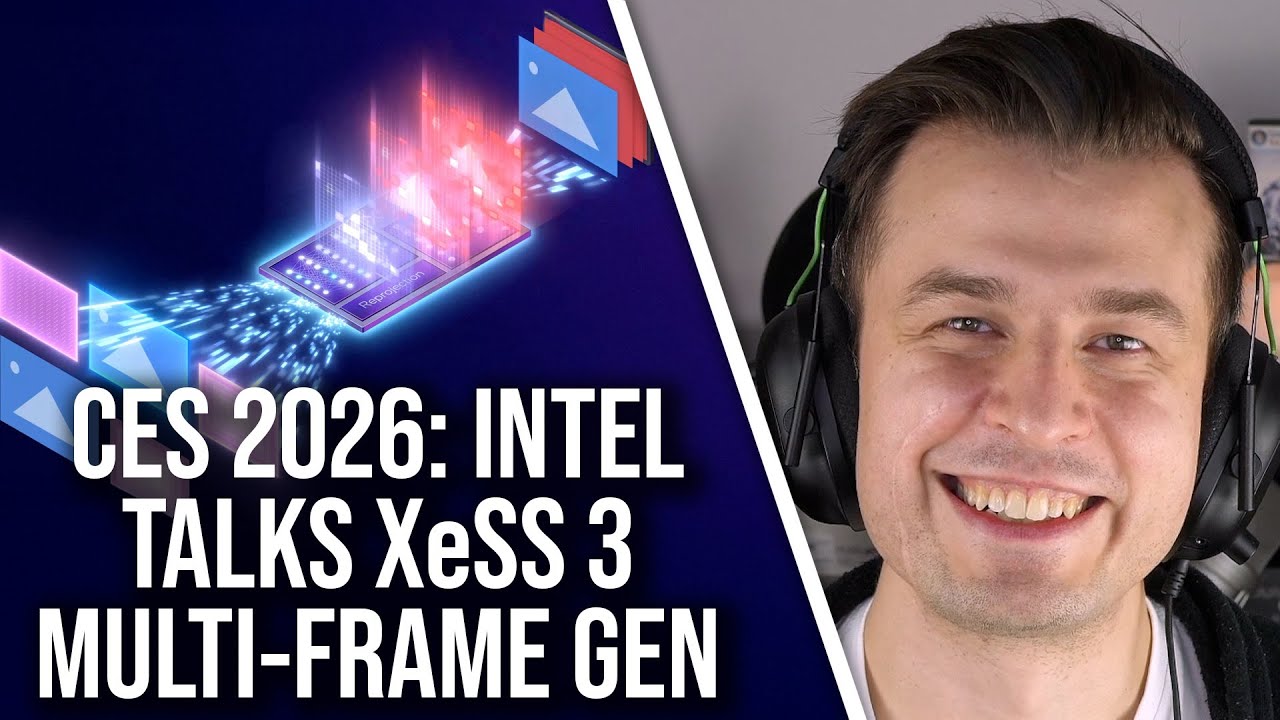
Intel’s XeSS 3 Multi-Frame Generation technology advances frame generation by optimizing AI-driven optical flow calculations for efficient multi-frame interpolation and focusing on precise frame pacing to ensure smooth, artifact-free visuals. Looking ahead, Intel aims to create flexible, adaptive frame delivery systems that reduce latency and improve visual quality, while addressing misconceptions about frame generation as a performance boost rather than a visual enhancement.
In the discussion about Intel’s XeSS 3 Multi-Frame Generation (MFG) technology, the transition from Frame Generation (FG) to Multi-Frame Generation was highlighted as a process that required significant development time rather than encountering any specific technical hurdles. The key advancement involved creating new models and architectures, particularly optimizing the AI-driven optical flow calculation. This calculation is performed once and reused for multiple interpolated frames, which enhances performance efficiency. The engineering team focused on refining this process to ensure optimal operation.
Frame pacing emerged as a critical component in the implementation of frame generation technology. Because frame generation involves inserting synthetic frames between real rasterized frames, pacing these frames correctly is essential to avoid visual artifacts and ensure a smooth viewing experience. The technology must handle bursty rendering times—longer for the base frame and shorter for generated frames—requiring careful synchronization. Intel is still exploring the best methods to make synthesized frames appear seamless, with frame pacing playing a central role in this ongoing research.
Looking toward the future, Intel envisions a flexible system where the number of rasterized versus generated frames can vary, especially as display technologies advance to higher refresh rates such as 1000 Hz monitors. A potential model inspired by VR technology involves decoupling the rendering engine from the projection process, allowing for perfect alignment with the display refresh rate regardless of how many frames are rasterized or generated. This approach could lead to more adaptive and visually perfect frame delivery systems.
The conversation also touched on latency challenges and the potential for extrapolation techniques to reduce perceived latency, particularly in scenarios involving rapid user movements like eye or gun tracking in games. While extrapolation is difficult to implement effectively, it remains a promising area of research. Intel differentiates between two types of latency: click-to-photon latency, which is hard to improve, and motion-to-photon latency, which can be significantly reduced through advanced frame generation and prediction techniques.
Finally, the discussion addressed the broader reception of frame generation technologies in the gaming community. A major hurdle to wider adoption has been the misconception that frame generation is primarily a performance enhancement, when it is more accurately a visual improvement tool that smooths frame delivery. Intel emphasizes the importance of clearly distinguishing between rasterized frame performance and frame generation smoothing effects to manage expectations. Despite some visible artifacts in slowed-down analysis, the overall user experience with frame generation, even on integrated GPUs, is significantly improved, and the technology continues to evolve to enhance smoothness and visual quality.