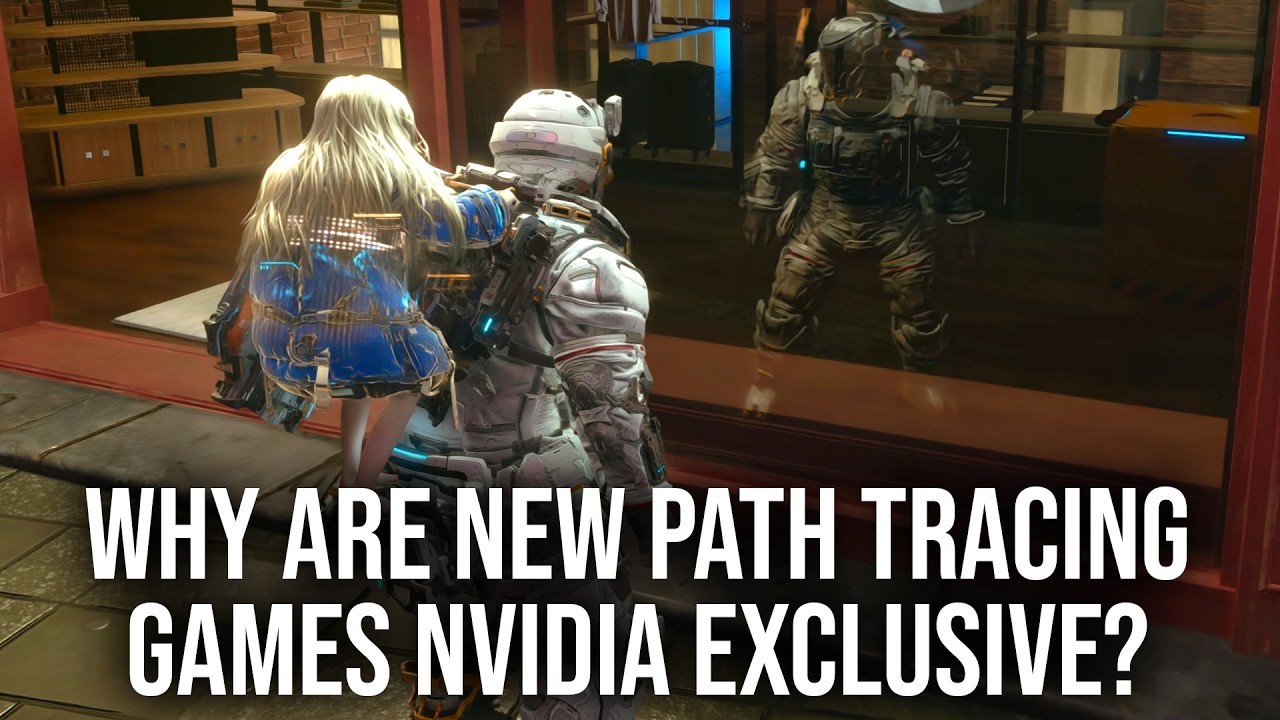
The recent trend of new path tracing PC games being exclusive to Nvidia GPUs has sparked criticism and confusion among industry observers. This exclusivity began with titles like Resident Evil 9, Pragmata, and Neverness to Everness, where path tracing features are locked to Nvidia hardware. One key reason appears to be the reliance on Nvidia’s proprietary ray reconstruction denoiser technology, which developers have integrated into their games without offering alternatives for other GPUs. This approach limits access for players using AMD or other brands, creating frustration as games ship with only one type of denoiser optimized for Nvidia.
Historically, games like Alan Wake 2 introduced advanced path tracing effects such as path trace transparency with multiple light bounces, but even then, developers restricted these effects to Nvidia’s denoiser due to compatibility and quality issues with alternatives. The Nvidia denoiser handles noise and ghosting better, while other denoisers struggle, resulting in poor visual quality. This technical limitation is often cited as justification for exclusivity, but critics argue that developers should provide multiple denoising options to support a wider range of GPUs and not lock features behind a single vendor’s technology.
Another factor discussed is the evolution of GPU APIs and features. Previously, Nvidia exclusivity could be partly explained by their proprietary shader execution reordering via NVAPI, which was not available on other hardware. However, with the advent of DirectX 12, these features have become more broadly accessible, reducing the technical barriers for AMD and others to support path tracing. Despite this, developers continue to favor Nvidia’s solutions, which some see as a strategic move to lock out competitors rather than a necessity based on hardware limitations.
Market considerations also play a role. Nvidia holds a significant share of the high-end GPU market segment, especially among cards capable of running demanding path tracing effects. Developers may choose to prioritize Nvidia GPUs to reduce development complexity and focus on the largest user base, especially since supporting multiple denoisers or fallback solutions requires additional engineering resources. This business decision, while pragmatic, undermines competition and limits consumer choice, frustrating those with AMD or other GPUs who want to experience the latest graphical advancements.
Looking forward, there is hope for more vendor-neutral solutions in the industry. Some suggest that companies like Epic Games could develop machine learning-based denoisers or super-resolution algorithms that work across all GPU brands, leveling the playing field. Such cross-vendor technologies would simplify integration for developers and broaden access to advanced graphics features. However, creating these solutions requires significant engineering effort and cooperation, and until then, Nvidia’s dominance in path tracing exclusivity is likely to continue, much to the disappointment of many gamers and industry watchers.