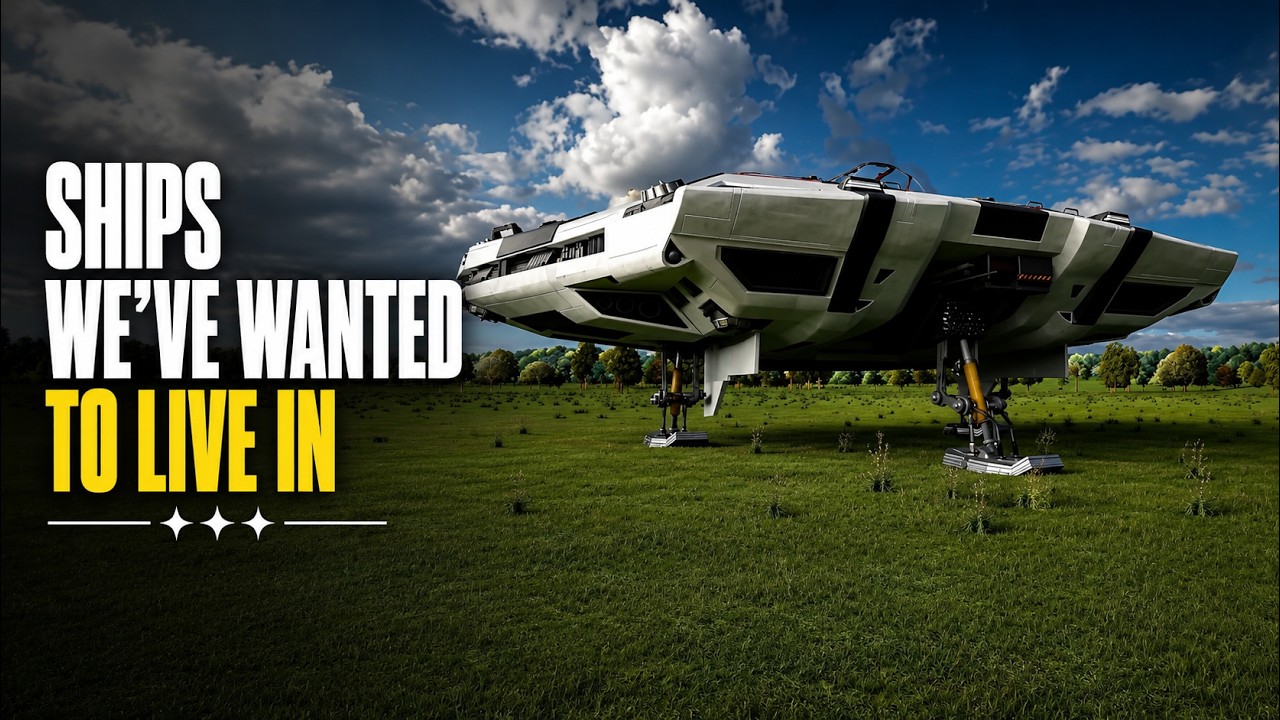
The video explores the idea that spaceships in sci-fi and games are often more than just vehicles—they are imagined as real, livable places. Many fans can sketch the interiors of iconic ships like the Millennium Falcon or the Nostromo from memory because these ships are portrayed as full environments with distinct rooms and functions. This contrasts with many space games where ships often feel like mere vehicles without meaningful interiors. The presenter argues that whether a game allows players to wonder about what lies behind the pilot’s seat reflects whether the ship is treated simply as a tool or as a place to inhabit.
Several modern games have embraced the concept of ships as homes or living spaces. For example, No Man’s Sky’s Voyagers update lets players build and customize ships inside and out, walk around inside them, and even perform spacewalks. Star Citizen has also focused on detailed, immersive ship interiors from the start, reflecting a strong demand for this type of experience. The video highlights a unique project called Starship Simulator, which features a meticulously engineered Magellan class ship with over 200 rooms, designed with real-world engineering principles to make the ship feel authentic and lived-in.
Other games approach ship interiors differently depending on their gameplay focus. X4 Foundations, for example, emphasizes its complex economy and fleet management, with ships that function within a realistic universe where they can dock, move, and interact physically. While interiors are less central to gameplay, players can still explore their ships, which adds to the immersion. The game’s ships are part of a living economy, moving and operating independently, which enhances the sense that ships are more than just tools—they have lives of their own.
Elite Dangerous is praised for its exceptional flight mechanics and distinctive ship personalities, with each ship feeling unique through its handling and sound design. However, it lacks detailed ship interiors, which many players desire to enhance immersion and make the ship feel like a true home rather than just a cockpit. This absence highlights a broader trend in space games where the depth of ship environments varies, but there is increasing interest in making ships fully realized spaces.
In conclusion, the video suggests that the future of space games lies in balancing rich game worlds with detailed, inhabitable ships that players can truly live in. Ships can be much more than vehicles—they can be homes, workplaces, and extensions of the player’s identity within the game universe. The presenter invites viewers to consider how important ship interiors are to their experience and whether they see ships as just gameplay tools or as meaningful places that enhance immersion and storytelling.