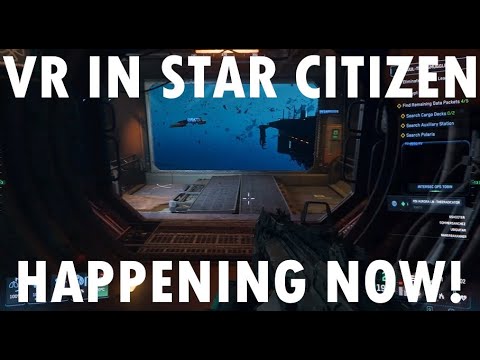
Star Citizen Alpha 4.5 has introduced an early, experimental implementation of virtual reality (VR) support, marking a significant step forward in the game’s development. This initial VR version is not the official launch but rather a prototype developed quietly by a small team of engineers at Cloud Imperium Games (CIG). By releasing this early version to the community, CIG aims to gather player feedback to identify weaknesses, push the limits, and help shape the future of VR integration in Star Citizen. The company emphasizes that this release is highly experimental, incomplete, and only offers a glimpse into what VR support could eventually become.
Despite its early stage, the current VR implementation is surprisingly comprehensive. Players can enter VR from the game’s launch, navigate menus, fly ships, and interact with nearly every part of the game world. The entire Star Citizen universe is accessible in VR, although many systems are not yet optimized for the experience. To provide flexibility, CIG introduced a theater mode that displays the game on a virtual flight screen inside the headset. This mode allows players to switch seamlessly between full VR and traditional desktop controls, catering to different gameplay styles and comfort levels.
The VR settings include options to enable or disable VR mode, adjust virtual screen scale and distance, and fine-tune camera behavior during gameplay. Since traditional VR locomotion isn’t implemented yet, two interim control schemes are offered: one stabilizes the camera pitch to reduce motion sickness, and the other fully synchronizes head and camera movements for a more immersive experience but with a higher risk of discomfort. Players can also customize HUD elements, visor positions, and lens settings, giving them considerable control over their early VR experience.
Performance-wise, VR in Star Citizen is demanding and requires modern GPUs, fast CPUs, and proper VR runtime settings. Players are advised to use Vulkan as the renderer and enable upscaling technologies like DLSS or FSR to improve performance. Some features, such as asynchronous spacecraft warp, should be disabled with certain headsets to avoid visual artifacts. Known issues include disabled HUD elements, incorrect camera behavior in vehicles, and UI components that were not designed for VR, which will need significant work to become user-friendly. CIG encourages players to report VR-specific bugs to help refine the feature.
Looking ahead, CIG envisions adding advanced VR capabilities such as full motion controls, full body tracking, facial tracking, and eye tracking once the foundational VR framework is stable. The current experimental release is more an invitation for players to engage with the feature, provide feedback, and help shape what could become one of Star Citizen’s most transformative gameplay experiences. While rough and incomplete, this early VR support signals CIG’s commitment to pushing the boundaries of immersive gameplay in both Star Citizen and potentially Squadron 42.