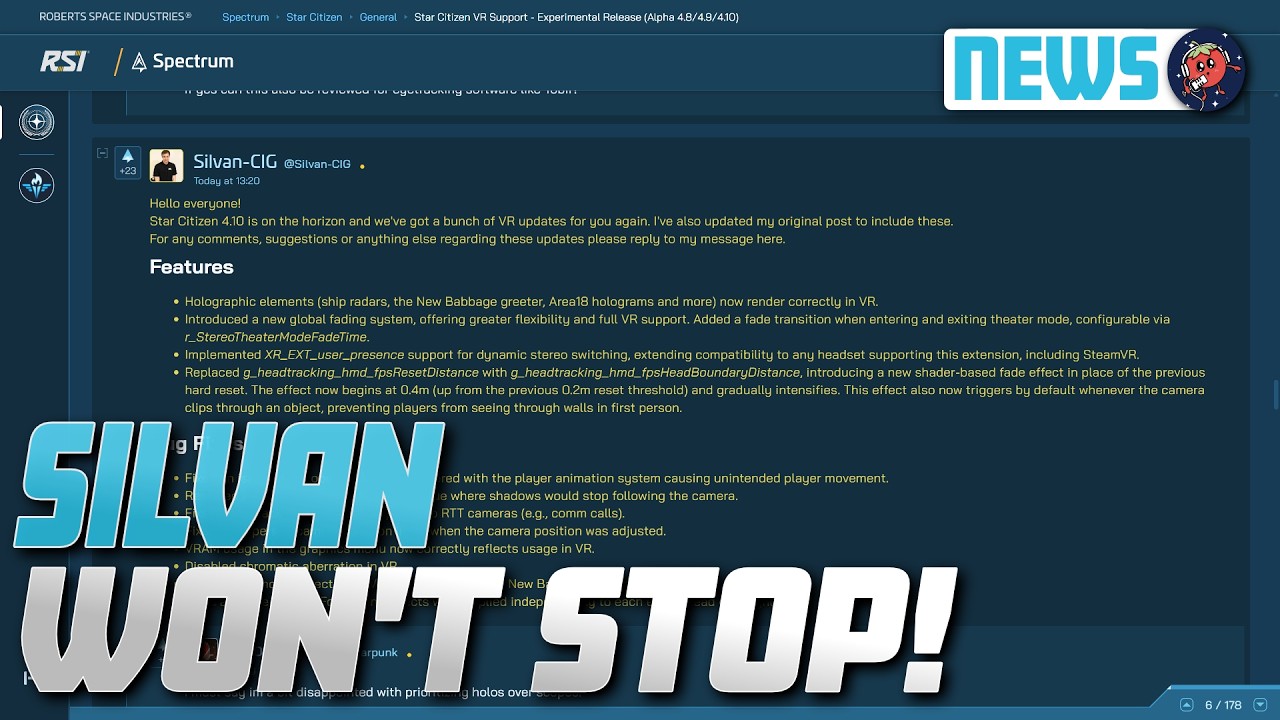
In 2026, virtual reality (VR) remains the most consistently updated feature in Star Citizen, largely thanks to the dedicated efforts of Silven and a small support team. Despite VR not being the primary focus for most players, its steady improvements are notable and worth following. Updates have been regularly posted throughout the summer, with the latest coming in August, highlighting ongoing enhancements and bug fixes that contribute to a better VR experience within the game.
One of the key feature updates includes improved rendering of holographic elements such as ship radars, the Babbage greeter, and Area 18 holograms in VR. A new global fading system has been introduced to provide smoother transitions when entering and exiting theater mode, enhancing immersion. A particularly user-friendly aspect is the seamless switching between VR and normal gameplay modes without needing to adjust settings manually, allowing players to remove their headsets and instantly resume regular play.
Technical improvements also include extended OpenXR compatibility, dynamic stereo switching, and a refined headtracking reset system. The headtracking reset now uses a shader-based fade effect that begins closer to the player’s head, reducing jarring snaps when moving around. This change addresses previous issues where the player’s view could feel disconnected from their body, although full body movement support remains a hoped-for future enhancement.
Numerous bug fixes accompany these feature updates, tackling issues such as animation interference when opening kiosks, shadow flickering, incorrect headtracking on various cameras, and third-person camera collisions. VRAM usage is now accurately reported in the graphics menu, a significant quality-of-life improvement. Additionally, visual effects like chromatic aberration have been disabled in VR to improve clarity, and synchronization issues with certain graphical effects have been resolved.
Overall, while the VR updates in Star Citizen are incremental rather than revolutionary, they reflect a commendable commitment to refining this immersive mode. The work by Silven, who also contributes to other major rendering projects within the game, ensures that VR remains a steadily evolving feature. For space and VR enthusiasts, the prospect of a fully realized Star Citizen VR experience is exciting, offering potentially unparalleled immersion in a space simulation—though widespread adoption may depend on future hardware improvements and further game development.