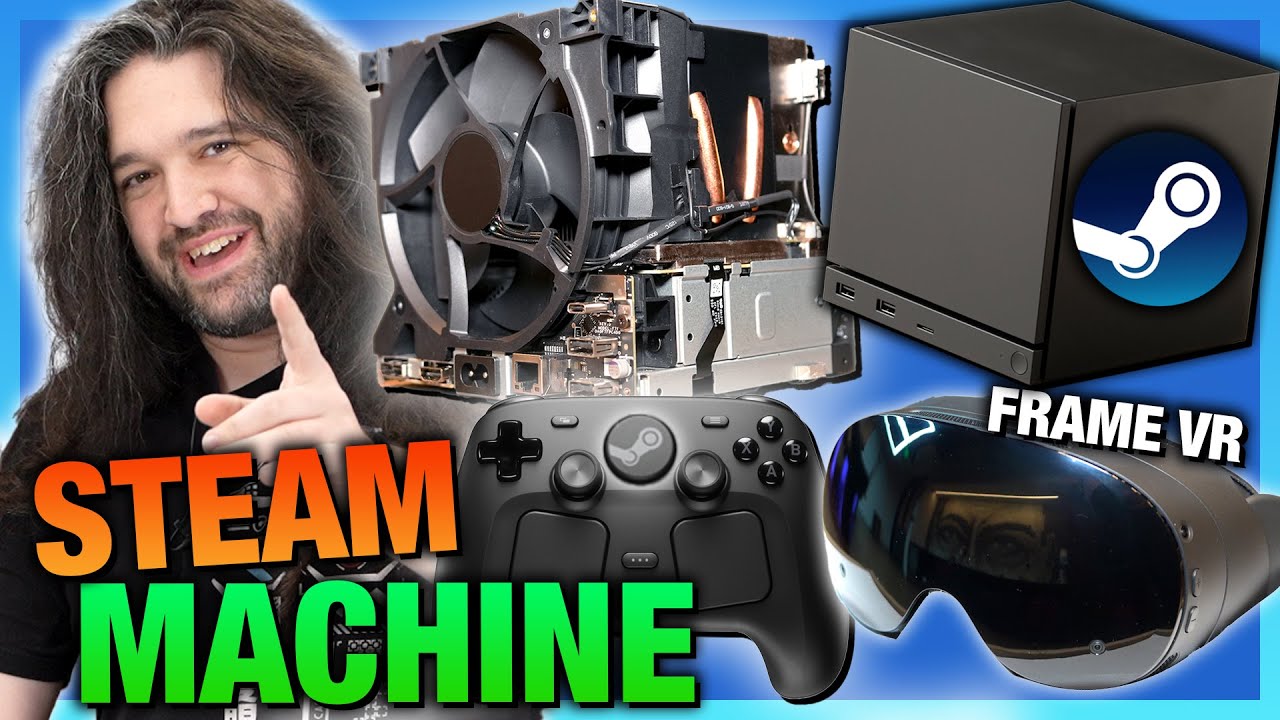
Valve has announced a suite of new hardware and software products centered around Steam OS, aiming for a 2026 release. Key among these is the Steam Machine, a mini PC designed as a small form factor computer running Steam OS on an AMD Zen 4 six-core CPU paired with a semi-custom RDNA3 28 Compute Unit GPU. Unlike previous Steam Machine attempts, this iteration is a first-party Valve product with a focus on modularity, user serviceability, and optimized thermals. Valve has integrated a robust internal power supply and a carefully engineered cooling system featuring a single 120mm axial fan and heat pipes, designed to fit within typical living room media setups while managing airflow efficiently.
The Steam Machine’s hardware emphasizes a balance between performance and compactness, with soldered CPU and GPU components for size and thermal control, though this limits upgradeability. It includes 16GB DDR5 memory, modular M.2 storage, and a micro SD card slot compatible with the Steam Deck for seamless game library sharing. Valve has also invested heavily in PCB design, especially for routing high-speed GDDR6 VRAM signals, employing techniques like back drilling to minimize interference. The machine supports multiple USB ports, Wi-Fi 6E, and a dedicated antenna for Steam Controllers, reinforcing its role as a versatile living room PC alternative.
Valve’s Steam Frame VR headset represents a significant shift in VR design, featuring a modular ARM-based Snapdragon 8650 compute core with Steam OS on ARM, pancake lenses with high resolution and refresh rates, and a novel foveated streaming technology. This streaming approach uses eye tracking to prioritize bandwidth and rendering quality where the user is looking, reducing latency and power consumption while maintaining image fidelity. The headset also includes a dedicated 6 GHz wireless dongle for low-latency PC streaming, four speakers tuned to cancel vibrations, and capacitive controllers with six degrees of freedom, designed to support both VR and traditional gamepad inputs.
Software-wise, Valve is expanding Steam OS beyond x86 handheld devices to ARM-based VR and desktop platforms, leveraging Proton and a new FEX emulation layer to ensure compatibility with x86 games. Developers can ship VR APKs through Steam, with automatic build selection based on device architecture, and users can share game libraries across devices via micro SD cards. Valve is positioning the Steam Frame not just as a VR accessory but as a new way to experience the entire Steam library, including non-VR games, streamed directly to the headset.
Finally, Valve introduced a new Steam Controller that builds on the original’s dual touchpad design with improved ergonomics, TMR thumbsticks, capacitive grip sensing, and advanced haptics for enhanced feedback. The controller connects via a dedicated wireless puck supporting up to four controllers with low latency, or via Bluetooth and USB. Valve emphasized design choices that improve reliability and resistance to electrostatic discharge. Overall, these announcements mark Valve’s renewed commitment to integrated hardware and software ecosystems, leveraging lessons from past efforts and the success of the Steam Deck to push Steam OS and PC gaming further into living rooms and VR.