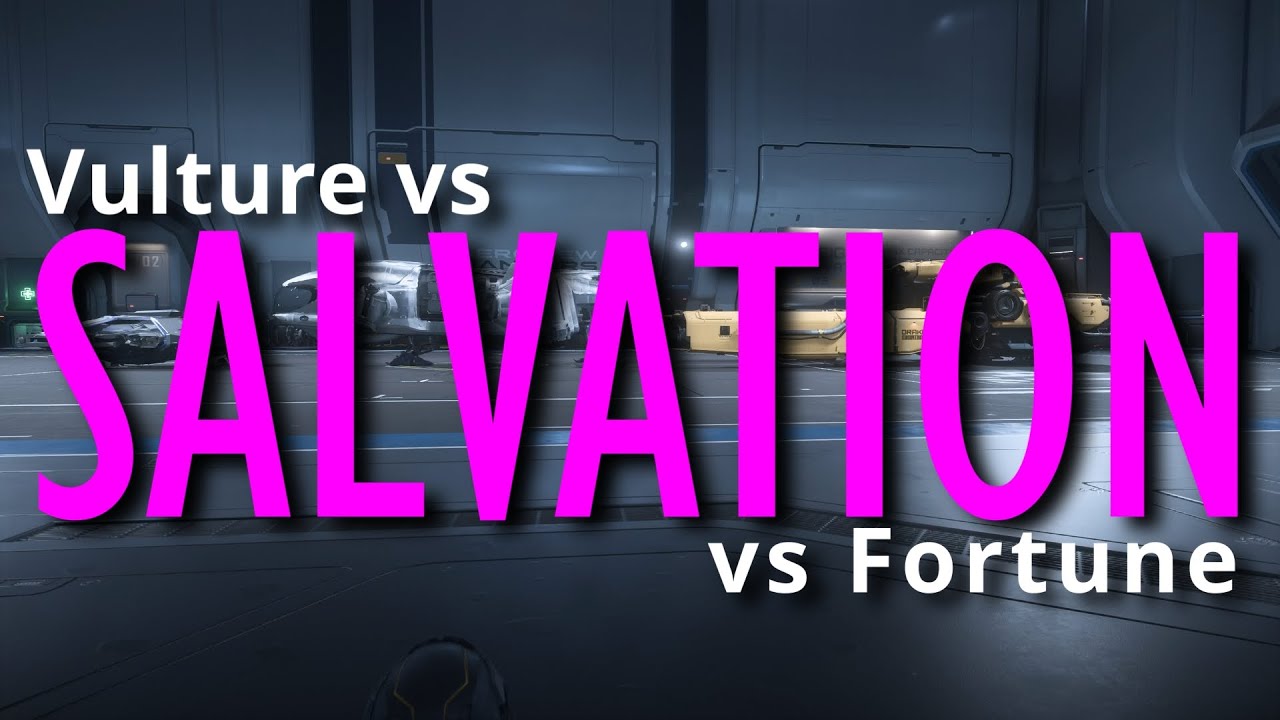
In this video, Daniel Raymond from Ray’s Guide discusses the newly announced RSI Salvation salvage ship revealed at the IAE Expo. Priced at $60 with a $55 warbond option and lifetime insurance, the Salvation is positioned as an affordable entry point into salvage gameplay and serves as the Lifetime Insurance (LTI) token for this year’s show. Daniel notes that buyers interested in the more expensive RSI Perseus salvage ship might consider purchasing a Salvation first and then upgrading it to the Perseus to save money while securing LTI. Compared to the existing solo salvage ships, the Drake Vulture and MISC Fortune, both valued at around $175, the Salvation is significantly cheaper but also more limited.
Daniel then compares the three ships side-by-side, starting with the Drake Vulture, the original solo salvage ship. The Vulture offers 12 SCU of cargo capacity on the grid and another 12 in the hopper, with creative players often expanding off-rid capacity. It has crafting capabilities for items like fuses and multi-tools, full access to components, and living spaces, making it a versatile salvage platform. The MISC Fortune is similar in function but has slightly different cargo handling, better damage resistance, and is tuned more for RMC (refined metal content) scraping rather than structural demolition, reflecting its role as a more durable salvage ship.
The Salvation, by contrast, has a much smaller capacity with only six SCU on a single cargo tray and six more in the hopper, no off-rid cargo options, no crafting abilities, and no living or bed spaces. Access to components requires EVA (extravehicular activity), making it less self-sufficient. While these limitations might make it seem like a less serious salvage ship, Daniel encourages viewers to think of the Salvation not as a starter but as a salvage snub—a small, nimble ship that can easily fit inside larger cargo ships like the Hercules C2 and Polaris. This compact size allows it to be transported conveniently to salvage sites, mitigating its limited cargo space.
Daniel also explores the potential synergy between the Salvation and the larger Reclaimer salvage ship. By using the Salvation as a scouting and scraping vessel, it can begin harvesting RMC from wrecks ahead of the Reclaimer, which specializes in structural salvage. This “Salvation Army” approach could involve multiple Salvation scouts increasing overall salvage efficiency and keeping the Reclaimer fully occupied, making the small ship valuable even in large industrial salvage operations. Thus, the Salvation’s role extends beyond a simple starter ship to a tactical asset within a coordinated salvage fleet.
Finally, Daniel touches on the unreliability of leaks and data mining related to RSI ships, emphasizing the importance of official announcements like RSI Day. He concludes by mentioning his ongoing giveaways, inviting viewers to subscribe and comment using a secret word to enter. The secret word for this video is “the role of the salvation other than as a starter salvage ship.” Daniel signs off encouraging viewers to fly safe and keep it real in the verse.