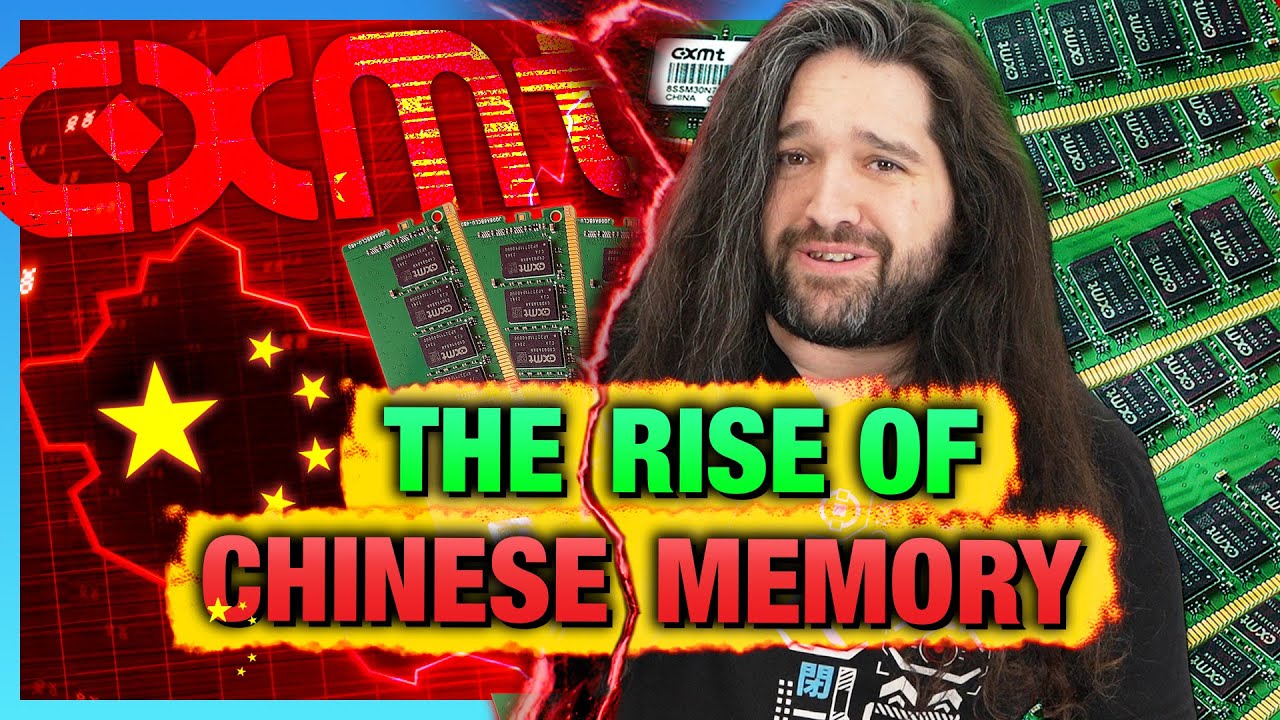
The video “The Rise of Chinese Memory” explores China’s rapid advancement in the semiconductor memory industry, focusing on two major companies: CXMT (Chongqing Xinya Memory Technologies) and YMTC (Yangtze Memory Technologies). Established in 2016 with substantial government backing and private investment, these firms have made significant strides in DRAM and NAND flash memory production, sectors traditionally dominated by South Korean giants Samsung and SK Hynix, and American company Micron. Despite initial skepticism and accusations of intellectual property theft and corporate espionage, CXMT and YMTC have rapidly grown their market share and technological capabilities, challenging the established players and altering global memory supply dynamics.
China’s semiconductor ambitions are rooted in the “Made in China 2025” initiative, aiming for self-sufficiency and technological independence within a decade. This plan acknowledged China’s prior weaknesses in innovation and manufacturing but committed vast resources to overcome these challenges through state-led investments and industry consolidation. The U.S. and other Western countries responded with skepticism and trade restrictions, citing concerns over unfair subsidies, forced technology transfers, and national security. These measures included placing Chinese memory firms on entity lists, restricting access to critical manufacturing equipment, and blocking collaborations with Western companies, which in turn forced Chinese firms to innovate domestically under constrained conditions.
Despite these obstacles, CXMT and YMTC have employed aggressive strategies such as acquiring patents from defunct companies, poaching experienced engineers from abroad, and leveraging extensive government funding to advance production and technology. CXMT has notably closed the technological gap to incumbent DRAM manufacturers to about three years and increased production capacity dramatically, while YMTC has developed advanced NAND flash technologies like its proprietary Xtacking architecture, achieving competitive density and performance. Both companies have begun supplying significant volumes to the domestic and global markets, with YMTC even attracting interest from major brands like Apple before U.S. sanctions curtailed such partnerships.
The video also addresses concerns about potential security risks, such as embedded backdoors or spyware in Chinese memory products. Expert analysis suggests that such vulnerabilities would be difficult and costly to implement covertly in DRAM and NAND chips, and that reverse engineering by competitors and security researchers would likely expose any malicious hardware. While political tensions and trade restrictions persist, the technical feasibility of harmful backdoors in memory modules appears low, though scrutiny remains important given the geopolitical context.
Finally, the rise of Chinese memory manufacturers signals a significant shift in the global semiconductor landscape. With their growing production capabilities, market share, and technological innovations, CXMT and YMTC are poised to disrupt the longstanding oligopoly of memory suppliers. This competition could lead to more supply and potentially lower prices for consumers worldwide, though geopolitical tensions and export controls continue to complicate the industry’s future. The video concludes by emphasizing the complexity of the situation, involving intertwined political, economic, and technological factors, and encourages viewers to follow ongoing developments as China’s memory industry continues to evolve.