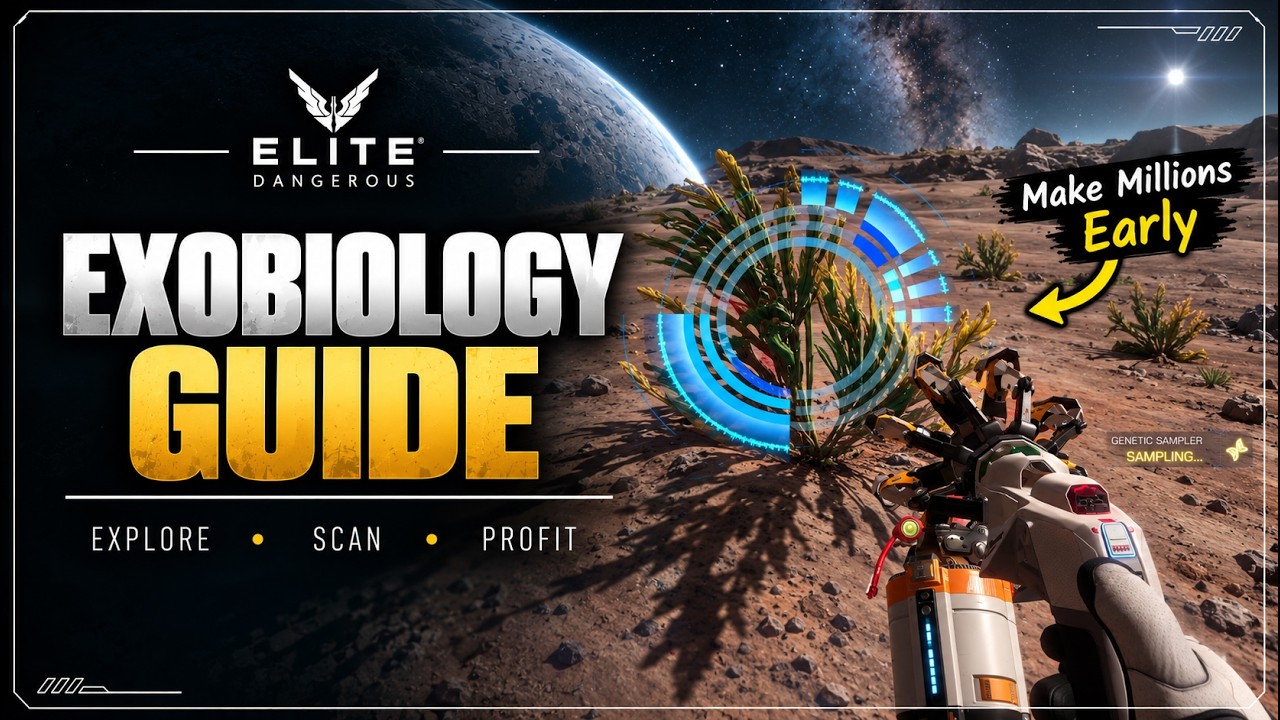
The guide explains how to engage in exobiology in Elite Dangerous by equipping an Artemis suit and surface scanner to explore and scan planets for biological samples, which are collected by locating and analyzing color-coded signals. Players then sell these samples at stations for profitable rewards, with additional bonuses for discovering new biological data, making exobiology both an enjoyable and lucrative activity.
In this comprehensive guide to exobiology in Elite Dangerous, the presenter introduces exobiology as a relaxing and profitable activity in the game. To get started, players need to acquire an Artemis suit, which includes a genetic sampler essential for collecting biological samples. This suit can be purchased from Pioneer Supplies for 150,000 credits. Additionally, installing a detailed surface scanner on any ship is necessary, costing about 250,000 credits. Together, these tools prepare players to begin exploring planets for biological data.
The next step involves selecting suitable planets within star systems. Players should look for planets that have both a full blue circle (indicating an atmosphere) and a semi-blue arc (indicating they can be landed on). Using the system map, players can identify planets with biological features and the number of biological signals present. Planets with more biological signals offer greater opportunities for sample collection and higher payouts, though even planets with fewer signals can be worthwhile.
Once a planet is chosen, players approach it in supercruise mode and enter analysis mode (activated by pressing M). They use the surface scanner to launch probes that map the planet’s surface, aiming for 100% coverage. After scanning, players filter biological signals on the planet’s surface, which appear as colored spots. The goal is to land near these spots to collect biological samples. The color-coded signals guide players to viable sample locations, and the genetic sampler is used to scan and collect samples.
Collecting samples involves scanning biological signals three times per sample. Green signals indicate scannable samples, while blue signals mean the sample has already been collected and cannot be scanned again nearby. Purple signals represent new biological signals that can be collected but will reset the current sample progress if scanned mid-collection. Players must move between sample sites to gather multiple sets of three samples, repeating the process to maximize their haul before returning to a station.
Finally, players sell their collected samples at stations like Vista Genomics. Payouts vary widely, with some excursions earning millions of credits. Players can also earn discovery bonuses if they are the first to log a particular biological sample, increasing rewards significantly. This cycle of scanning, collecting, and selling forms the core gameplay loop of exobiology in Elite Dangerous, offering both enjoyment and lucrative returns for players who engage in it.