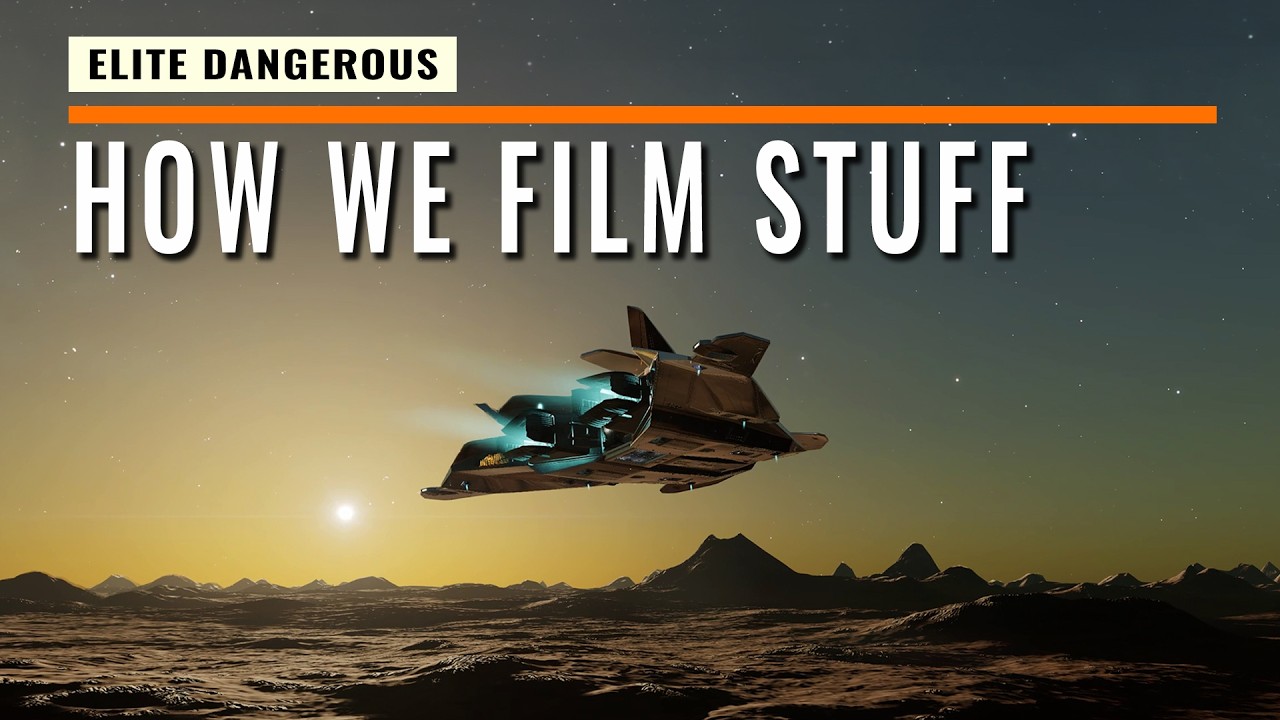
In this video, the team behind Elite Dangerous explains their process for capturing in-game footage, highlighting the collaborative effort between the voice and writer, and the camera operator/editor, Commander Reini. They categorize their footage into three types: solo shots by Reini, specialized sequences with single-seater ships, and complex multi-crew setups. Solo shots often involve exploring the game’s detailed environments, such as mega ships and settlements, with tips on how to keep footage dynamic by panning the camera around ships or characters. A key piece of advice for filming on foot is to adjust the camera zoom level from its default fisheye setting and ensure depth of field and blur are enabled in graphics settings for better visual effects.
The video also discusses the challenges of filming single-seater ships, which often require a second ship to act as a camera platform. Due to their size and the complexity of capturing dynamic footage, single-seaters like the Type 8 don’t feature as prominently in their videos. Additionally, network lag can cause discrepancies in ship positioning during close formations, making precise shots difficult. Examples such as filming mining operations and intro titles illustrate how they use multiple ships and crew members to capture intricate scenes.
Multi-crew filming is their signature technique, allowing one person to pilot the ship while the other controls the camera, enabling dynamic shots where the ship and camera move independently. This method originated from the difficulty of filming combat footage solo. They emphasize the importance of orienting the camera relative to the ship in space to maintain viewer comfort, and they favor certain ships for their kinetic movement, which looks better on film. Despite common assumptions, most of their flying is done with flight assist on, relying on careful control of lateral thrusters and throttle for tight maneuvers.
Technical specifications are also covered, with the primary footage captured on a high-end PC featuring an Nvidia RTX 4070 GPU and AMD Ryzen 9 CPU, displayed on an ultrawide 3440x1440 monitor. They use HOTAS controls but acknowledge that others might prefer controllers or mouse and keyboard setups. Graphic settings are optimized to the highest levels, with particular attention to supersampling and anti-aliasing to reduce jagged edges, although they note there is no one-size-fits-all solution for Elite Dangerous graphics. They avoid post-processing or mods that alter the game’s visuals, aiming to present footage that reflects the game’s true appearance.
Finally, they invite viewers to share their own filming setups and tips, encouraging community interaction. They emphasize their commitment to authenticity in showcasing Elite Dangerous’s visuals, praising recent improvements such as better shadows in the Odyssey expansion. The video concludes with an invitation to subscribe, follow their community posts, and support their work via Patreon, providing links for viewers interested in further engagement.