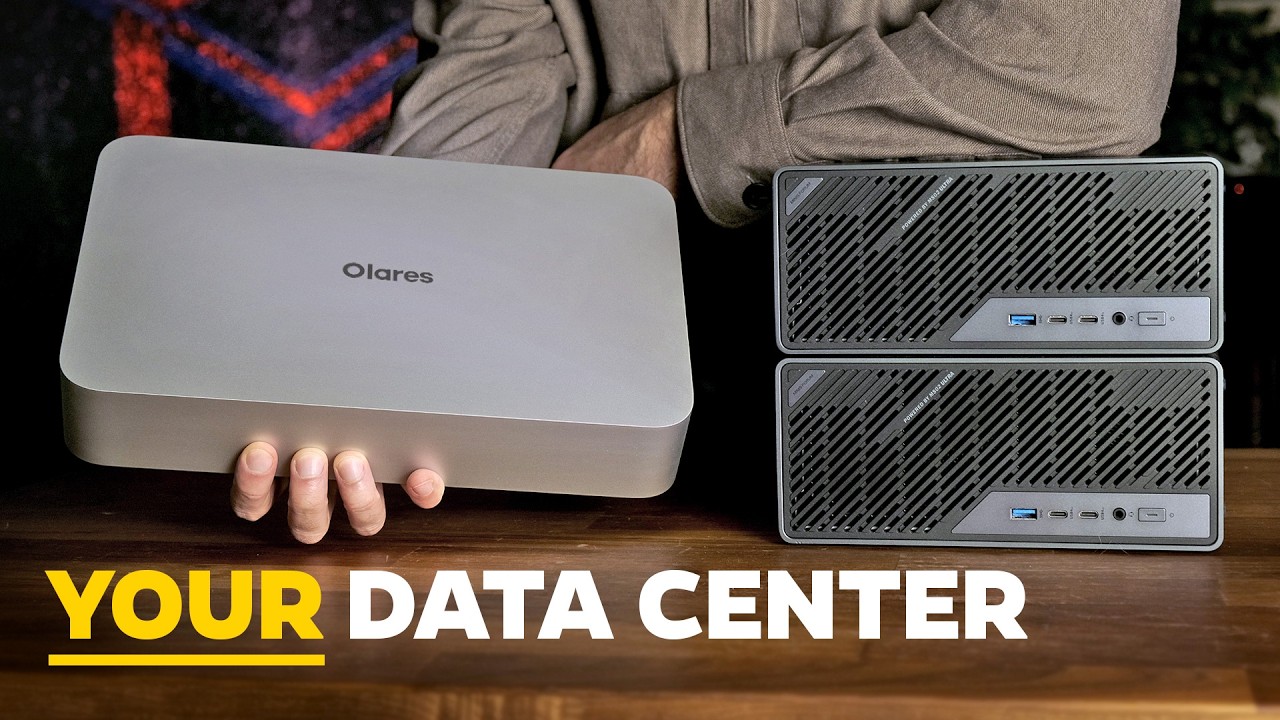
The video showcases the Olaris 1, a personal AI cloud device that empowers users to run AI applications locally, demonstrated through a cluster setup with mini PCs for efficient media localization and subtitle generation without relying on traditional cloud services. Emphasizing privacy, control, and subscription-free operation, the presenter highlights Olaris as a forward-thinking solution for personal AI computing and media management.
The video explores the concept of local AI computing through the Olaris 1, a powerful personal cloud device designed to give users full control over their AI and cloud computing needs. Unlike relying on traditional cloud services, Olaris 1 allows users to own and operate their own AI cloud accessible from anywhere, providing tools for media management, research, and productivity without subscription dependencies. The presenter emphasizes the freedom and accessibility that come with local AI, positioning Olaris as a future-forward solution for personal computing.
To demonstrate its capabilities, the presenter builds a cluster consisting of the Olaris 1 as the master orchestrator and two Minis Forum MS2 Ultra mini PCs as worker nodes. This cluster setup enables efficient distribution of AI tasks, with the Olaris 1 handling orchestration and the mini PCs performing intensive workloads. The presenter installs Ubuntu on the worker nodes and connects them via a high-speed network, following Olaris’s comprehensive cluster setup guide. This setup forms the backbone for running custom AI applications developed using Olaris’s built-in AI agent, LRS.
The presenter’s main use case involves solving a media localization problem. Living in the EU restricts access to many Asian media titles, and existing services often lack English subtitles. Using the LRS agent, the presenter codes two custom applications: a hardware monitoring app to track cluster resource usage and a subtitle generation app that scans a movie library, searches for existing subtitles, and if none are found, generates English subtitles locally using speech-to-text models. This pipeline enables seamless access to localized content without relying on external cloud services.
The subtitle generation app runs on one of the worker nodes, efficiently utilizing the cluster’s resources while leaving the master node free for other tasks. The presenter showcases the app’s functionality by generating English subtitles for a Japanese movie that previously only had French subtitles. Additionally, JellyFin media server is installed on the worker node to stream localized media across devices on the local network and remotely via secure connections. This entire system operates independently of commercial cloud AI services, ensuring privacy and control.
In conclusion, the Olaris 1 cluster represents a versatile and powerful solution for personal AI and media needs, replacing multiple subscription services with local alternatives. The presenter hints at future plans to expand the cluster and develop further applications, including potential revenue-generating tools. A special discount offer on the Olaris 1 is shared exclusively for the audience, highlighting the device’s value proposition. Overall, the video underscores the benefits of owning a local AI cloud and the transformative potential of the Olaris ecosystem.