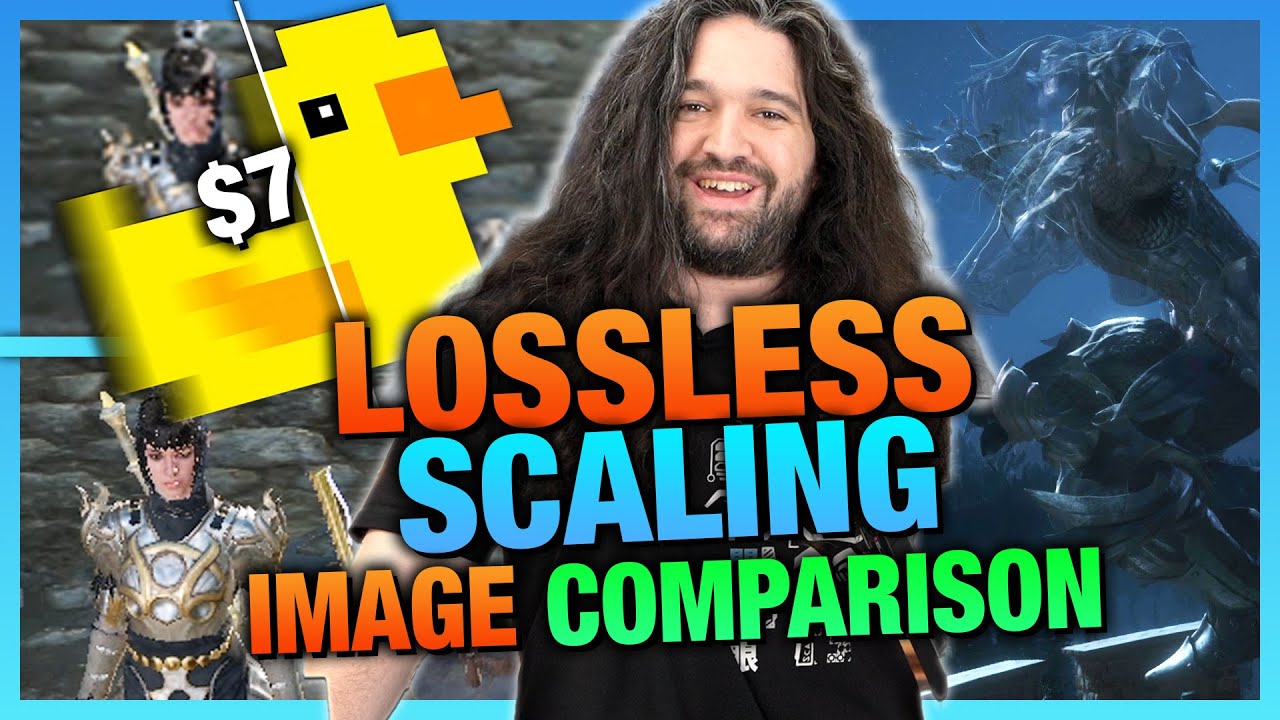
The video provides an in-depth analysis of Lossless Scaling, a $7 third-party tool on Steam that offers frame generation and upscaling capabilities across various GPUs and games without needing native game integration. Unlike first-party solutions from Nvidia, AMD, or Intel, Lossless Scaling is fully agnostic and can be used broadly, including niche applications like emulation and pixel art. While it doesn’t replace vendor-specific technologies like DLSS or FSR, it offers a versatile, affordable option for boosting performance on older hardware or in scenarios where native support is absent.
The frame generation feature, called LSFG, can interpolate frames up to 20 times the original frame rate, though higher multipliers tend to produce significant visual artifacts and distortions. Testing across several games such as Final Fantasy 16, Cyberpunk 2077, Marvel Rivals, and Space Marine 2 showed that while LSFG can smooth motion and maintain UI stability reasonably well, it struggles with fast-moving objects, causing blurring, warping, and doubling effects. The adaptive mode, which targets a specific frame rate, is an innovative feature not yet seen in first-party solutions, allowing smoother gameplay on games with locked or unstable frame rates.
On the upscaling front, Lossless Scaling’s LS1 mode provides a purely spatial upscaling approach without access to game engine data, limiting its effectiveness compared to DLSS or FSR. Image quality comparisons revealed that while LS1 can sharpen textures and improve clarity over native 1080p in some cases, it often causes oversharpening and aliasing, and it falls short of true native 4K fidelity. Nonetheless, it offers a useful enhancement for players without access to proprietary upscaling technologies, particularly in windowed or borderless modes.
The video emphasizes that Lossless Scaling’s strengths lie in its versatility, independence, and broad compatibility rather than outright image quality or performance superiority. It is not a silver bullet for low frame rates or poor visuals but can be a valuable tool for enthusiasts who enjoy tweaking settings or need a solution for unsupported hardware or games. The developer’s inclusion of features like dual GPU mode, adaptive frame generation, and support for multiple upscaling algorithms adds to its appeal as a flexible, if imperfect, utility.
In conclusion, Lossless Scaling is praised for its agnostic approach and wide applicability, even though it cannot match the quality of integrated vendor solutions. The video encourages tempering expectations, noting that while frame generation can enhance smoothness, it cannot magically double frame rates without visual compromises. The tool’s ongoing development and the presence of other emerging competitors signal a growing market for independent upscaling and frame interpolation software, making Lossless Scaling a noteworthy option for certain use cases.