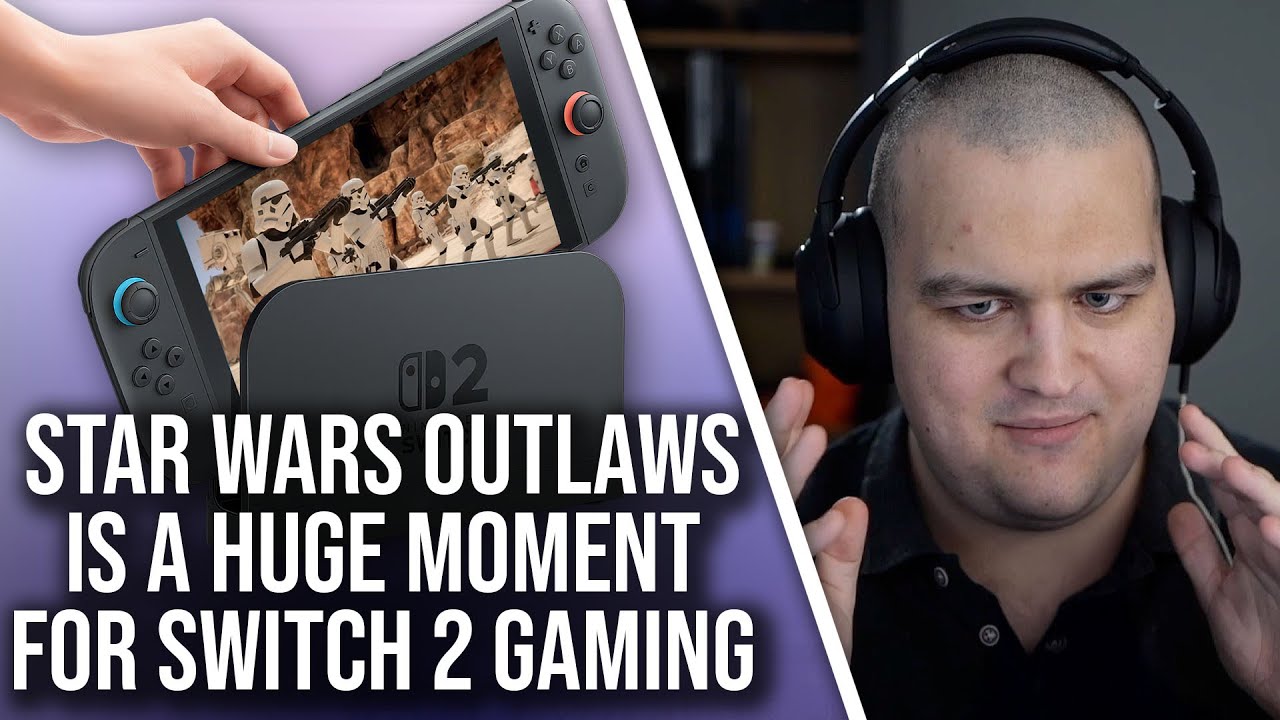
Star Wars Outlaws’ release on the Switch 2 marks a significant milestone for the platform, as it is the first known game on the system to utilize hardware-accelerated ray tracing via Ubisoft Massive’s Snowdrop engine, alongside DLSS2 upscaling. Initial pre-release media and demos showed underwhelming performance and visuals, leading to skepticism about the game’s quality on Switch 2. However, the final product has proven to be surprisingly impressive, delivering a strong performance that challenges expectations for the console’s capabilities in handling current-generation games with advanced graphical features.
Oliver, who reviewed the game, expressed genuine surprise at how well Star Wars Outlaws runs on Switch 2, especially compared to early impressions. Despite some compromises, such as reduced geometry detail and a noisier ray-traced global illumination (RTGI) effect, the game maintains core ray tracing features like reflections and shadows on distant objects. The Switch 2 version even competes with, and in some aspects outperforms, the Xbox Series S, benefiting from DLSS for image quality and showing stable frame times without stuttering. These achievements highlight the substantial effort by Ubisoft Massive and RedLynx Berlin in optimizing the game for the console.
John added that the game feels like a low-compromise port, lacking the typical issues seen in earlier “impossible ports” on the original Switch, such as frame pacing problems. Features like adjustable motion blur, lens distortion effects, and HDR support enhance the experience, although some minor issues like inability to adjust HDR sliders were noted. The game employs smart reductions in asset complexity, particularly geometry and foliage density, to maintain performance without sacrificing the overall visual fidelity or gameplay experience. This approach demonstrates thoughtful adaptation to the hardware limitations of Switch 2.
From a broader perspective, the successful port of Star Wars Outlaws challenges concerns about Switch 2’s ability to handle current-generation games, especially those heavily reliant on ray tracing. Unlike games designed with extensive scalability like Cyberpunk 2077, Outlaws was built primarily for current-gen hardware, making its smooth performance on Switch 2 a strong indicator of the console’s architectural strengths, particularly its ray tracing efficiency compared to RDNA2-based consoles. However, CPU limitations remain a bottleneck, suggesting that while ray tracing is feasible, dynamic and complex scenes might still pose challenges.
Looking ahead, the game’s success opens possibilities for other Snowdrop engine titles and ray-traced games to appear on Switch 2, though challenges remain for more asset-dense and vertically complex worlds like Avatar: Frontiers of Pandora. The port’s compromises in geometry and asset density suggest that games with massive draw distances and dense foliage might require significant adaptation to run well. Nonetheless, Star Wars Outlaws sets a promising precedent, demonstrating that with dedicated effort, Switch 2 can deliver impressive current-gen gaming experiences with advanced graphical features like hardware-accelerated ray tracing and DLSS.