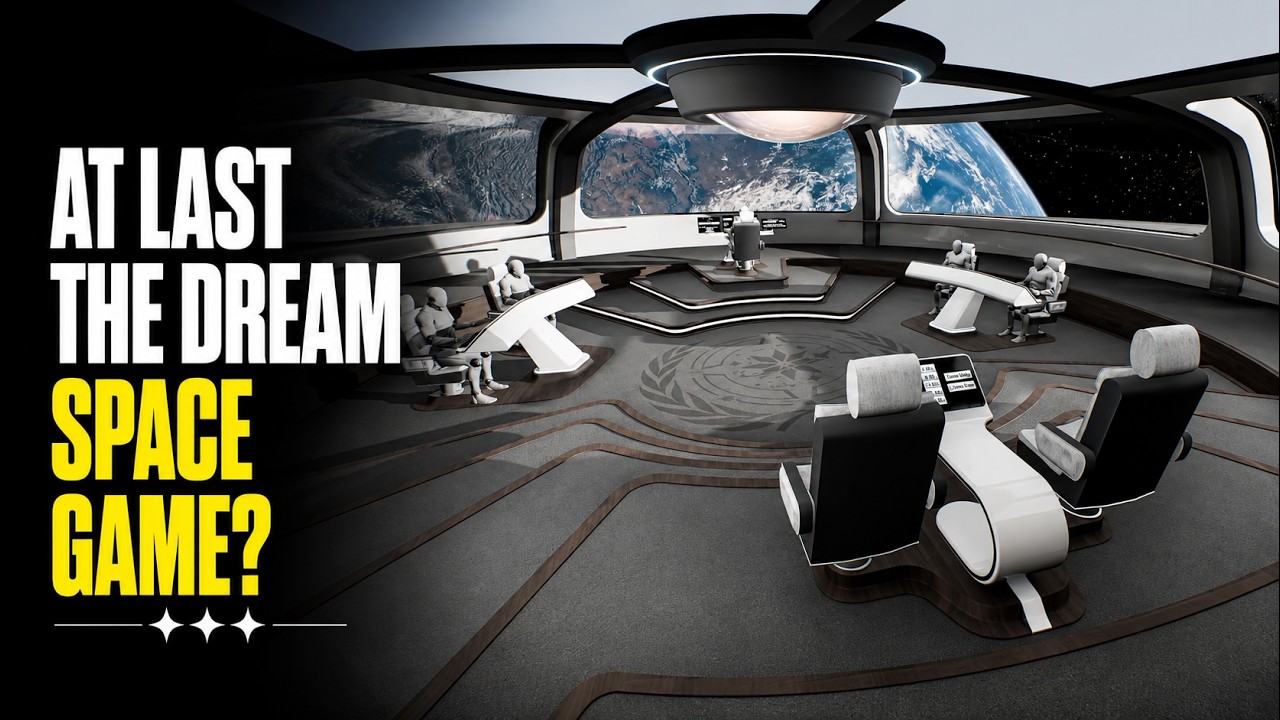
The video discusses the long-held dream of commanding a starship exploring a vast galaxy, highlighting how current space exploration games like Elite Dangerous and No Man’s Sky fall short of fully realizing this vision. While these games offer expansive galaxies to explore, they lack the immersive experience of being on the bridge of a ship where crew members actively contribute to discoveries. The key difference lies in how the ship itself participates in exploration, with crew roles such as captain, engineer, science officer, and others playing real, interactive parts in uncovering new phenomena.
Starship Simulator aims to fulfill this dream by introducing a multi-crew starship experience where each role has specific responsibilities. The game’s latest update, called Genesis, represents a significant overhaul, merging previously separate galaxy and star system generation systems into a single, cohesive C++ system. This update brings a high level of realism, with over 21 million stars, many based on real celestial data, and planets and moons with detailed formation histories, making every discovery meaningful and grounded in a believable cosmic narrative.
A standout feature of Starship Simulator is how exploration unfolds through the ship’s crew and systems rather than player-driven manual searching. For example, a science officer might detect a rare ocean moon with potential life, prompting the captain to make strategic decisions. This approach contrasts with other games where players must individually scan and investigate objects. The game emphasizes that discoveries are the result of complex astrophysical processes, giving each celestial body a unique backstory and reason for existence, enhancing immersion and the significance of exploration.
The simulator also models the ship itself as a fully interactive entity, with a vessel computer managing all ship systems and controls. Players interact with the ship through consoles that communicate directly with the ship’s ID, simulating a realistic starship environment. This design philosophy extends to the flight model, which uses Newtonian physics and features like quadcopter-style thrusters for atmospheric landings. Future updates plan to introduce flight assist modes to cater to different player preferences, balancing realism with accessibility.
Currently, Starship Simulator is making steady progress, with an older demo available on Steam and ongoing development builds accessible to Kickstarter backers. The video creator expresses excitement for the game’s future, encouraging viewers to explore developer updates and share their thoughts. Overall, Starship Simulator promises a fresh, immersive take on space exploration by combining detailed astrophysics, a fully simulated ship, and a crew-driven discovery experience that could finally deliver the dream of commanding a starship in a living galaxy.