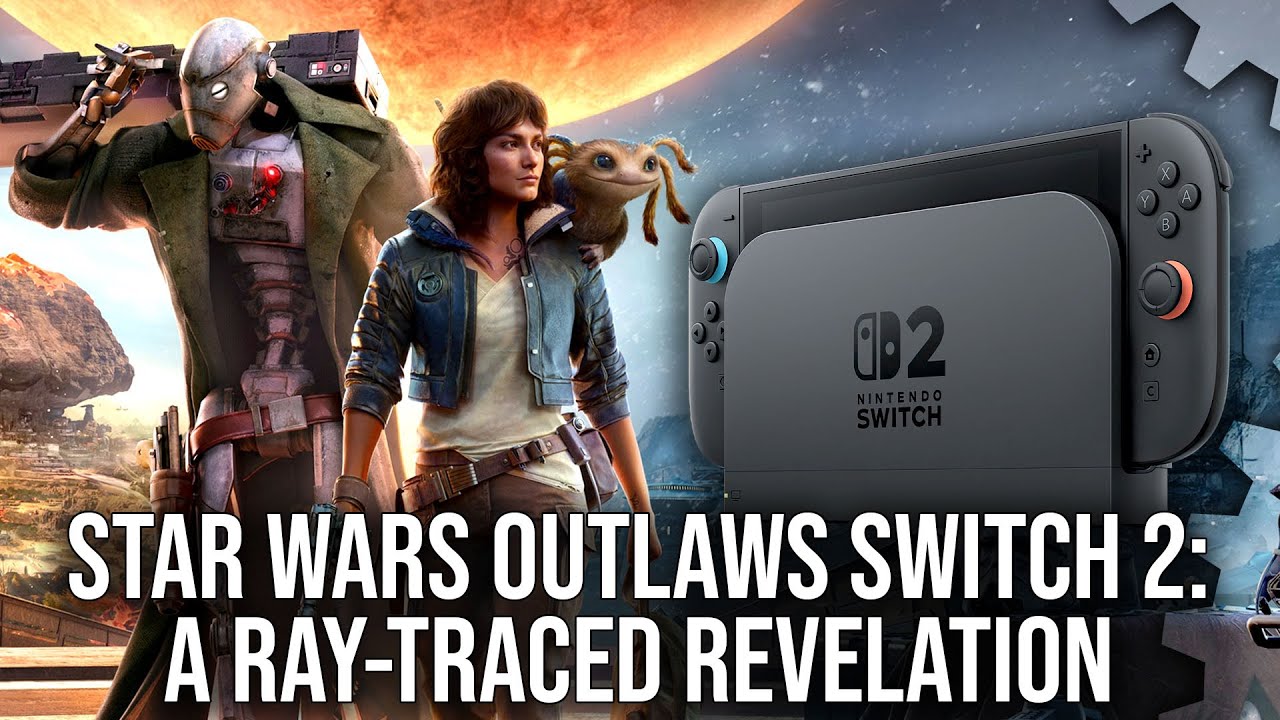
Star Wars Outlaws, originally a visually impressive title on current-gen consoles and PC, has made a remarkable transition to the Nintendo Switch 2 despite the handheld’s comparatively weaker hardware. The game retains its signature ray tracing effects, including ray traced diffuse global illumination (GI), which adds soft, believable lighting and realistic object interaction. While the Switch 2 version exhibits some subtle noise and coarser lighting compared to the Xbox Series S, it surprisingly matches or even outperforms it in certain ray-traced reflections and lighting details, showcasing the hybrid’s architectural advantages in ray tracing and machine learning acceleration.
In terms of visual fidelity, the Switch 2 version features some asset and environmental cutbacks, such as reduced foliage density, fewer NPCs, and less detailed models, particularly in open-world city areas. However, mission areas and enclosed spaces maintain high detail, and overall image quality remains solid with smooth edges and sharp visuals, especially when docked. The game runs at around 720p internally with an output resolution of 1440p using DLSS, offering a crisp image that compares favorably to the Series S, which uses FSR and operates between 720p and 1080p internally.
Performance on the Switch 2 is notably stable, maintaining a consistent 30 FPS in most gameplay scenarios, including missions, combat, and free roam, with some menus running at 60 FPS. While there are occasional frame rate dips and minor technical issues like crashes, lens distortion bugs, and save-related pop-in problems, these are relatively isolated and do not significantly detract from the overall experience. In comparison, the Xbox Series S suffers from more severe frame pacing issues and sharper frame drops, making the Switch 2 port arguably more stable in practice.
Handheld mode on the Switch 2 sees a resolution drop to around 540p internally with a 1080p output on the device’s LCD, along with reduced draw distances and some noticeable pop-in of environmental assets. Despite these compromises, the core visual features such as ray tracing, volumetric clouds, and reflections remain intact, making the portable experience very close to the docked mode. The Switch 2 also supports advanced display technologies like 120 Hz output with VRR and LFC, helping to smooth out frame delivery and maintain a solid performance even on the go.
Overall, Star Wars Outlaws on Switch 2 represents a significant leap forward for Nintendo ports, breaking the trend of heavily downgraded versions seen in past titles. Thanks to efficient hardware architecture and extensive developer effort, the game delivers a feature-rich, visually impressive open-world experience with ray tracing on a compact, power-efficient device. Despite some minor technical quirks, this port stands as a powerful proof of concept for future AAA titles on the Switch 2, demonstrating that high-end graphical fidelity and stable performance can coexist on a handheld platform.