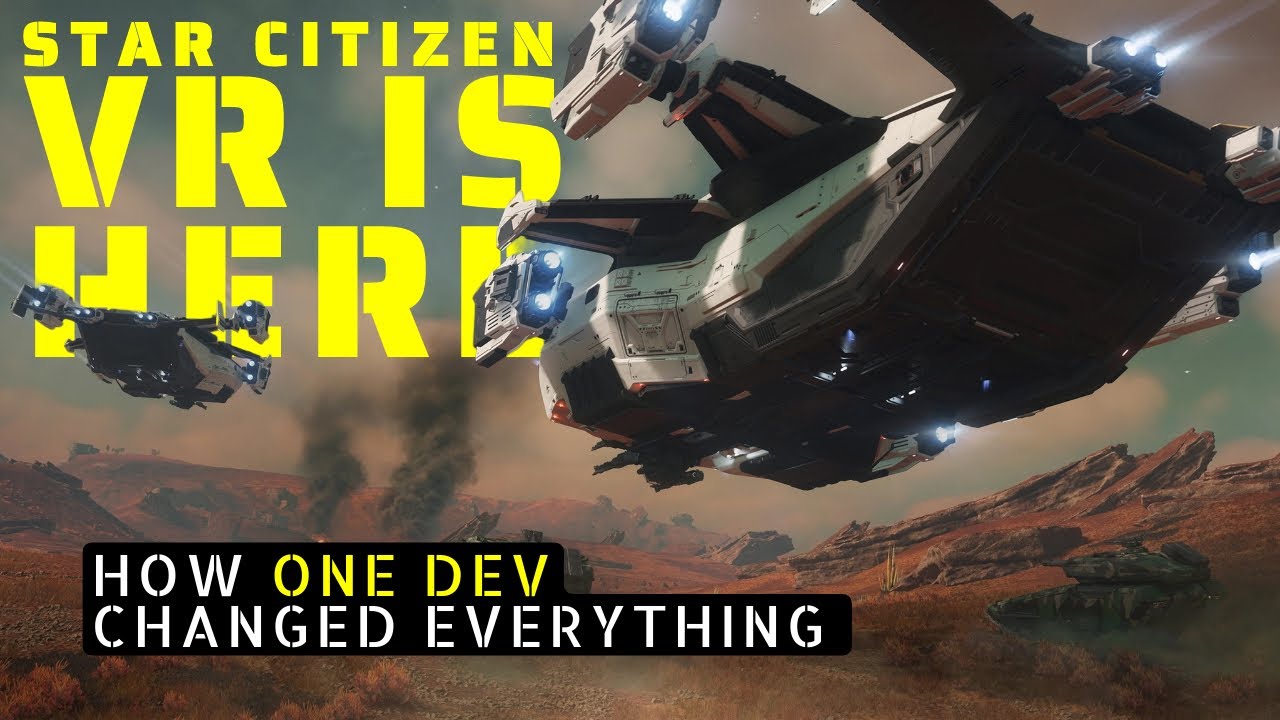
Star Citizen’s long-awaited native VR support has been successfully implemented through the dedication of engineer Silven, who spent over a year working on it in his own time, enabled by the game’s transition to the Vulkan graphics API. Although still experimental, this VR feature offers immersive stereoscopic experiences with head tracking, transforming gameplay inside ships and marking a significant milestone in the game’s development.
Star Citizen’s long-promised native VR support has finally been realized, thanks to the dedication of a senior engineer named Silven, who worked on it during his own weekends for over a year. Despite the studio initially considering VR support unfeasible, Silven’s passion project resulted in a full stereoscopic VR implementation that runs through Open XR and the Vulkan graphics API. This breakthrough allows players to experience true depth perception inside their ships, moving beyond traditional flat screen or track IR setups to being physically present in the cockpit with immersive head tracking. The achievement is both inspiring and a reflection of the challenges in ambitious game development.
VR in Star Citizen was previously thought impossible due to the game’s high performance demands, especially since VR requires rendering two images simultaneously at 90 frames per second to avoid motion sickness. The key technical advancement enabling this was the switch from DirectX 11 to Vulkan, a modern, multi-threaded graphics API that can efficiently handle the parallel rendering pipelines VR demands. This transition took five years of behind-the-scenes work, invisible to most players, but it laid the infrastructure needed for VR to function smoothly in the game’s complex and large-scale environments.
Silven joined Cloud Imperium Games in 2018 specifically to make VR happen, but it wasn’t until September 2024 that he began working on it in his own time, dedicating over 500 unpaid hours to build the VR rendering pipeline, head tracking, and interface adjustments. Remarkably, this effort didn’t divert company resources or delay other features; it was accomplished entirely as a passion project. This pattern of developers driving key features through personal dedication is a recurring theme in Star Citizen’s development, raising questions about how much innovation depends on official priorities versus individual initiative.
The VR implementation is still experimental, with some issues like UI scaling inconsistencies and motion sickness risks during on-foot gameplay, but it already offers a transformative experience. Players can switch between full stereoscopic VR and a “theater mode” that uses a virtual screen inside the headset to reduce motion sickness during certain activities. The immersive sense of scale and presence when flying or sitting in ships like the 400i is profound, changing players’ perception of the game world and offering tactical advantages in combat through enhanced situational awareness.
To try VR in Star Citizen, players need the 4.5 alpha PTU build, Vulkan enabled, and the appropriate Open XR runtime for their headset. They should start slowly, using theater mode and simple activities to build tolerance and avoid nausea. The community is encouraged to share their experiences, especially regarding which ships provide the best VR experience. Ultimately, this milestone showcases how one developer’s passion and years of foundational work have finally delivered a long-awaited feature that could redefine how players experience Star Citizen’s vast universe.