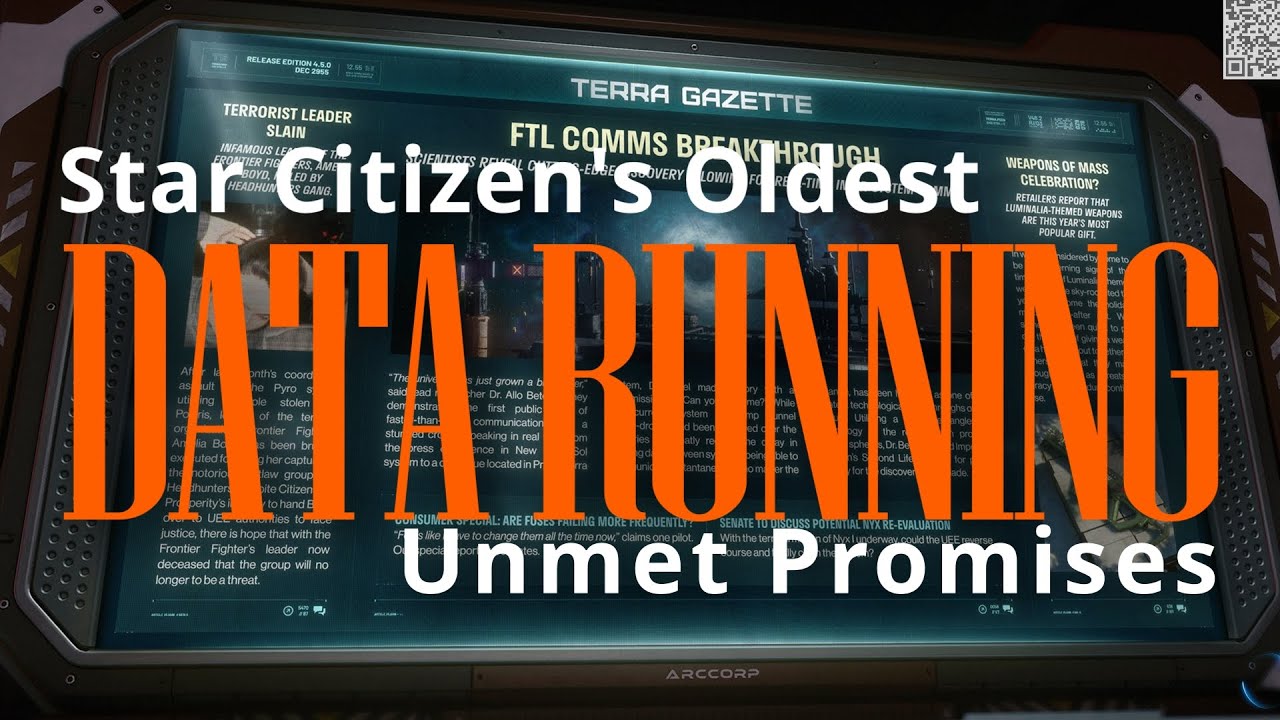
In this video, Daniel Raymond of Ray’s Guide discusses the long-standing promise of data running in Star Citizen, focusing on the two ships sold specifically for this purpose: the Herald and the Mercury Starrunner. Both ships were introduced years ago, yet the gameplay and mechanics for data running have not materialized as initially expected. Interestingly, the 4.5 patch splash screen hints at new developments related to data running, particularly the discovery of faster-than-light communications, which challenges the traditional concept of data running involving physical transport of data through wormholes.
Raymond explains that the original idea behind data running was based on the premise that while ships could travel through wormholes instantly, data itself had to move at light speed, causing delays in interstellar communication. This delay created a gameplay niche for data running careers, where players would physically transport data to bypass communication lag. However, the recent announcement suggests that data drones and faster-than-light communications may render this concept obsolete, as routine data transmission would no longer require physical transport, thus potentially eliminating the need for traditional white hat data running missions.
The video also delves into the broader issue of communication speed in the Star Citizen universe, comparing it to other sci-fi franchises like Star Trek and Star Wars, which use subspace relays or holonets to enable near-instant communication across vast distances. Raymond highlights the complexity of realistically implementing communication delays in the game, noting that while such realism would enhance immersion, it is technically challenging and could complicate mission acceptance and propagation across systems.
Given these developments, Raymond suggests that the future of data running gameplay in Star Citizen will likely focus more on black hat and gray hat operations, such as intercepting or hacking communications rather than simple data courier missions. He proposes a new hacking mini-game concept called “Guess the Password,” which would be simple, cooperative, and engaging for players working together to break encryption. This approach could make hacking gameplay more interactive and less tedious compared to traditional hacking mini-games found in other titles.
Finally, Raymond updates viewers on upcoming giveaways and encourages participation by sharing a secret word related to his proposed hacking mini-game. He concludes by emphasizing that while the traditional data running career may be limited due to technological advancements in the game’s lore, there remain exciting opportunities for espionage, hacking, and secure data transport missions. Overall, the video provides insight into how Star Citizen’s evolving communication technology affects gameplay promises and offers creative ideas for future mission design.