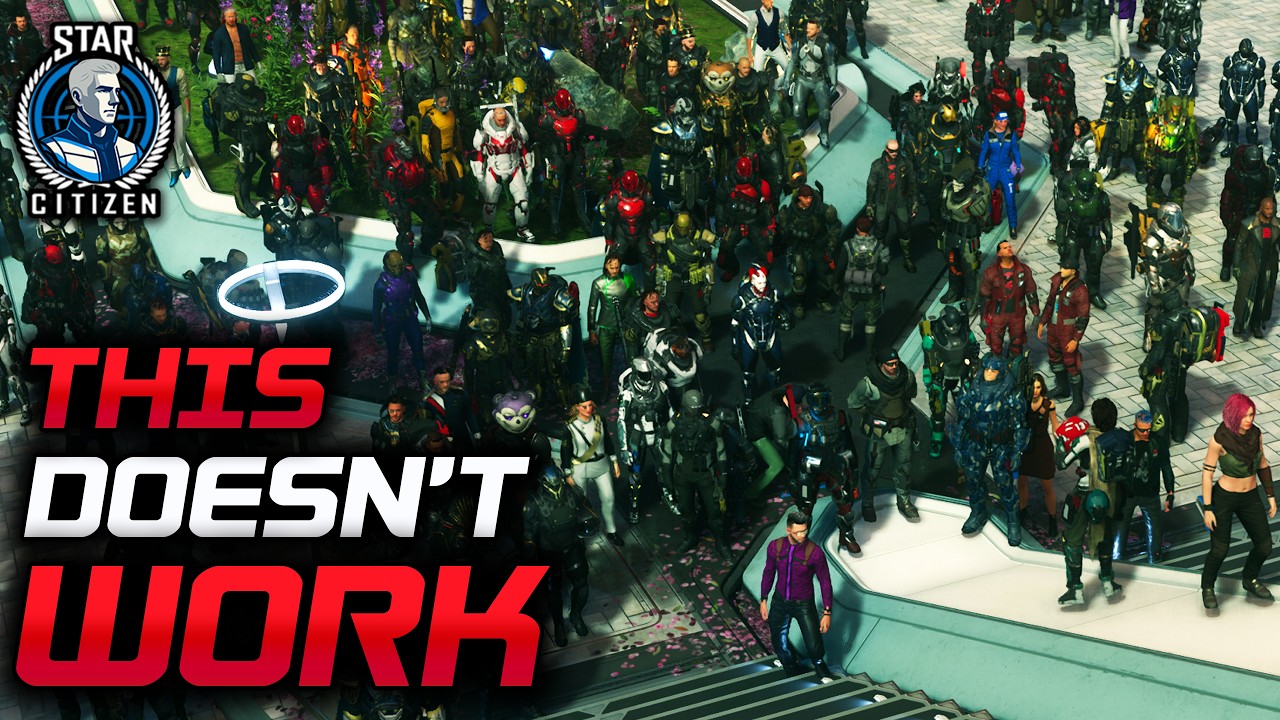
The upcoming Star Citizen patch 4.10 is reigniting heated debates about instancing, particularly with the return of the Siege of Orison as an instanced mission for up to four players. While many fans view this as a betrayal of the game’s original “single shard” dream—where all players exist simultaneously in one seamless universe—the video argues that this dream was never truly achievable. The core issue is not the server technology, which has improved dramatically, but the game design itself. The math and infrastructure behind handling thousands of players converging on the same locations simply don’t work without breaking gameplay and immersion.
Server meshing technology has indeed increased player counts per shard from around 50 to 700 and could potentially support thousands more. However, the real bottleneck lies in the design of the game’s locations and systems, which were originally crafted for small player populations. When large groups gather in one place, such as orbital stations or landing zones, congestion and long wait times occur, leading to a poor player experience. Expanding these areas to accommodate tens of thousands of players would require rebuilding almost every location from the ground up, including transit systems, shops, and mission givers, which is an enormous and complex undertaking.
The video highlights a fundamental tension in Star Citizen’s vision: it aims to be both a vast, solitary space exploration experience and a bustling, living multiplayer universe. Unlike games like No Man’s Sky or Elite Dangerous, which excel at providing solitude, Star Citizen also wants to offer a dynamic civilization of thousands of players. Achieving both simultaneously is an “impossible balancing act.” Instancing, while controversial, helps manage this by allowing players to experience meaningful gameplay without overcrowding, preserving both the solitude and community aspects of the game.
Philosophically, the video embraces the concept of instancing through the lens of the many-worlds interpretation of quantum mechanics, suggesting that each instanced mission represents a parallel universe where different versions of events coexist. This perspective reframes instancing not as a loss but as a unique sci-fi feature that fits well within Star Citizen’s narrative ambitions. Additionally, instancing is not new to the game—hangars have been instanced for years without causing major backlash, showing that such design choices can enhance playability and scalability without betraying the game’s spirit.
Ultimately, the video argues that Star Citizen’s evolution is a natural part of game development, where initial visionary concepts are gradually adapted to practical realities. The original vision of permanent death and a fully persistent universe has softened over time to ensure player retention and enjoyment. CIG’s move toward instanced locations and seamless transitions is a pragmatic choice to prioritize gameplay quality over an unattainable ideal. The “single shard” dream was always more aspirational than feasible, and now the developers are focusing on making the game work well for players, even if that means letting go of some early promises.