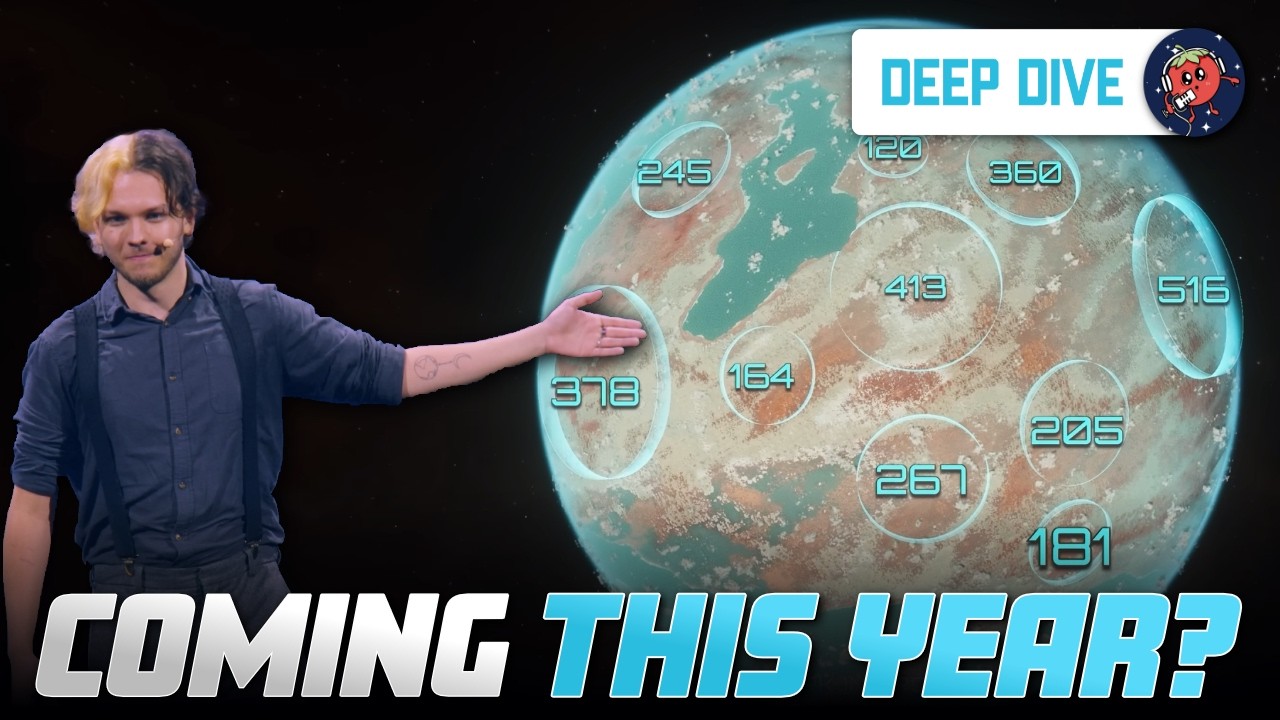
The video discusses the development of “Staritect,” a new technology tool in Star Citizen designed to address the challenge of populating the game’s vast planetary environments with meaningful, scalable, and contextually appropriate locations. Currently, the game features handcrafted locations like Ghost Hollow and distribution centers, but these are limited in number and do not scale well with the upcoming server meshing technology, which will increase player counts and require many more points of interest. Staritect aims to modularize existing assets into a library of buildings and layouts that can be procedurally scattered across planets, ensuring unique, non-repetitive, and lore-consistent settlements that feel alive and purposeful.
The tool’s design philosophy revolves around creating locations with distinct personalities and functions, such as mining outposts, farming communities, or high-tech emergency shelters. Each location will be built using predefined archetypes and styles—frontier, utilitarian, high-tech, and others—that align with the lore and environment of each planet or system. This approach is meant to enhance player immersion by providing diverse, believable environments where missions and activities naturally fit. For example, mining missions would logically take place at mining outposts, while salvage operations might occur near derelict ships in hard-to-reach areas, encouraging exploration and varied gameplay.
Staritect also incorporates rules governing placement and clustering of locations to simulate realistic settlement patterns. Locations will not be randomly scattered but grouped in clusters and sectors, mimicking how communities form around resources, trade routes, or strategic points. This clustering adds depth to the game’s world-building, creating neighborhoods or regions with interconnected stories and activities. The system will consider environmental factors like proximity to water for refineries or suitable terrain for farms, ensuring that each settlement makes ecological and narrative sense.
The integration of AI and narrative elements is another critical aspect highlighted in the video. Staritect is not just about physical structures but also about populating these locations with life—NPCs, factions, and missions that reflect the local culture and conflicts. This will help transform empty planets into vibrant worlds where players can spend extended time engaging with content without needing to constantly travel between planets. The goal is to create a more grounded experience where players can “live” on a single planet, fully exploiting its resources, factions, and storylines.
Finally, while the technology and vision behind Staritect are impressive, the video expresses cautious optimism about its implementation timeline and effectiveness. The system is still in development, with initial work done last year and expectations that it might debut alongside the Genesis update. However, the community and observers remain hopeful but reserved, emphasizing that seeing the tool in action and how well it integrates into the game world will be crucial. If successful, Staritect could revolutionize how Star Citizen handles planetary content, making vast, explorable planets feel alive, diverse, and engaging for players.