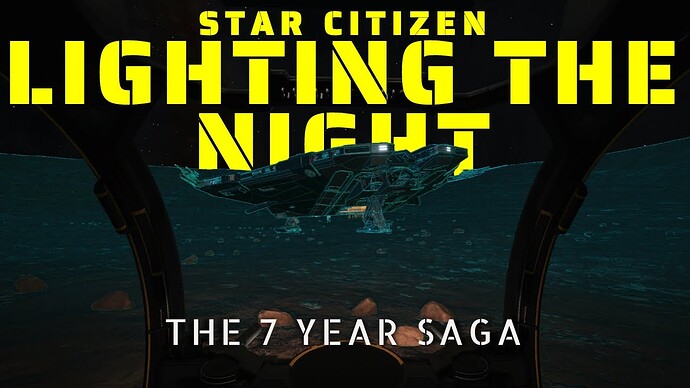
Night vision in Star Citizen took an extraordinary seven years to develop, bouncing between five different development teams before finally being introduced in alpha 3.24. Despite night vision being a standard feature in games since 2007, Cloud Imperium Games (CIG) aimed for a highly sophisticated implementation rather than a simple green filter. The feature was delayed largely because CIG wanted to implement spectral rendering that simulates how different materials reflect infrared light based on their molecular composition, which required extensive engine-level work and design approval that took years to secure.
The development saga reveals a pattern of teams passing responsibility back and forth, with gameplay, UI, vehicle, graphics, and engine teams each deflecting questions about night vision. Early mentions in 2018 suggested weapon attachments with night vision scopes were being considered, but it wasn’t until 2024 that those scopes shipped. Meanwhile, the graphics and engine teams explained the technical challenges of mapping RGB colors to infrared spectrums, and how the new Gen 12 renderer and Vulkan API were critical to making the feature feasible without crippling performance.
By late 2023, the feature was finally playable on certain ships like the Vulture, which had the new cockpit glass shader system supporting night vision, while older ships like the Cutless Black did not. The system, called LAMP (Light Amplification), amplifies all light entering the cockpit glass, providing a realistic but sometimes uncomfortable visual experience in bright environments. This approach rewards tactical awareness, as players must learn when to toggle night vision on or off and which ships support it, adding a new layer of gameplay depth, especially for night operations on planets’ dark sides.
The seven-year delay was not due to incompetence but rather CIG’s commitment to technical fidelity and building the necessary engine foundation first. This meant that features took longer to arrive because they were designed to be complex and realistic rather than simple and quick. The video highlights the frustration and exhaustion visible on developers’ faces over the years as they repeatedly fielded questions about night vision, underscoring how even seemingly basic features can become multi-year projects in Star Citizen’s ambitious development pipeline.
Ultimately, night vision’s journey from concept to implementation exemplifies the broader challenges in Star Citizen’s development: balancing technical innovation, design approval, and performance optimization. Players now have a new tactical tool that changes how they approach nighttime missions, but only on newer ships with updated cockpits. The feature’s release is a testament to CIG’s dedication to pushing the boundaries of realism in space simulation games, even if it requires extraordinary patience from the community.