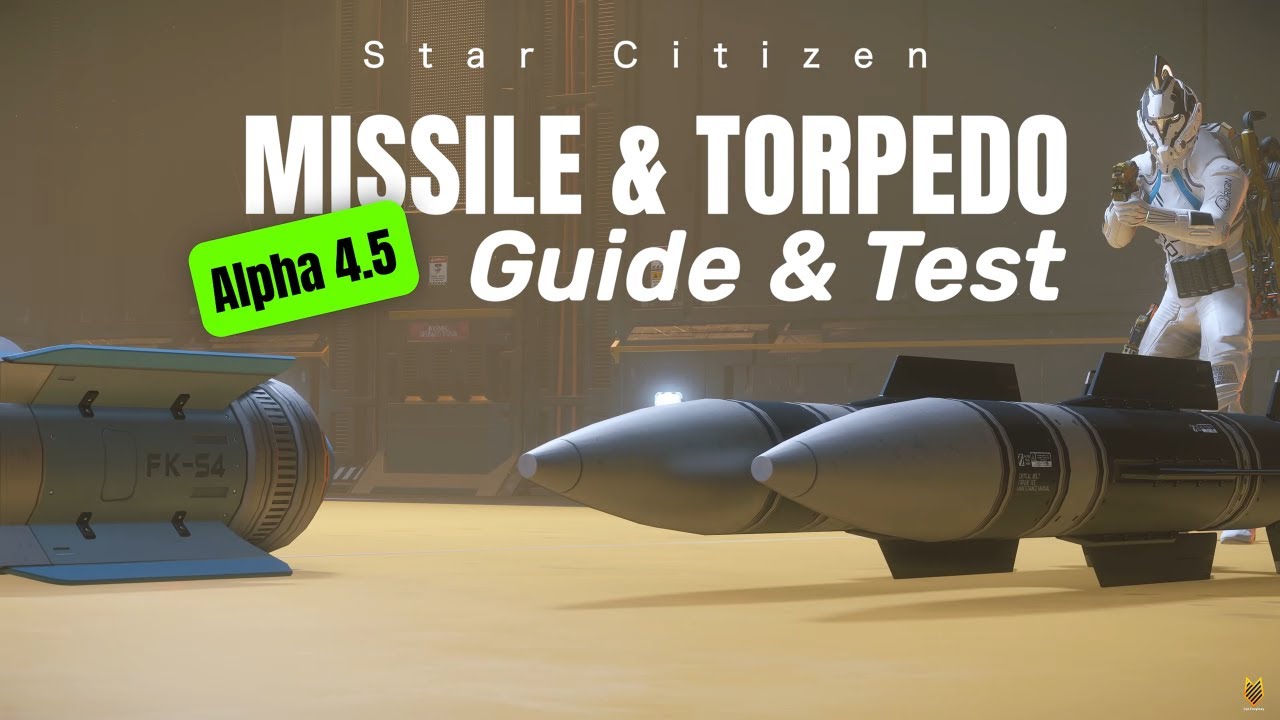
The video provides a comprehensive guide on missiles and torpedoes in Star Citizen Alpha 4.5, detailing their specifications, types, and effectiveness in combat. Missiles and torpedoes range from size one to size twelve, though some sizes like six, eight, and eleven are currently unavailable. Smaller missiles (sizes one to four) are generally faster with lower damage, while larger torpedoes (size five and above) deal significantly more damage but travel slower. Each size category has variations in speed, damage, explosion radius, locking range, and health, with specific exceptions like the scimitar missile on the Ballista and unique torpedoes for ships such as the Polaris and Idris.
A critical gameplay mechanic introduced is the safety distance for torpedoes, which prevents torpedoes from detonating if the firing ship is too close to the target at the moment of impact. For smaller missiles (sizes one to seven), this safety distance is only five meters, but for larger torpedoes (sizes nine, ten, and twelve), it extends to 1,500 meters. This mechanic stops players from firing powerful torpedoes at close range, as demonstrated in a test where a size nine torpedo bounced off a target when the firing ship was within the safety distance, only detonating once the firing ship moved beyond 1.5 kilometers.
The video explains three main missile tracking types based on their tracking signals: IR (infrared), cross-section, and EM (electromagnetic). IR missiles track heat signatures from engines and weapons, cross-section missiles track the ship’s radar cross-section depending on the ship’s orientation, and EM missiles track electromagnetic emissions from ship components. The effectiveness of these missiles varies based on the target’s signature levels, with IR missiles generally having lower lock ranges due to reduced heat signatures in the current patch, while EM missiles provide longer-range locks unless the target uses stealth components.
Countermeasures such as flares (decoys) and chaff (noise) play a vital role in missile defense. Flares are effective against IR missiles, easily flaring them off, but less so against EM and cross-section missiles, which require many more flares to counter. Chaff is useful primarily before missiles are fired by disrupting lock-ons but appears ineffective once missiles have already locked onto a target. The video’s tests show that EM missiles are the hardest to flare off, followed by cross-section missiles, while IR missiles are the easiest to counter with flares.
In conclusion, the video highlights that missile choice and countermeasure strategy depend heavily on the target’s signature profile and the missile type. IR missiles, while easier to counter and less effective at long range, still have situational uses. EM missiles are the most reliable for locking and hitting targets that are not using stealth components, whereas cross-section missiles perform better against stealthy targets. Understanding these dynamics is crucial for effective missile combat in Star Citizen Alpha 4.5.