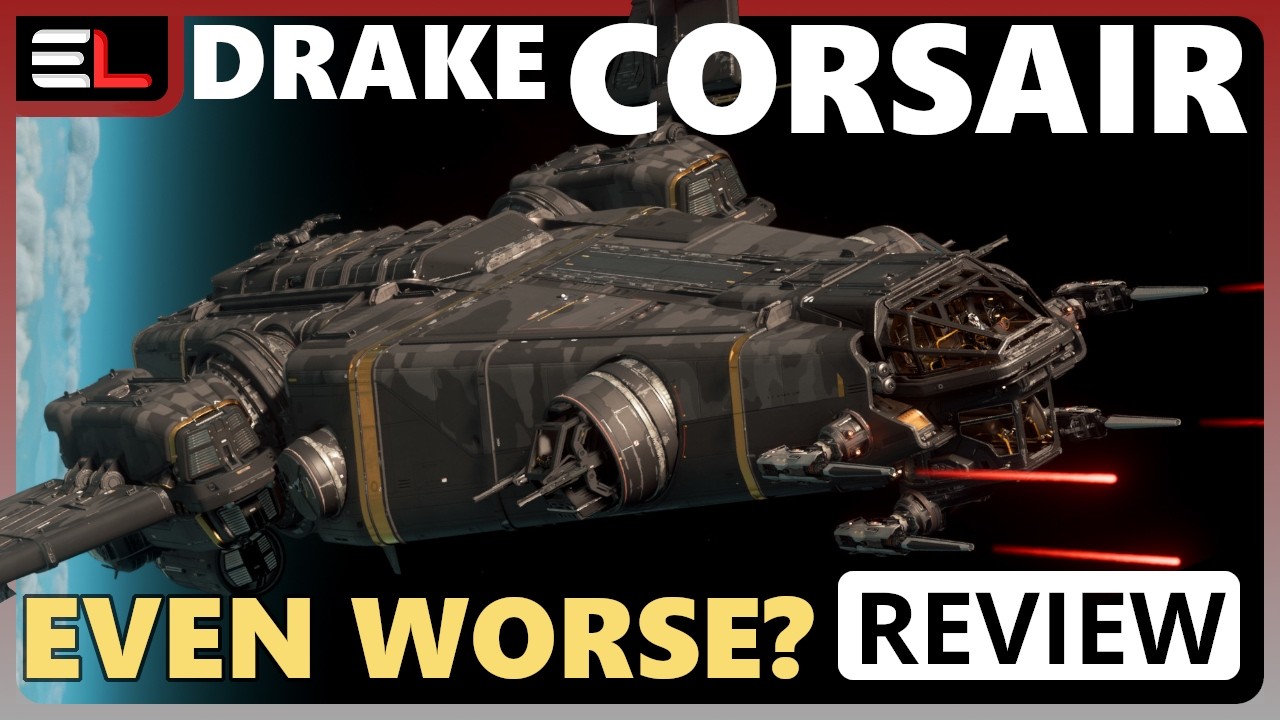
In this review of the Drake Corsair in Star Citizen 4.6, Evan Lace provides an in-depth analysis of the ship’s current state following recent engineering updates. Priced at $250 on the pledge store or over 6 million UEC in-game, the Corsair is positioned as an exploration and light combat vessel. While it boasts impressive forward-facing firepower with multiple size 4 and 5 laser cannons and a remote turret operated by a co-pilot, the pilot loses some weapon functionality if the co-pilot seat is occupied, which is a notable design flaw. The ship also carries eight size 3 missiles, though the reviewer recommends replacing the default missiles with more effective options like electromagnetic thunderbolts.
Defensively, the Corsair comes with a 62,500 shield capacity and 9,000 HP of armor, which the reviewer criticizes as insufficient for its size and role. The shield has decent resistance values but relies on a single shield generator, making it vulnerable if that component is destroyed. Additionally, the armor is relatively weak, especially compared to other ships like the industrial-focused Fortune, which ironically has more armor. This leaves the Corsair susceptible to component damage and reduces its survivability in combat, especially against agile fighters that can flank and attack its weaker side and rear.
The ship’s mobility has also taken a hit since the last review, with its top speed dropping from 200 to 190 SCM and its maneuverability worsening. The Corsair feels floaty and sluggish, making it difficult to handle in dogfights, particularly against smaller, faster fighters. Despite its heavy forward firepower, the ship struggles when enemies get close or attack from the sides or behind. Its fuel capacity is a bright spot, with a large hydrogen and quantum fuel tank that supports longer exploration missions, but the lack of a medbay or repair facilities limits its effectiveness for deep-space expeditions.
Internally, the Corsair features a practical layout with multiple crew rooms, a kitchen, engineering bay, and cargo hold accessible via a rear ramp that fits most vehicles except the largest ones. The ship’s lighting and interior design receive mixed reviews, with lighting being somewhat poor but the overall arrangement functional. The engineering section is notable for its physicalized components, including visible shield generators and fuel tanks. However, the power management system is problematic, as the ship’s stock power plant struggles to supply all weapons simultaneously, forcing players to consider weapon loadout changes to optimize power usage.
In combat testing, the reviewer finds the Corsair more suited to PvE scenarios rather than PvP, where it can handle larger ships but is vulnerable to smaller, more maneuverable fighters. Solo play is possible but risky against skilled players due to the ship’s defensive and handling weaknesses. Overall, the Corsair scores a 71 out of 100, a decline from previous reviews primarily due to reduced speed, maneuverability, and underwhelming armor. Despite its flaws, the ship remains a viable option for players interested in a multi-role exploration and combat vessel, provided they understand and work within its limitations.