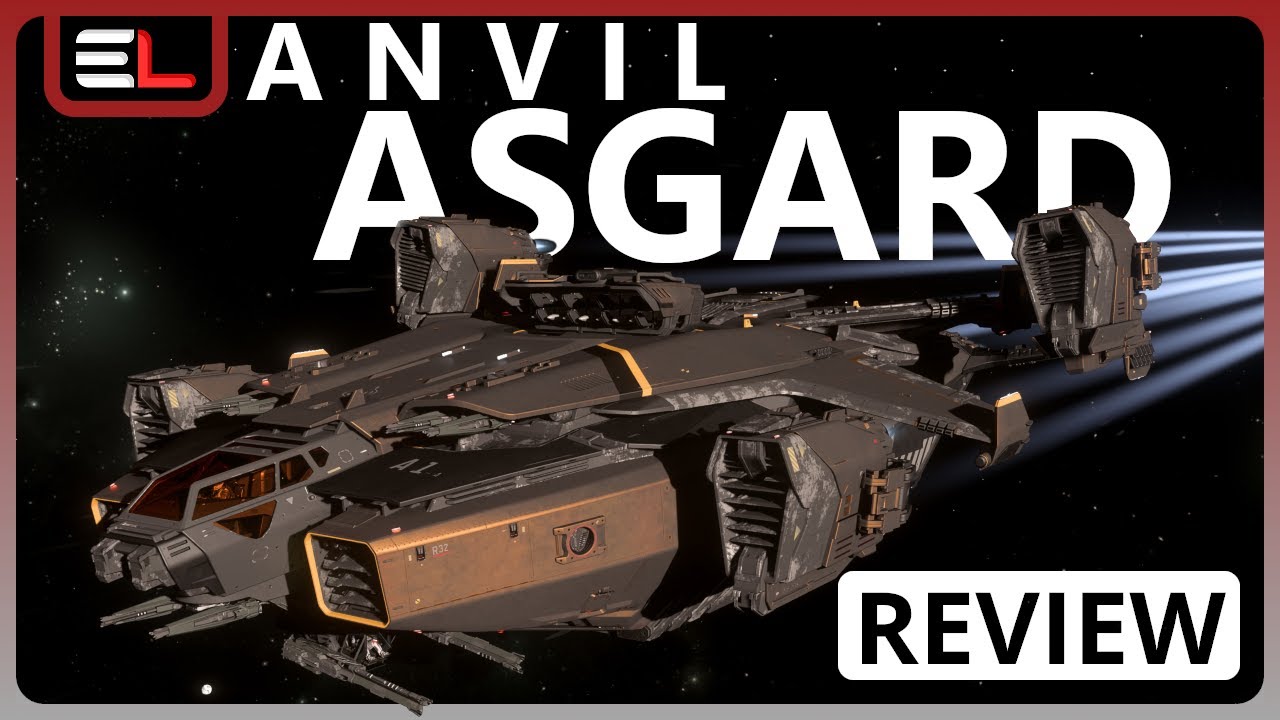
In this Star Citizen ship review, Even Lee provides an in-depth overview of the Anvil Asgard, a versatile and highly capable spacecraft priced at $350 or 17,860,500 AUEC in-game. The Asgard stands out because it can perform nearly every gameplay role except mining and salvage, although it can technically support those roles by carrying specialized vehicles like the Salvation or Gollum. Its large cargo capacity and ability to transport any ground vehicle make it an excellent daily runner for PvE, cargo transport, and vehicle logistics. The ship features a reasonable claim time of 17 minutes, which can be expedited to just over four minutes, allowing players to quickly get back into action after destruction.
In terms of combat capabilities, the Asgard is equipped with six size three CF337 Panther laser cannons and 16 size three Arster 3 cross-section missiles, with the option to customize weapons based on mission needs. Its manned turret features two size four CF447 Rhinos, offering substantial burst damage. Defensively, the ship has four size two military-grade C shield generators that collectively provide a robust shield pool, alongside 12,000 ship armor with specific resistances to physical and energy damage. The ship boasts a total health pool of 77,000 HP but is somewhat vulnerable due to its large size and exposed engines, which can impact maneuverability if damaged.
The Asgard’s speed and maneuverability are decent for a ship of its size, with a top speed of 203 SCM and a forward boost of 425. It is not the most agile ship, but its handling is adequate for its multi-role purpose. Countermeasures include 192 flares and 20 decoys, providing good missile defense. However, the quantum fuel capacity is surprisingly low, limiting the ship’s range for extended quantum travel without refueling. This is a notable downside for those planning long-haul missions.
Internally, the Asgard features multiple access points, a spacious cargo hold capable of carrying large vehicles, and well-distributed ship components that enhance survivability by preventing simultaneous critical damage. The ship includes two jump seats for crew members, an engineering terminal, and a manned turret station. The living quarters offer a functional bathroom, crew bunk, kitchen prep area, and weapons lockers, making it comfortable for extended missions. The cockpit provides a decent field of view despite some structural obstructions, and the ship’s components are generally solid but could benefit from power management improvements, such as swapping out coolers for stealth-grade versions.
Overall, Even Lee rates the Anvil Asgard highly, giving it a 96 out of 100 for its versatility, design, and capability to handle a wide range of gameplay activities. While it may feel fragile due to exposed engines and its large target profile, it is a reliable ship for PvE and logistical roles rather than direct PvP combat. The review concludes with thanks to Patreon supporters and a recommendation for Beam Eyetracking software to enhance gameplay immersion, along with a shoutout to Longship Industries for PC builds. The Asgard is praised as a fun and functional ship that appeals to players who want a multi-role vessel capable of supporting various in-game activities.