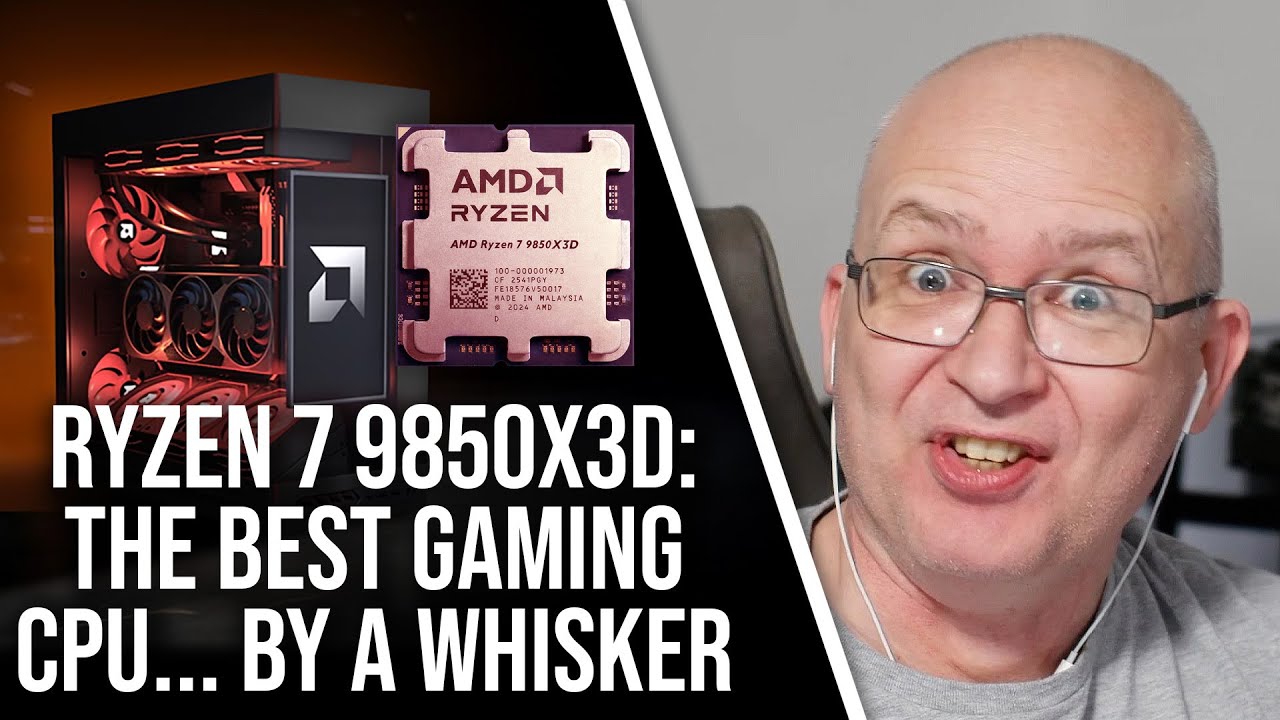
The video discusses the newly released AMD Ryzen 7 9850X3D, which is positioned as the fastest gaming CPU available, succeeding the Ryzen 7 9800X3D. The 9850X3D achieves its performance gains primarily through a modest increase in clock speeds—around 400 MHz higher than its predecessor—resulting in only a slight 2-3% performance improvement in gaming benchmarks. Tests conducted on two different gaming workloads, Cyberpunk 2077 and Far Cry 6, revealed minimal differences in frame rates and frame times between the 9850X3D and the 9800X3D, with the 9850X3D showing only marginal gains that are unlikely to be perceptible to most users.
A key focus of the video is the analysis of AMD’s claims regarding memory performance with the 9850X3D. AMD asserts that there is less than a 1% difference in gaming performance when pairing the CPU with slower DDR5-4800 memory compared to faster DDR5-6000 kits. However, independent testing contradicts this, showing up to a 10% performance difference in Cyberpunk 2077 between the slowest and fastest memory configurations. Interestingly, latency differences between memory kits (e.g., CL28 vs. CL36) appear to have little impact on performance for the 9850X3D, suggesting some tolerance to memory latency in certain gaming scenarios.
The video highlights that while AMD’s memory performance claims may hold true in some games like Far Cry 6, where memory speed differences resulted in negligible performance variation, the generalization across all titles is questionable. The presenter emphasizes the importance of realistic benchmarking scenarios, noting that AMD’s tests may have used less CPU-intensive workloads in Cyberpunk 2077, which do not reflect typical gameplay conditions. This discrepancy calls for more rigorous and representative testing to accurately assess the impact of memory speed on gaming performance.
From a consumer perspective, the Ryzen 7 9850X3D is seen as a niche, halo product offering only incremental gains over the 9800X3D, with a higher price point and increased power consumption. The modest performance improvements do not justify upgrading for most users, especially given the current high prices of RAM and storage. The video also touches on rumors of upcoming AMD processors with enhanced 3D V-Cache configurations, but these remain unconfirmed. Overall, the 9800X3D remains the more practical choice for gamers seeking top-tier performance without unnecessary expense.
Finally, the discussion turns to the broader implications of memory latency and frequency on gaming performance. The surprising finding that latency differences have minimal effect on the 9850X3D’s performance could influence future purchasing decisions, allowing gamers to save money by opting for higher latency but more affordable RAM kits without sacrificing much in terms of frame rates. The presenters express interest in further exploring this phenomenon across more games to provide clearer guidance. In conclusion, while the 9850X3D is a technical step forward, the real headline is AMD’s contentious memory claims and their potential impact on building cost-effective, high-performance gaming PCs.