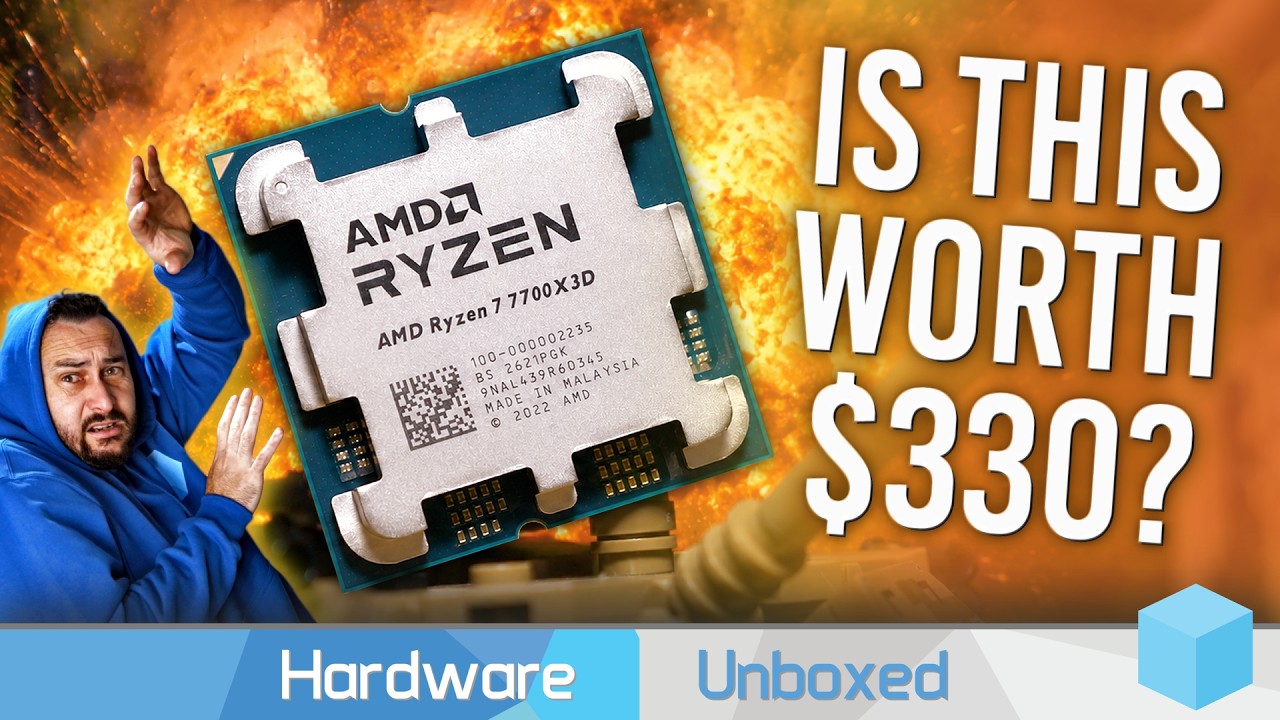
The video reviews AMD’s Ryzen 7 7700X3D, a slightly down-clocked and more affordable version of the Ryzen 7 7800X3D, priced at around $330 US. Despite being a newer Zen 4-based processor released in 2026, the 7700X3D features a 5% lower base clock (4.0 GHz vs. 4.2 GHz) and a 10% lower boost clock (4.5 GHz vs. 5 GHz) compared to the 7800X3D, while retaining the same 96 MB L3 cache, 120W TDP, and eight cores with 16 threads. The video also highlights ASUS’s Neo motherboard lineup designed for AMD’s AM5 platform, which offers enhanced power delivery, AI networking, and optimized cooling to support Ryzen processors.
Benchmark tests across 13 games reveal that the 7700X3D performs about 7% slower than the 7800X3D on average, with performance gaps narrowing under GPU-bound conditions. In many titles such as Rainbow Six Siege, Marvel Rivals, Horizon Zero Dawn, Baldur’s Gate 3, and Cyberpunk 2077, the 7700X3D holds its own, often outperforming Intel’s mid-range chips like the Core Ultra 5 250K Plus and 6-core Ryzen 7600X3D, while trailing the 7800X3D by a small margin. The CPU particularly excels in CPU-bound games and scenarios that leverage its large 3D V-Cache.
Power consumption and thermal performance benefit from the lower clock speeds, with the 7700X3D showing a 7% reduction in power usage and a 5°C drop in peak temperatures compared to the 7800X3D. This makes it a more efficient option for users who want strong gaming performance without the higher power draw. However, the review notes that the value proposition of the 7700X3D depends heavily on its retail price relative to the 7800X3D, which has been found at competitive prices close to or below $360 US.
When factoring in the total platform cost, including motherboards and memory, the 7700X3D offers good value for gamers looking to build or upgrade an AM5 system with DDR5 memory. However, the older 5800X3D paired with cheaper AM4 motherboards and DDR4 RAM can still be a better value overall, especially when considering productivity performance and platform cost. The reviewer suggests that for those considering older platforms, Intel’s 250K Plus package might be a more balanced choice due to better productivity and newer features.
In conclusion, the Ryzen 7 7700X3D is a solid mid-range gaming CPU that offers slightly reduced performance compared to the 7800X3D but at a lower price point. Its appeal depends on current pricing dynamics, which fluctuate frequently, and the ongoing high cost of DDR5 memory. While it may not entice users who already own similar AM5 CPUs, it represents a worthwhile option for budget-conscious gamers wanting the benefits of 3D V-Cache on a newer platform. The reviewer encourages viewers to monitor pricing and consider their specific needs before purchasing.