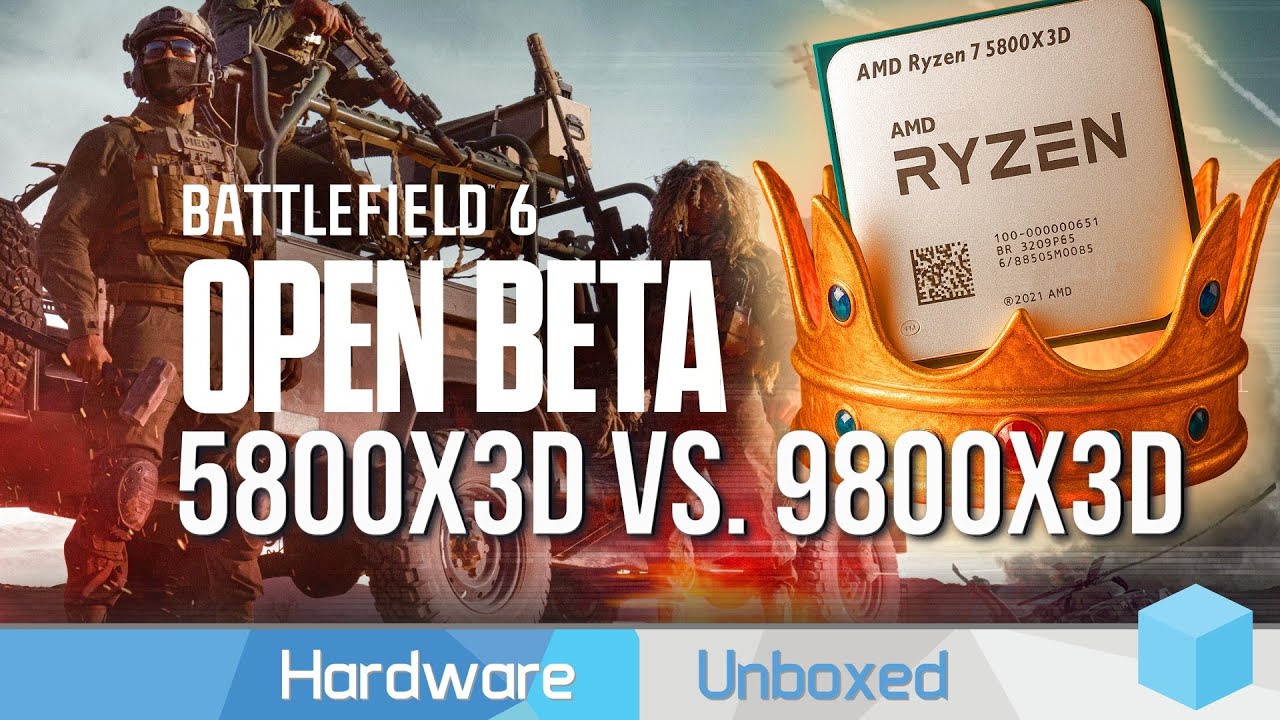
The video presents a detailed benchmark comparison between the Ryzen 7 5800X3D and the Intel 9800X3D CPUs using the Battlefield 6 Open Beta. The host acknowledges prior criticism for excluding the 5800X3D from earlier tests and addresses concerns about testing methodology raised by Reddit users. To ensure accurate CPU performance measurement, the host emphasizes the necessity of testing both systems simultaneously in the exact same match due to significant performance variance between different matches. This approach involved using two identical test systems running side-by-side in multiplayer matches, allowing for apples-to-apples comparisons while minimizing GPU bottlenecks by using high-end RTX 5090 GPUs.
At 1080p ultra settings, the Intel 9800X3D consistently outperforms the Ryzen 7 5800X3D by approximately 30-40% in average frame rates and 1% lows, with the margin holding steady across various map objectives and gameplay moments. At 1440p, the performance gap narrows but the 9800X3D still maintains a clear lead, particularly in 1% low frame rates, indicating smoother gameplay during intense moments. At 4K resolution, both CPUs become largely GPU-limited, resulting in nearly identical average frame rates, though the 9800X3D still shows slightly better 1% lows.
The host addresses criticism from Reddit, particularly from a user named Oxygen Please, who questioned the testing methodology. The host explains the challenges of benchmarking multiplayer games like Battlefield 6, where map selection and match dynamics vary widely, making traditional benchmarking unreliable. He highlights that testing in the exact same match with two systems is the only viable approach to obtain meaningful CPU performance data in such a dynamic environment. The host also critiques other benchmarking attempts that rely on random matches or different maps, stressing that these methods produce inconsistent and incomparable results.
Further testing comparing the 9800X3D and the Ryzen 5 265K reinforces previous findings, with the 9800X3D delivering roughly 40-50% better performance at 1080p medium settings, both outside and inside active combat zones. The host notes that despite the dynamic nature of multiplayer gameplay, the performance margins remain consistent whether testing is done in or out of combat, validating the chosen testing methodology. He also points out that while the 5800X3D is slower than the 9800X3D, it performs on par with CPUs like the 9700X and 265K, making it a capable choice for Battlefield 6 players not seeking the absolute highest frame rates.
In conclusion, the video underscores the importance of rigorous, side-by-side testing in multiplayer games to accurately assess CPU performance. The 9800X3D is shown to be significantly faster than the 5800X3D under CPU-limited conditions, particularly at lower resolutions, while the 5800X3D still offers solid performance at higher resolutions where GPU bottlenecks dominate. The host wraps up by thanking viewers, promoting his sponsor and community channels, and hinting at potential future content inspired by community feedback and ongoing discussions around benchmarking practices.