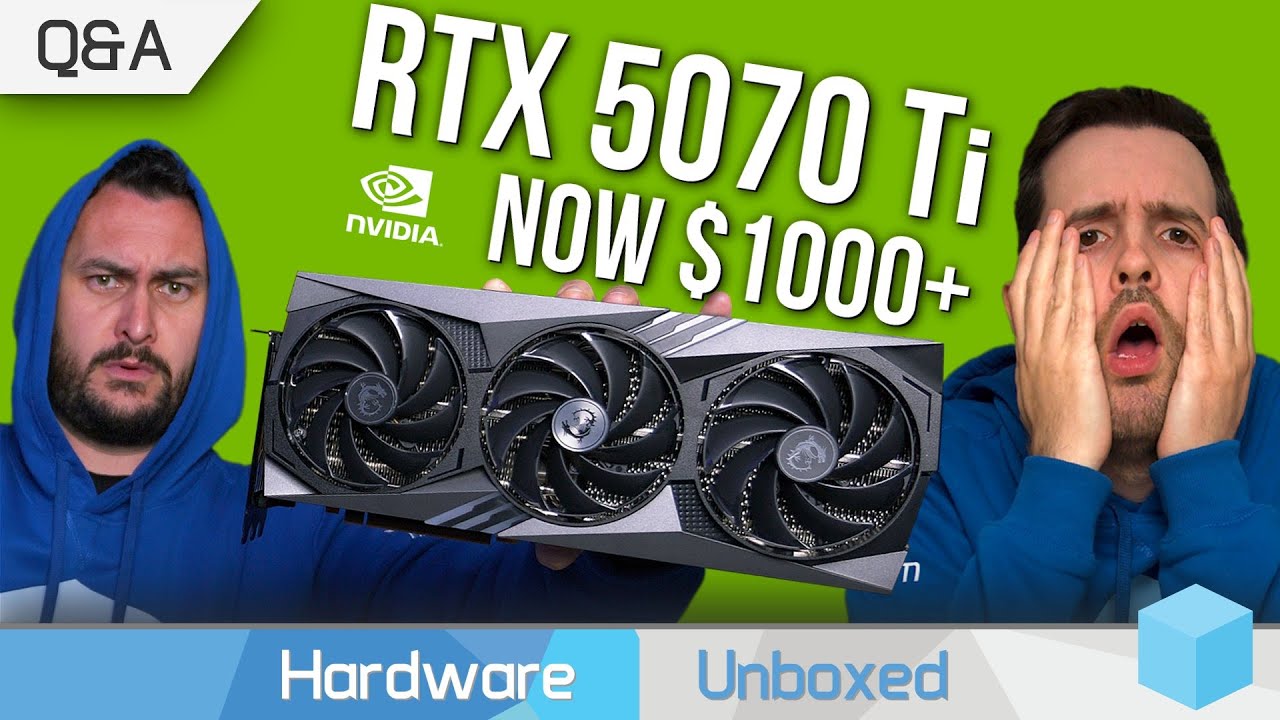
In this Harbor Unboxed Q&A, Steve and Tim discuss Nvidia’s RTX 5070 Ti being phased out primarily due to financial decisions rather than technical limitations, criticizing both Nvidia’s mixed messaging and AMD’s restrictive support for FSR4 on older GPUs. They also touch on VRAM requirements, CPU memory bottlenecks, and express tempered enthusiasm for new hardware amid ongoing market challenges and lackluster product launches.
In this 2026 Q&A episode from Harbor Unboxed, Steve and Tim discuss the current state of GPU availability and VRAM configurations, focusing heavily on Nvidia’s RTX 5070 Ti. They reveal that Nvidia’s decision to limit VRAM on recent GPUs was not a strategic foresight to handle the RAM crisis but rather a financial decision to prioritize higher-margin products. The RTX 5070 Ti is effectively being phased out due to supply constraints, with Asus confirming the end of production, although Nvidia later contradicted this publicly, leading to confusion and accusations of mixed messaging.
The hosts delve into whether Nvidia could release a 5070 with even less VRAM, such as 9 or 6 GB, concluding that such configurations would be unviable due to poor performance and consumer reception. They argue that 12 GB is the minimum viable VRAM for this tier, especially considering future gaming demands and longevity. Price differences between VRAM variants would not justify the performance compromises, making lower VRAM models unattractive to buyers.
The conversation then shifts to AMD’s refusal to extend FSR4 support to older RDNA GPUs despite the technology being compatible, contrasting it with Nvidia’s broader DLSS 4.5 support even on older cards. The hosts criticize AMD’s approach as a clear attempt to push consumers toward purchasing newer GPUs, thereby limiting feature support on existing hardware and damaging brand loyalty. They emphasize that upscaling technologies like FSR and DLSS are some of the most impactful advancements in recent years, and AMD’s decision to withhold support is seen as a significant misstep.
When asked about CPU core counts and memory bottlenecks, the hosts express uncertainty but suggest that dual-channel DDR5 memory should be sufficient for many workloads, especially gaming, even as core counts increase. They note that higher-end workstation platforms exist for users with extreme multi-core and bandwidth demands. They also speculate that future Zen 6 and Zen 7 CPUs might include architectural improvements and faster memory support to mitigate potential bottlenecks.
Finally, Steve and Tim reflect on whether their extensive experience reviewing hardware has made them apathetic toward new releases. While they remain passionate about PC technology, they acknowledge that the current market climate—with high prices, supply issues, and many underwhelming product launches—has dampened excitement. They express hope for more compelling and innovative products in the near future but recognize that enthusiasm has been tempered by recent disappointments and ongoing industry challenges.