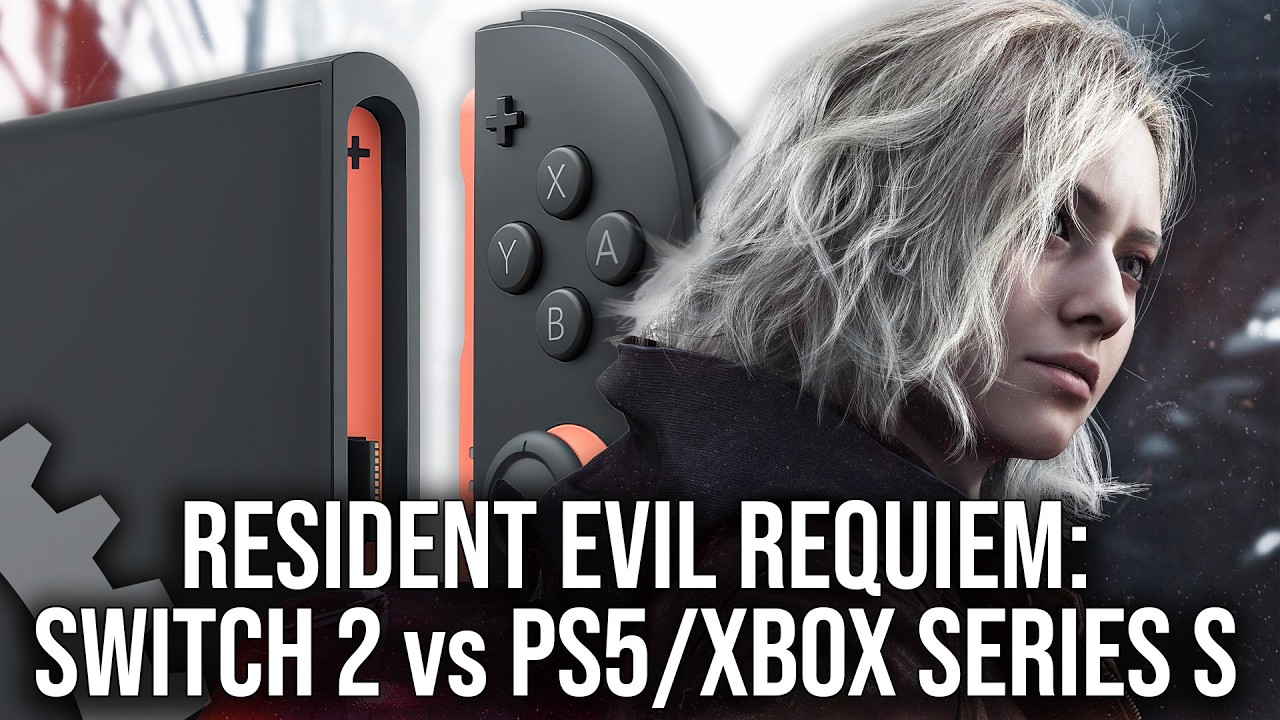
The video provides an in-depth analysis of Resident Evil Requiem running on the Nintendo Switch 2, comparing it against the PlayStation 5 and Xbox Series S versions. This marks the first major RE Engine-powered release on Nintendo’s new console, and the hosts express excitement about its performance. Despite some compromises, the Switch 2 port is praised as one of the best seen on the platform, delivering visuals and gameplay quality that stand up well against its more powerful console counterparts. The discussion is enriched by insights from Oliver McKenzie, who joins the main presenter to dissect the technical aspects and performance nuances of the game across systems.
Visually, the Switch 2 version retains much of the core graphical fidelity seen on the PS5, though it lacks ray tracing features present on higher-end versions. A notable difference is the use of card-based hair rendering on Switch 2, compared to the more detailed strand hair on PS5, which affects character realism especially in cutscenes. Textures and character models are slightly downgraded to accommodate hardware limitations, but these changes are subtle and do not detract significantly from the overall experience. Lighting effects such as screen space reflections and volumetric lighting remain intact, albeit at lower resolutions, maintaining the game’s atmospheric quality.
One of the standout technical achievements on Switch 2 is the use of DLSS (Deep Learning Super Sampling), which allows the game to run at a low internal resolution (around 540p docked, 360p handheld) while outputting a much sharper and more stable image comparable to the PS5’s 1080p. This AI-driven upscaling significantly enhances image quality, outperforming the spatial upscaling methods used on PS5 and Series S. However, the Switch 2 version targets 60fps but often fluctuates between 30 and 60fps depending on scene complexity, leading to variable frame pacing that some viewers found less than ideal. The absence of a frame rate cap or VRR support is noted as a missed opportunity to improve performance stability.
The Xbox Series S version, while running at a similar or slightly higher internal resolution than Switch 2, uses spatial upscaling and lacks DLSS, resulting in lower image quality with more noise and blur. However, it delivers a more stable 60fps experience compared to the Switch 2. Series S also features higher-detail character models but shares the card hair limitation. The video highlights that the choice between Switch 2 and Series S may come down to a preference for better image quality (Switch 2) versus smoother performance (Series S), though both versions have their compromises.
Overall, the hosts commend Capcom’s optimization work, noting that Resident Evil Requiem is a highly scalable and visually impressive game across all platforms. The Switch 2 version, in particular, is celebrated for pushing the boundaries of what’s possible on a portable device, delivering a compelling horror experience despite hardware constraints. The discussion closes with reflections on Capcom’s historical approach to frame rate management in RE Engine games and hopes for future improvements, while affirming that Resident Evil Requiem is a strong addition to the series that successfully balances horror and action elements.