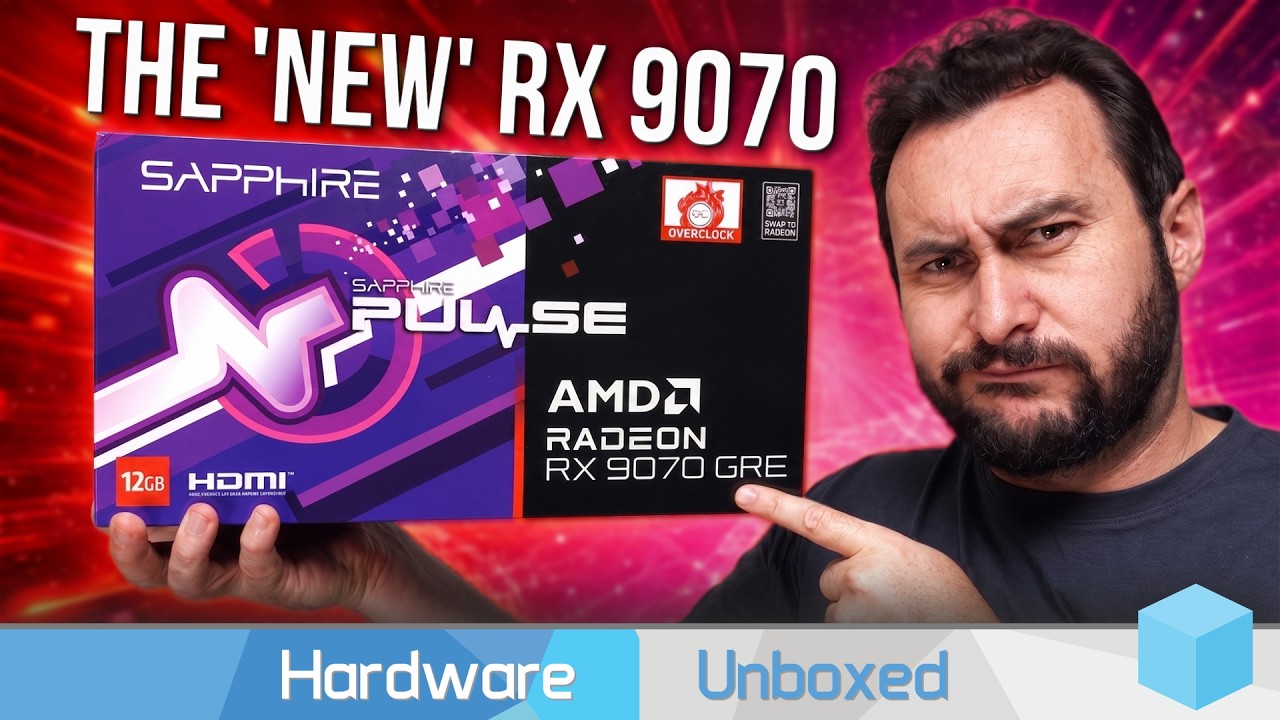
The Radeon RX 9070 GRE is essentially a rebranded and heavily cut-down version of AMD’s Na’vi 48 silicon, initially released exclusively in China in May 2025 and now available globally. Positioned as a mid-range option targeting 1440p gamers, it aims to compete with Nvidia’s RTX 5070 and the overpriced RTX 5060 Ti 16 GB. However, the 9070 GRE suffers from significant hardware reductions compared to the standard RX 9070, including fewer compute units, reduced Infinity Cache, a narrower memory bus, and less VRAM, leading to diminished memory bandwidth and capacity. Despite these cutbacks, AMD has priced the card at $550 USD, the same MSRP as the original RX 9070, which raises questions about its value proposition.
Performance testing across a range of modern games reveals that the 9070 GRE offers minimal generational improvements over the previous 7900 GRE, often performing similarly or even worse in some titles. When compared to Nvidia’s RTX 5070, the 9070 GRE generally matches or slightly trails in rasterization performance, while maintaining a comfortable lead over the RTX 5060 Ti 16 GB. However, it consistently underperforms relative to the standard RX 9070 and 9070 XT, with performance deficits ranging from 10% to over 20% depending on the game and resolution. This places the 9070 GRE awkwardly in AMD’s lineup, as it sits below the RX 9070 but is priced similarly.
Ray tracing performance further highlights the 9070 GRE’s shortcomings. In many ray-traced titles, the card falls behind both the previous generation 7900 GRE and Nvidia’s RTX 5070, sometimes even losing to the lower-tier RTX 5060 Ti 16 GB. This is partly attributed to the reduced VRAM and memory bandwidth, which negatively impact ray tracing workloads that are VRAM-intensive. While the card matches or slightly improves on the older 7900 GRE in some ray tracing tests, overall it offers no significant advantage and often represents a generational downgrade in this area.
Power consumption tests show that the 9070 GRE is generally efficient, with power draw similar to or slightly better than the previous generation 7900 GRE and competitive with the RTX 5070. However, Nvidia’s card still maintains a power efficiency edge in certain cases. The 9070 GRE also exhibits decent thermal performance and fan noise levels, with different models like the Gigabyte Gaming OC and Sapphire Pulse showing variations in clock speeds, temperatures, and noise. Despite these operational positives, the card’s performance-to-power ratio does not compensate for its pricing and performance limitations.
In conclusion, the Radeon RX 9070 GRE is a disappointing release that struggles to justify its price point. It offers minimal performance gains over previous models, reduced VRAM and memory bandwidth, and falls behind both AMD’s own RX 9070 and Nvidia’s RTX 5070 in key areas. Its $550 MSRP is seen as too high given the performance trade-offs, making it a poor value proposition. For gamers, the standard RX 9070 or even Nvidia’s RTX 5070 represent better choices. AMD’s 9070 GRE feels like an unnecessary product that complicates the lineup without delivering meaningful benefits, leaving consumers better off considering other options.