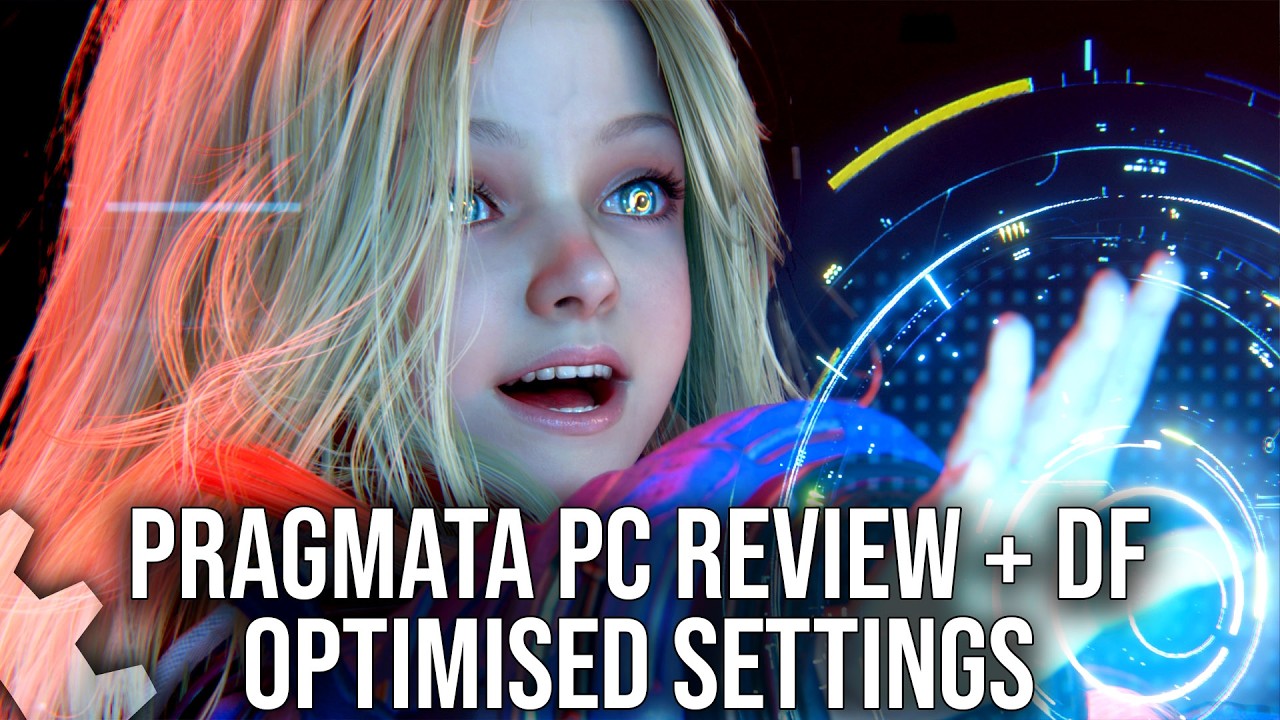
The Pragmata PC review highlights the game’s impressive blend of classic gameplay elements with modern graphics powered by Capcom’s RE Engine. The game runs smoothly across a range of hardware, including lower-end systems with 8 GB GPUs, although VRAM limitations can cause stuttering if not managed properly. The review emphasizes the need for optimized settings to balance visual quality and performance, especially for mainstream GPUs like the RTX 4060. Despite some frustrations with the settings menu—such as requiring restarts to change certain options and an unreliable VRAM meter—the game delivers a consistently smooth and engaging experience.
A key focus of the review is the game’s lighting options, particularly the path tracing (PT) mode, which offers highly realistic lighting but demands powerful hardware, ideally high-end RTX GPUs. Path tracing provides a dramatic visual transformation but can introduce temporal instability and noise artifacts, partly due to its reliance on DLSS ray reconstruction preset D. Using third-party tools to switch to preset E improves visual stability. While path tracing is impressive, the review notes the lack of a middle ground between basic ray tracing (RT) and full path tracing, which limits flexibility. RT itself offers a lighter but still visually significant improvement, covering global illumination and reflections with a moderate performance cost.
The review dives into detailed recommendations for various graphical settings to optimize performance, particularly on 8 GB GPUs. Texture quality is critical for fitting the game into limited VRAM, but the low texture setting contains bugs causing frame time spikes and texture flickering, making medium or low settings preferable depending on the GPU. Other settings like hair strand quality, mesh quality, shadow quality, and effects quality are also discussed, with recommendations generally leaning towards high or medium settings for a good balance of visuals and performance. Features such as shadow cache significantly improve frame time consistency and overall performance, especially on high-end GPUs.
Upscaling technologies are highlighted as a major advantage on PC, with DLSS balance mode at 1440p on an RTX 4060 delivering better image quality and less aliasing than the PS5 version upscaled from 1080p. The review also touches on the growing mainstream adoption of ray tracing, noting that the RTX 5070 is currently popular and capable of running path tracing at 1440p with acceptable frame rates. Multi-frame generation can be used to boost performance further, though it introduces some latency. On top-end hardware like the RTX 5090, path tracing at 4K with DLSS quality mode offers stunning visuals and smooth frame rates, showcasing the scalability of the technology.
In conclusion, Pragmata is praised as one of the standout game releases of the year, combining strong gameplay, excellent graphics, and broad hardware compatibility. Capcom continues to demonstrate its prowess as a top-tier publisher with steadily improving PC releases. The main technical critiques focus on the need for a more user-friendly settings menu and better VRAM management for 8 GB GPUs. Overall, the game is highly recommended for its smooth performance, visual fidelity, and engaging content, making it a compelling experience across both mainstream and high-end PC hardware.