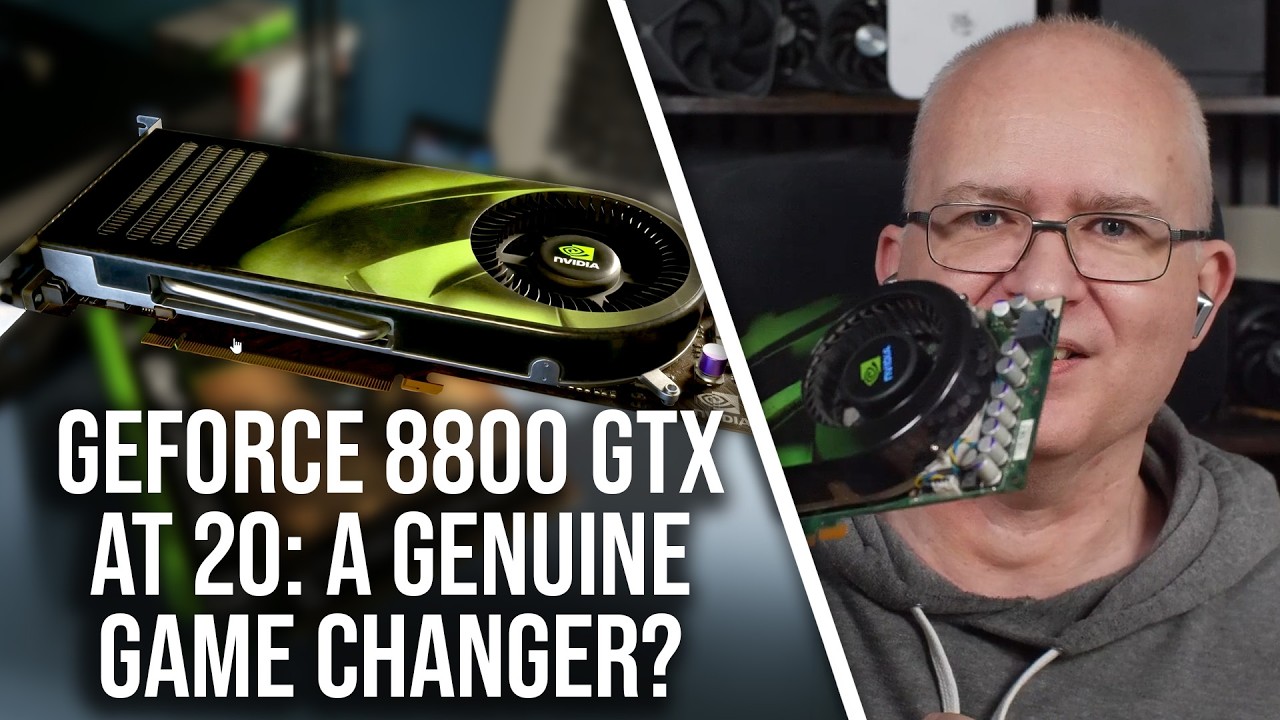
This week marks the twentieth anniversary of Nvidia’s iconic 8800 GTX GPU, celebrated for its groundbreaking G80 architecture. The 8800 GTX introduced several firsts in the GPU world, including support for DirectX 10 and CUDA, marking a significant leap in performance and technological innovation. Although the Xbox 360 had unified shaders a year earlier, the 8800 GTX’s impact was profound, delivering colossal performance improvements over previous generations. The architecture peaked with the 8800 GT, which benefited from a smaller manufacturing process and became more affordable, contrasting with the initially high price of the GTX model.
To commemorate this milestone, Nvidia released a path-tracing demo that nostalgically captures the PC culture of the mid-2000s. Created by Dylan Brown from Weta FX, the demo impressively recreates the era’s gaming environment, complete with CRT monitors, old IDE hard drives, and period-accurate peripherals. The demo, running on Unreal Engine, pays homage to the time when games like Crysis were cutting-edge, though some fans wished the demo had included more interactive elements from Crysis itself. Despite mixed reactions related to current GPU costs and Nvidia’s market position, the demo is praised for its detailed and authentic representation of the era.
Reflecting on personal experiences, the participants recall owning the 8800 GTX and GT, highlighting the card’s significance during a time of rapid advancement in consumer graphics technology. The 8800 GTX was paired with early quad-core processors, representing high-end PC builds of the era. Interestingly, the GPU’s power consumption was modest compared to today’s standards, with a compact dual-slot design and a small turbine fan, contrasting sharply with the massive, power-hungry GPUs common now. This period is remembered fondly as a golden age when Nvidia was heavily focused on consumer graphics innovation.
The discussion also touches on the broader context of the GPU market and hardware development. The 8800 GTX launched at a premium price of around $600, which would equate to about $1,000 today, while the 8800 GT was more affordable, especially in regions with favorable exchange rates. The longevity and quality of the G80 architecture were such that subsequent models like the 9800 GT shared nearly identical specifications, reflecting a time when incremental updates were common. This contrasts with today’s rapid and substantial changes in GPU design and performance improvements.
Finally, the conversation notes the evolution in GPU cooling solutions, recalling the shift from small heatsinks like those on the 8800 GTX to the large, elaborate cooling systems seen on modern cards starting with models like the Radeon 5870. This change set a new standard for GPU design, driven by increased power consumption and heat output. Overall, the 8800 GTX is celebrated not only for its technical achievements but also for its place in the history of PC gaming and graphics technology, marking a pivotal moment in the development of modern GPUs.