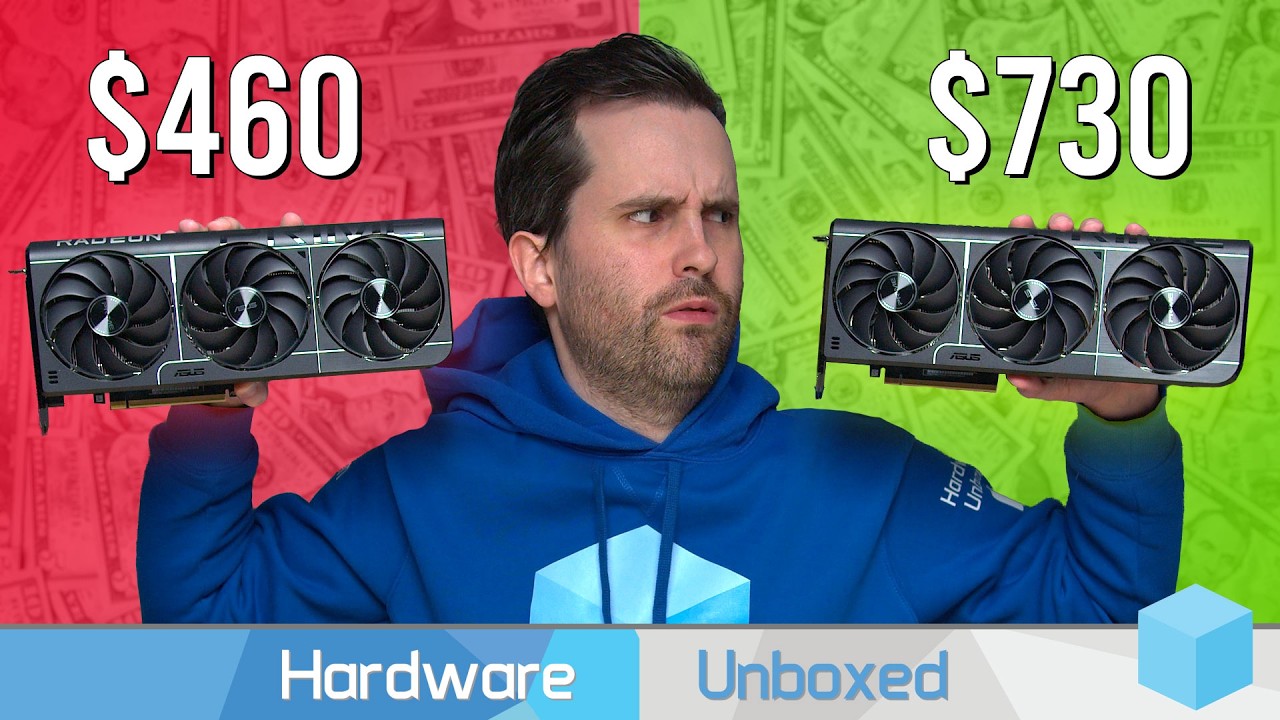
The video discusses the current state of GPU pricing and value across major brands Nvidia, AMD, and Intel, highlighting how recent price increases have shifted the competitive landscape. Nvidia’s GeForce GPUs have generally seen higher price hikes compared to AMD’s Radeon and Intel’s Arc GPUs, impacting their value proposition for gamers. The video analyzes cost per frame data across multiple regions using up-to-date pricing and performance benchmarks, revealing how these changes affect the relative attractiveness of various GPU models.
At the entry-level market, Intel’s Arc B-series GPUs, especially the B570 and B580, offer some of the best value due to their aggressive pricing and decent VRAM capacity. AMD’s Radeon RX 9600 XT series also remains competitive, particularly the 16 GB variant, which provides more VRAM and better cost per frame than similarly priced Nvidia models like the RTX 5060. However, Nvidia’s lower-end RTX 5050 continues to be a poor value choice across all regions, offering low performance for its price.
In the mid-to-high-end segment, AMD’s Radeon RX 970 XT and RX 970 dominate in terms of cost per frame value, often outperforming Nvidia’s RTX 5070 and 5060 Ti models by significant margins. This trend is consistent across various markets including the US, Australia, UK, Canada, and Europe, where Radeon GPUs not only offer better performance per dollar but also come with more VRAM, which is increasingly important for modern gaming. Nvidia’s mid-range offerings are often priced higher without matching AMD’s value, making them less attractive to gamers.
Regional variations exist, with Nvidia showing slightly better competitiveness in some markets like Brazil and Canada, while AMD’s dominance is more pronounced in places like India and the UK. Intel’s Arc GPUs generally perform well in entry-level categories but are less impactful in higher tiers. Overall, Radeon GPUs currently offer superior value in most price brackets, especially in the mid-to-high-end range, while Nvidia struggles with inflated prices that have eroded its traditional value advantage.
The video concludes by noting that GPU prices are unlikely to improve soon, and both Nvidia and AMD may see further price increases due to ongoing market pressures like the memory crisis. It advises gamers to avoid purchasing new GPUs right now unless absolutely necessary, as none of the current options represent good value. Instead, sticking with existing hardware is recommended until the market stabilizes. The analysis serves as a snapshot of the current GPU market dynamics rather than a buying guide.