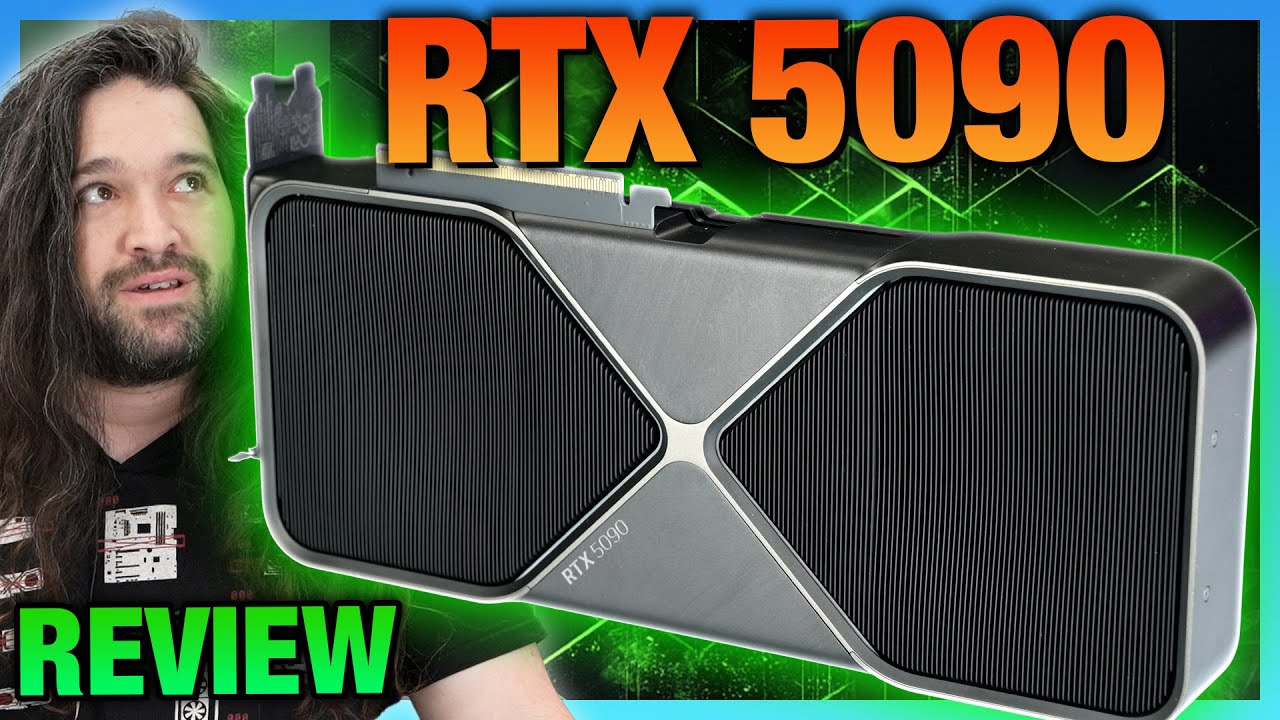
The video presents a detailed review of the NVIDIA GeForce RTX 5090 Founders Edition, focusing on its gaming performance, thermal management, and power consumption. The RTX 5090 shows a significant performance uplift compared to its predecessor, the RTX 4090, with a 20-50% increase in rasterization performance at 4K, depending on the game. Ray tracing performance also sees an improvement, with gains ranging from 27-35%. The review highlights that the powerful AMD Ryzen 9800 X3D CPU can keep pace with the RTX 5090, especially at lower resolutions, but performance gains diminish at 1080p and 1440p due to CPU limitations.
Thermal performance is a key focus, as the RTX 5090 operates within acceptable temperature ranges, achieving around 72°C under load, which is impressive for a two-slot design. However, memory temperatures are higher than desired, reaching 89-90°C, which could pose risks in smaller cases with poor airflow. The video emphasizes the efficient cooling design of the Founders Edition, which utilizes liquid metal and a dual flow-through approach to manage heat effectively while maintaining lower noise levels during operation.
In terms of specifications, the RTX 5090 features 32GB of GDDR7 memory and is built on the Blackwell architecture. The review notes that the card is a true PCIe Gen 5 device, with improved memory bandwidth and caching that contribute to its performance advantages, particularly at higher resolutions. The video also mentions upcoming content, including tests on how the card affects CPU thermals and performance in mini ITX cases, as well as a teardown of the card.
Benchmark results reveal that the RTX 5090 outperforms several high-end competitors, including the AMD RX 7900 XTX and previous NVIDIA models. In various gaming scenarios, the RTX 5090 achieves impressive frame rates, particularly at 4K resolutions, where it can deliver an average of 182 FPS in Final Fantasy 14, significantly outperforming the RTX 4090. The review highlights that while the RTX 5090 excels in high-resolution gaming, users playing at lower resolutions may not see as substantial gains.
The video concludes with a discussion on the card’s power consumption, which is notably high, drawing around 575 watts under load. The idle power consumption is also higher than its predecessor, leading to concerns about efficiency. Despite this, the thermal design and cooling solutions have received praise for their effectiveness. The review suggests that while the RTX 5090 is a powerful card with impressive performance, potential buyers should consider their specific gaming needs and resolutions before making a purchase, especially given the upcoming release of the RTX 5080 at a lower price point.